Workday India payroll: what a native integration must handle
Workday India payroll now ships packaged via Neeyamo. What any payroll integration must handle: statutory cadence, data ownership, retro pay, audit.
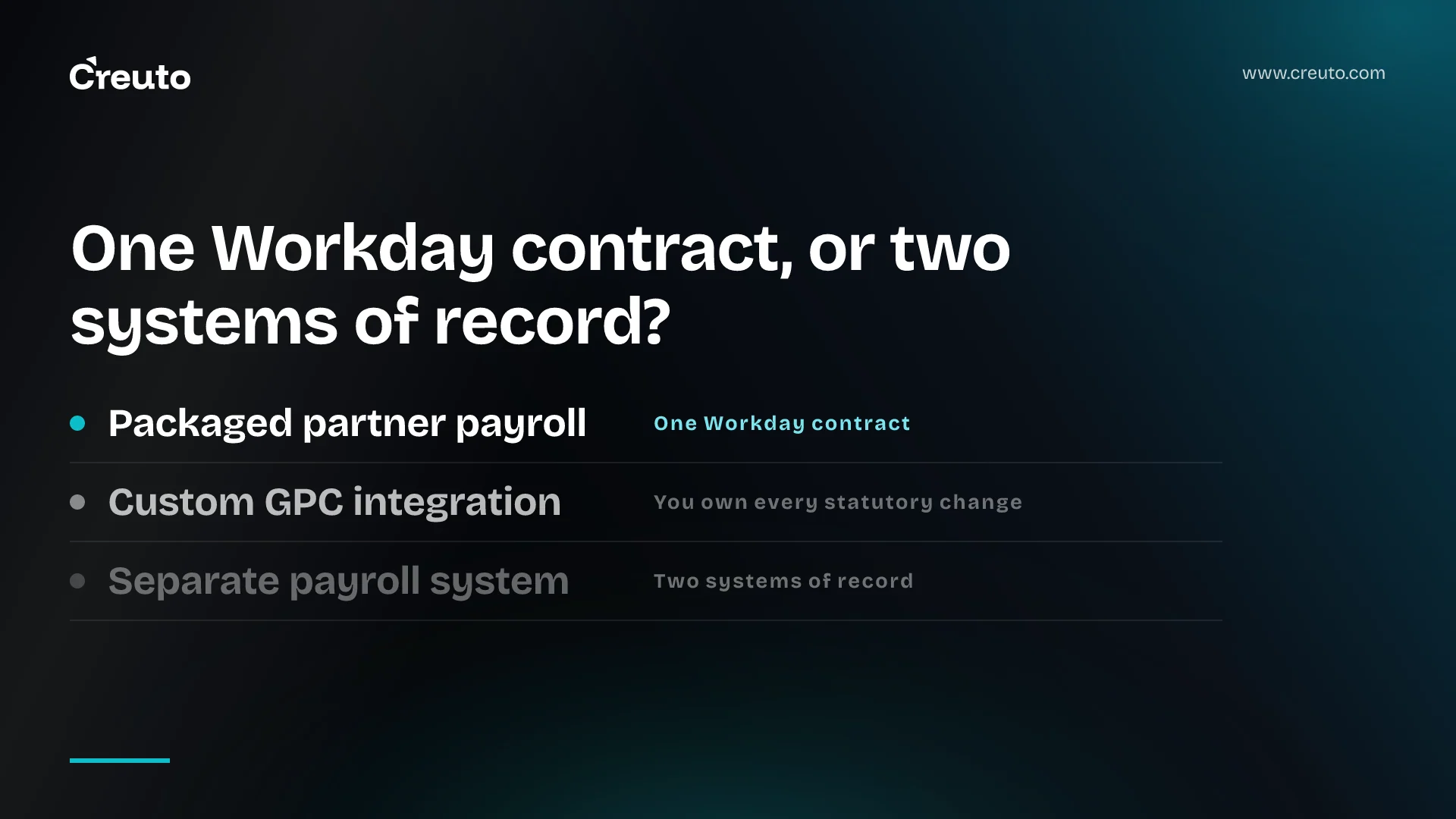
Workday India payroll can now be bought inside a single Workday contract, through a packaged offering from Neeyamo announced this week. If you run Workday HCM and pay people in India, that removes one procurement problem and leaves every engineering problem exactly where it was.
This post separates the two. First, what the announcement actually says — it is a company press release, and we treat it as one. Then what any India payroll integration has to handle whether you buy it or build it: statutory change cadence, which system owns which field, retro pay, exception queues and an audit trail that survives the hand-off.
What Workday and Neeyamo announced
Everything in this section comes from the companies' own press release, distributed by PR Newswire and datelined Los Gatos, California, 23 September 2026. No independent reporting has tested it, and we have not seen the product.
Neeyamo announced an extended partnership with Workday to introduce Workday Payroll provided by Neeyamo. Per the release as carried by Business Standard, the offering lets Workday customers with employees in India process India payroll from within the Workday experience, purchased through a single Workday contract. What is included, in the release's own terms: “certified integration with Workday Global Payroll Connect (GPC), synchronized HR and payroll data, and localized statutory updates and payroll compliance support managed through Neeyamo Payroll”. Implementation and managed payroll services are a separate engagement with Neeyamo.
Two quotes carry the positioning. Rangarajan Seshadri, CEO of Neeyamo: “Organizations expanding into India need payroll that combines local regulatory expertise with the simplicity of a unified enterprise platform.” Sunil Jose, President, Workday India, frames it as expanding customer choice rather than replacing anything. Neeyamo's own boilerplate says it processes payroll natively across 160+ countries.
One detail the coverage tends to flatten: this is an extended partnership, not a first one. Neeyamo already appears in Workday's own Global Payroll Connect datasheet, alongside ADP, CloudPay, Deel, Ramco Systems, Strada, TMF Group and others. What is new is the commercial packaging for India — one contract, one vendor relationship — not the existence of an integration.
What Global Payroll Connect actually does
The mechanics matter more than the announcement, and Workday publishes them. Global Payroll Connect is a set of pre-built bi-directional integrations to partner payroll providers, and Workday's own datasheet is specific about the shape.
- Bi-directional REST APIs let third-party systems flow and query data from Workday, for an entire pay group or an individual worker, returning structured JSON.
- An event subscription service notifies the payroll system of hires and terminations “almost instantly”.
- Payslips, tax documents and payroll results are uploaded back from the partner payroll into Workday.
- Global Payroll Hub gives processing status, checklists, variance analysis and “a comprehensive audit trail of actions performed by authorized users for each pay period”.
- Certified integrations keep Workday as the system of record, with over 100 country-specific certifications and deployment across more than 180 countries through partners.
Read that list as a contract, because that is what it is. GPC moves employee and organisational data out, brings results and documents back, and gives you one place to watch the run. What it does not do is calculate Indian statutory deductions, interpret a state-specific rule, or decide what happens when a February correction lands in April. That is the partner's job under a packaged deal, and yours under a custom one.
What any Workday India payroll integration has to handle
The rest of this post is our judgement, from building payroll and HR systems rather than from the release. Five things decide whether an India payroll integration is boring or a monthly incident.
Statutory change cadence is the real SLA
India does not hold its payroll rules still. In the last year alone we have written about the EPF wage ceiling moving to ₹25,000 and Form 130 replacing Form 16, and about the fact that labour code compliance is now effectively per-state. Each of those is a change to calculation logic, to a document template, or to both, on a date somebody else chose.
So the question to ask a packaged vendor is not “do you handle statutory updates” — every vendor says yes. It is: how many working days between a notification being published and the change being live in my tenant, who tells me it happened, and what is the process when a change lands mid-cycle? Get the answer in the contract. If you are building the integration yourself, that cadence becomes your team's standing commitment, and it is the single most underestimated cost of the build route.
Decide which system owns which field
“Synchronised HR and payroll data” is a sentence that hides a design decision. For every field that exists in both systems — bank account, PAN, address, cost centre, pay component mapping — exactly one system must own it, and the other must be read-only. When both sides can write, you get a field that flips back and forth on alternate syncs and nobody notices until a salary lands in a closed account.
Write the ownership map before any code. Workday is the HR system of record in this model, so most master data flows one way; payroll results and documents flow back. The fields that cause arguments are the ones payroll operations edit locally under deadline pressure.
Retro pay is where payroll integrations break
A promotion backdated two months, a joining date corrected after the run, an arrears payment ordered by a tribunal: each produces a recalculation that spans closed periods. The integration has to carry not just the new amount but the period it belongs to, because EPF, professional tax and TDS all behave differently depending on which month the earning is attributed to.
Test retro before go-live, not after. Push a backdated change across a closed period boundary and a financial year boundary, and check what appears in the payslip, the statutory return and the general ledger posting. In the systems we work on, this is the scenario that exposes whether an integration was designed or assembled.
Exceptions need a queue, not an email
Every cycle produces records that cannot process: a missing bank detail, a worker in two pay groups, a component with no mapping. The default failure mode is that these surface as an email to one payroll analyst who fixes them by hand and tells nobody. Build or demand a visible exception queue with an owner, an age and a resolution note, and report the count per cycle. A queue that is growing month on month is the early signal that the integration is quietly being run by humans.
The audit trail has to survive the hand-off
Workday's Global Payroll Hub keeps an audit trail of actions inside Workday. The risk sits at the seam: a value that was corrected in the payroll system after export has an explanation that lives only there. For a statutory audit you need to reconstruct, for a given employee and month, what was sent, what came back, what changed in between and who changed it. Decide where that record lives before the first run, because retrofitting it means replaying files nobody kept.
How to prove it works before the first live run
Nobody signs off a payroll integration on a demo. The evidence is a parallel run: process the same month in both the old and the new path, then reconcile line by line rather than on the net total. A net figure that matches while two components are wrong in opposite directions is the outcome you are trying to catch.
Set the acceptance criteria before the run, not after you see the variance report. We use four: zero unexplained variance at component level, every exception in the queue closed with a written reason, statutory returns generated and compared against the prior month's filings, and the general ledger posting reconciled against finance's own figures. Two consecutive clean cycles, not one.
Workday's Global Payroll Hub gives you the variance analysis and the per-period checklist to run that process inside one screen, which is a genuine advantage over reconciling exports in a spreadsheet. It does not tell you which variances are acceptable. That threshold is a business decision and it belongs to your payroll lead, in writing, before the parallel run starts.
Packaged, custom, or separate: which route fits
Three routes, and the honest verdict on each.
| Route | What you own | Choose it when |
|---|---|---|
| Packaged partner payroll (one Workday contract) | Configuration, the exception queue, your side of the data ownership map | India is one country in a multi-country footprint and your pay structures are conventional |
| Custom GPC integration | You own every statutory change, the mapping, the retro logic and the tests | Your pay rules genuinely differ — unusual components, plant-level agreements, a payroll engine you already trust |
| Separate payroll system, manual reconciliation | Two systems of record and a spreadsheet between them | Almost never, and only as a deliberate interim with a dated end |
Give the build case its strongest form: a packaged offering prices in complexity you may not have, its roadmap is not yours, and a certified integration still leaves you owning configuration and exceptions. If your pay structure is unusual, a custom integration against the documented REST APIs is a smaller, better-understood surface than bending a product to fit.
The counter is the cadence problem above. A custom integration signs you up for an unbounded compliance commitment with no end date, and that commitment does not scale down when the project team moves on. That is why we push most clients towards packaged payroll plus a custom layer only where their business genuinely differs — usually the integration and API layer between payroll and everything else: attendance, field operations, ERP, finance.
That layer is the work we actually do in this space. In Nomina, the enterprise HR and payroll platform we built, the hard parts were never the gross-to-net arithmetic; they were the thirteen-plus modules that had to agree with each other and the five user roles that each needed a different view of the same run.
If you are evaluating this announcement, the decision in front of you is narrower than build-versus-buy. Ask the vendor for the statutory change cadence in writing, run a backdated correction across a closed period in the sales cycle rather than after signature, and name the owner of every shared field before anyone writes code. Those three answers will tell you more than the demo.
Frequently asked questions
Workday customers can now process India payroll within the Workday experience through Workday Payroll provided by Neeyamo, announced in a September 2026 press release. It is purchased through a single Workday contract and uses certified integration with Workday Global Payroll Connect, with statutory updates managed through Neeyamo Payroll.
Global Payroll Connect is Workday's set of pre-built, bi-directional integrations to partner payroll providers. Workday's datasheet describes REST APIs that query worker and pay group data, event notifications for hires and terminations, upload of payslips and payroll results, and a Global Payroll Hub for processing status and audit trails.
Build a custom integration only when your pay rules genuinely differ, because you then own every statutory change indefinitely. India changes payroll rules frequently, and that maintenance commitment outlives the project team. For a conventional pay structure in a multi-country footprint, a packaged partner payroll is usually the cheaper route.
Retroactive pay breaks first. A backdated promotion or an arrears order produces a recalculation spanning closed periods, and EPF, professional tax and TDS behave differently depending on which month an earning is attributed to. Test a backdated change across a closed period and a financial year boundary before go-live.
No. Neeyamo already appears in Workday's Global Payroll Connect datasheet alongside providers such as ADP, CloudPay, Deel, Ramco Systems and Strada. The September 2026 announcement describes an extended partnership, and what is new is the commercial packaging for India under a single Workday contract.