EPF wage ceiling 25000: what payroll must change from 17 September
The EPF wage ceiling is ₹25,000 from 17 September 2026, up from ₹15,000. Where the old limit hides in payroll software, and what to update first.
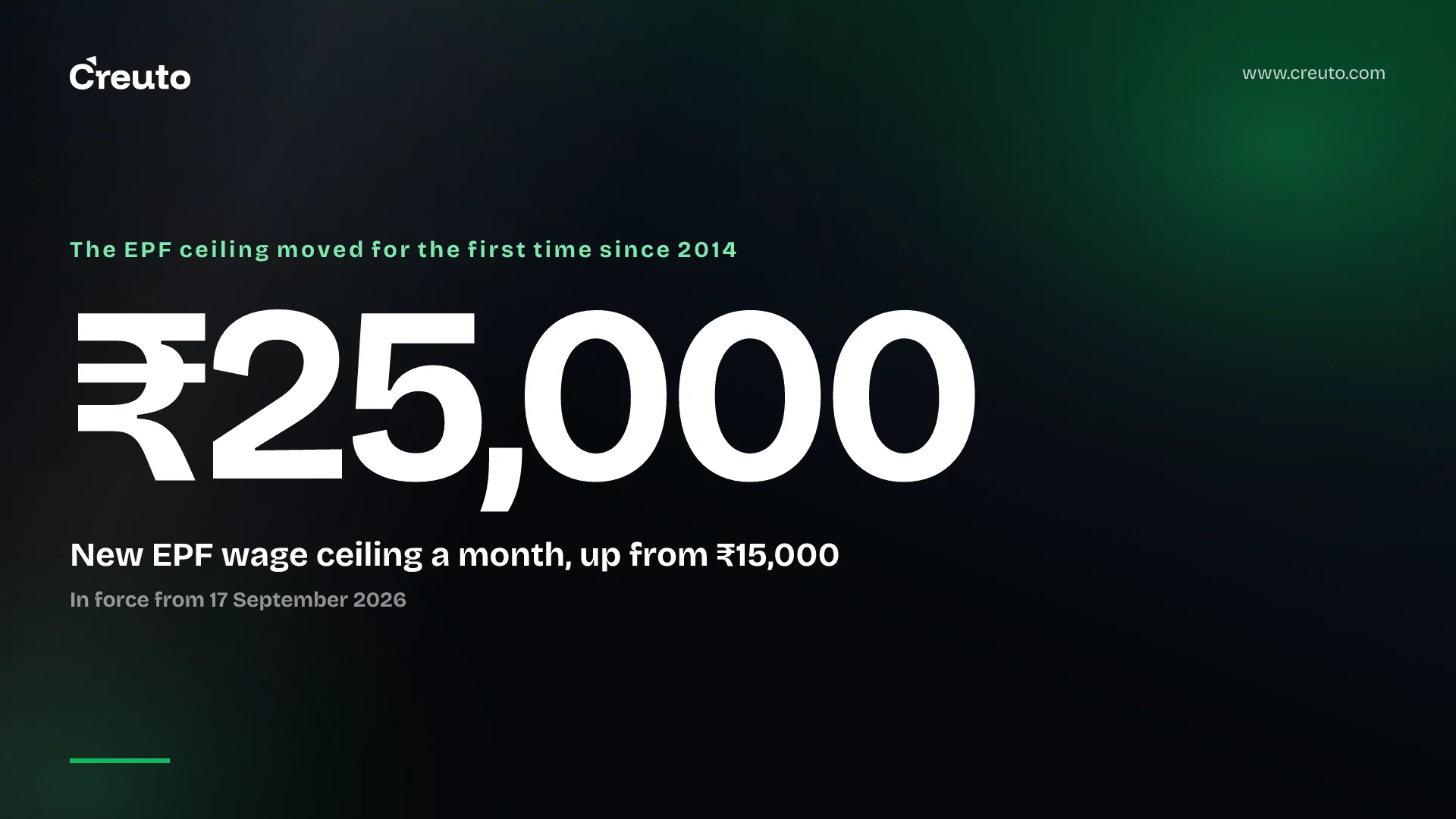
The EPF wage ceiling for mandatory coverage is now ₹25,000 a month, up from ₹15,000. The Union Cabinet approved the change on 16 September 2026 and it applies from 17 September. It is the first revision since September 2014. For employers the policy question is settled; the practical one is whether your payroll software still has ₹15,000 written into it somewhere — in an eligibility rule, a contribution cap, a report or a spreadsheet formula. The epf wage ceiling 25000 change touches all of them.
What the Cabinet decided
According to the Ministry of Labour and Employment's release, the wage ceiling for mandatory coverage under the Employees' Provident Fund Organisation was raised from ₹15,000 to ₹25,000 a month with effect from 17 September 2026. Labour Minister Mansukh Mandaviya said the ceiling had stayed unchanged since September 2014 despite considerable increases in wages, minimum wages and living costs.
Until now, an employee who joined an establishment at wages above ₹15,000 was not automatically covered by the mandatory EPF framework. With the new ceiling, employees earning between ₹15,000 and ₹25,000 a month become eligible for mandatory coverage under all three EPFO schemes: the Employees' Provident Fund, the Employees' Pension Scheme (EPS) and the Employees' Deposit Linked Insurance Scheme (EDLI).
The government puts its annual outgo at about ₹11,339 crore, against existing budgetary support of around ₹10,250 crore, and roughly ₹56,696 crore over five years. ThePrint reports that more than 51 lakh additional workers are expected to come under PF, pension and insurance cover.
What is still to come
The release says the ministry and EPFO "will undertake the necessary statutory and administrative steps for implementation". That matters for payroll teams. The headline number is settled, but the operational detail — how the September wage month is treated when the change lands mid-cycle, how existing excluded employees are brought in, and what EPFO's ECR and portal changes look like — will come through notifications and circulars on the EPFO website.
We would not recommend building contribution logic on secondary summaries alone. Some commentaries already publish revised contribution arithmetic; the government release itself does not restate contribution rates. Configure your payroll so that the ceiling is a dated parameter, and confirm the treatment against EPFO's instructions before the first ECR under the new rules.
Where a ₹15,000 assumption hides in payroll
The ceiling was stable for twelve years, which is long enough for it to stop looking like a setting. In the payroll systems we see, it tends to appear in five places.
- Eligibility. The rule that decides whether a new joiner is enrolled in PF at all. Anyone joining with basic wages between ₹15,001 and ₹25,000 now needs to be enrolled and given a UAN.
- Contribution base. Many systems cap the wages on which contributions are computed at ₹15,000 unless an employee has opted for higher contribution. That cap is now wrong for the newly covered band and needs to follow the new ceiling as EPFO specifies.
- EPS allocation. The pension share is calculated against the ceiling, so any code that splits the employer contribution between EPF and EPS with a hard-coded ₹15,000 will misallocate.
- CTC templates. Where the employer's PF contribution sits inside cost-to-company, bringing an employee into mandatory PF changes their take-home pay. Offer-letter templates and salary-structure calculators need updating.
- Reports and filings. The ECR, internal cost reports and any reconciliation spreadsheets that assume the old ceiling.
Search your codebase and formulas for the literal 15000. It is crude, and it works.
How to update payroll for the new EPF wage ceiling
A short checklist for HR, finance and whoever maintains the payroll engine:
- Make the ceiling a dated parameter. Store ₹15,000 valid to 16 September 2026 and ₹25,000 from 17 September, rather than overwriting one value. Arrears, corrections and audits for earlier months must still use the old ceiling.
- List who is affected. Pull every employee with basic wages plus dearness allowance between ₹15,000 and ₹25,000 who is not currently a member. That is your enrolment list.
- Plan UAN onboarding. Newly covered employees need UANs generated or linked, with KYC. This is usually the slowest step.
- Tell employees before their payslip does. A person moving into mandatory PF may see lower take-home pay alongside a new retirement balance. The conversation is better had before the first deduction.
- Test the September run. Run a parallel calculation for affected employees and reconcile it against EPFO's instructions once published.
- Watch for the circular. Assign someone to track EPFO notifications for the implementation detail, and reopen these steps when it lands.
EPF wage ceiling impact on employer cost
For employers, the cost impact is concentrated in the ₹15,000–₹25,000 band: people who were previously outside mandatory PF, or whose contributions were capped at the old ceiling. How much it changes your wage bill depends on how many staff sit in that band and on how your salary structures treat PF — as an addition to gross pay or inside CTC.
This change also arrives on top of the labour codes' wage definition, which has already pushed many employers to restructure basic pay. We covered that in how payroll compliance under the labour codes now varies by state. Taken together, the two changes mean the basic-wage figure your system computes now drives more statutory outcomes than it did a year ago, and errors in it compound.
Why this is a software problem
Rules like this one change rarely, which is exactly why they end up hard-coded. The systems that absorbed this week's news in an afternoon are those where statutory thresholds are dated configuration rather than constants, and where a change can be tested against last month's payroll before it runs on this month's.
We built that approach into an enterprise payroll management system for a client with a large, varied workforce, and it is the standard we apply to any payroll or HR module in our custom software development work. If your payroll logic lives in spreadsheets or an unmaintained module, the ceiling change is a good prompt to fix that before the next rule moves.
Frequently asked questions
The new EPF wage ceiling for mandatory coverage is ₹25,000 a month, raised from ₹15,000 by the Union Cabinet on 16 September 2026. Employees joining at wages up to ₹25,000 now fall under mandatory EPF, EPS and EDLI coverage.
The EPF wage ceiling of ₹25,000 applies from 17 September 2026, according to the Ministry of Labour and Employment. EPFO is expected to issue notifications and circulars covering implementation details, so payroll teams should track those before finalising the September run.
The EPF ceiling hike increases employer cost mainly for employees earning between ₹15,000 and ₹25,000, who become mandatory members or whose contributions were capped at the old ceiling. The size of the increase depends on headcount in that band and on how salary structures treat PF.
Employees who join at wages above ₹25,000 are not brought into mandatory EPF coverage by this change, based on the government's announcement. Existing members and voluntary arrangements follow the EPF scheme rules, so check EPFO's guidance for specific cases.
The EPF wage ceiling was last revised in September 2014, when it was set at ₹15,000 a month. The September 2026 increase to ₹25,000 is the first change in twelve years, according to the Labour Minister.