Form 130 replaces Form 16: what payroll software must change in 2026
Form 130 replaces Form 16 and Form 138 replaces 24Q under the Income-tax Act 2025. What payroll and ERP software must update to avoid TDS validation errors.
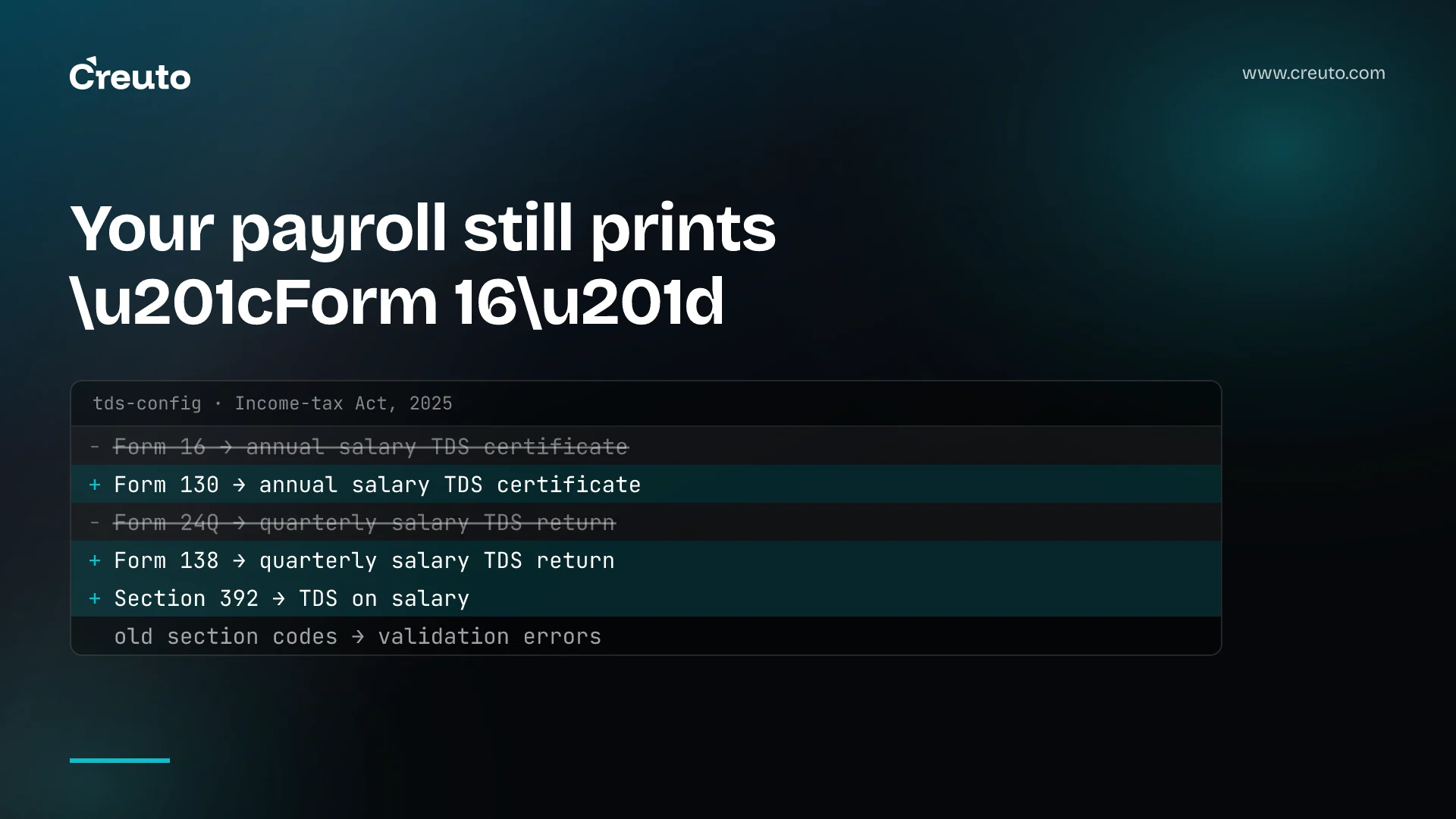
If your payroll team still talks about Form 16 and Form 24Q, the vocabulary is out of date. Under the Income-tax Act, 2025, which applies from 1 April 2026, Form 130 replaces Form 16 as the annual TDS certificate for salaried employees, the quarterly salary TDS return 24Q becomes Form 138, and TDS on salary moves to Section 392. The substance of the forms is largely unchanged; the numbers, codes and references are not — and payroll or ERP software still producing the old ones will run into validation errors.
What changed under the Income-tax Act, 2025
According to ClearTax's guide to the April 2026 TDS changes:
- Sections: all TDS provisions are consolidated into Sections 392, 393 and 394. Section 392 covers TDS on salary; Section 393 covers non-salary payments to residents and non-residents.
- Certificates: Form 130 replaces Form 16; Form 131 replaces Form 16A; Form 133 replaces Form 27D.
- Returns: Form 138 replaces Form 24Q as the quarterly return for TDS on salary.
- Codes: payment codes have been reassigned, and old section codes filed for the new tax year trigger validation errors.
The Act also introduces the term "tax year" in place of the old "previous year / assessment year" pairing, so tax year 2026-27 is the first under the new forms.
Form 130 vs Form 16 for employers
The transition has two tracks, as CompuTax explains:
- FY 2025-26 (the year to 31 March 2026): deductions were made under the old Act, so employers issued Form 16 and Form 16A for that year.
- Tax year 2026-27 onwards: deductions fall under the new Act, so certificates are Form 130 and Form 131, and quarterly salary returns are Form 138.
Content and structure are largely the same — employee details, salary break-up, deductions and tax deducted — but the form number, section references and codes must match the new Act.
Where payroll software breaks
Payroll systems carry the old references in more places than most teams expect:
- Section codes on TDS deductions and challans.
- Return generation that builds 24Q files for the validation utility.
- Certificate templates printing "Form 16" and old section numbers.
- Payment and nature-of-payment codes in the ERP's vendor and payroll modules.
- Reports and employee self-service portals showing old form names.
- Year logic built around "assessment year" labels.
A search of your codebase and templates for "24Q", "Form 16" and "192" is a crude but effective first audit.
How to update payroll software for the Income-tax Act 2025
- Make form and section mappings dated. Keep old mappings for FY 2025-26 corrections and use new ones from tax year 2026-27. Do not overwrite one with the other.
- Update return generation to produce Form 138 in the current file format, and validate with the latest utility before the next quarterly deadline.
- Update certificate templates to Form 130 and 131 with new section references.
- Remap payment codes in payroll and accounts payable.
- Test with last quarter's data and reconcile totals against TRACES records.
- Tell employees that "Form 16" is now Form 130, so HR is not flooded with questions at year end.
Form 130 replaces Form 16: what employees will notice
For most employees, very little changes except the name. The certificate still shows salary paid, exemptions and deductions claimed, and tax deducted and deposited. But employees use these documents to file returns, apply for loans and change jobs, and banks and new employers often ask specifically for "Form 16". A short note from HR explaining that Form 130 is the new name for the same certificate will save a lot of back-and-forth.
Common questions from payroll teams
- Do we reissue old certificates? No. Certificates for FY 2025-26 remain Form 16; the change applies to deductions under the new Act.
- Can one system handle both? Yes, if mappings are dated by tax year rather than replaced.
- Do salary TDS rules themselves change? The consolidation mainly renumbers sections and forms; review rate and slab changes separately each budget, as you always would.
- What about vendors and contractors? Non-salary TDS moves under Section 393 with its own new certificate (Form 131) and return, so the accounts payable side of your ERP needs the same review.
Is Form 16 replaced by Form 130?
Yes, for tax year 2026-27 onwards. Form 16 remains correct for FY 2025-26 deductions made under the old Act. Both may appear in the same payroll system for some time, which is why dated mappings matter.
A pattern worth planning for
Statutory change keeps arriving as software change: the EPF wage ceiling, labour code wage rules and now the new Act's forms. Systems that treat forms, sections, rates and thresholds as dated configuration absorb these changes quickly; systems with hard-coded values need a project each time. We built our enterprise payroll management system on that principle, and our custom software development team can update or replace payroll modules that are struggling to keep up.
Frequently asked questions
Form 130 is the annual TDS certificate for salaried employees under the Income-tax Act, 2025 and Income Tax Rules, 2026, replacing Form 16 from tax year 2026-27. Its content is largely the same as Form 16, with new section and form references.
Form 130 replaces Form 16 for tax deducted under the Income-tax Act, 2025, from tax year 2026-27. Form 16 remains correct for FY 2025-26 deductions made under the old Act, so both may appear during the transition.
Form 138 is the quarterly TDS return for salary under the Income-tax Act, 2025, replacing Form 24Q. Payroll software must generate it with the new section and payment codes, because old codes trigger validation errors.
TDS on salary falls under Section 392 of the Income-tax Act, 2025. Sections 392, 393 and 394 consolidate the old TDS provisions, with Section 393 covering non-salary payments.