Meta Muse Shopify: should you let shopping agents in?
Meta Muse Shopify agentic checkout runs on every Shopify store, and Amazon blocked the same agent. What merchants should require before saying yes.
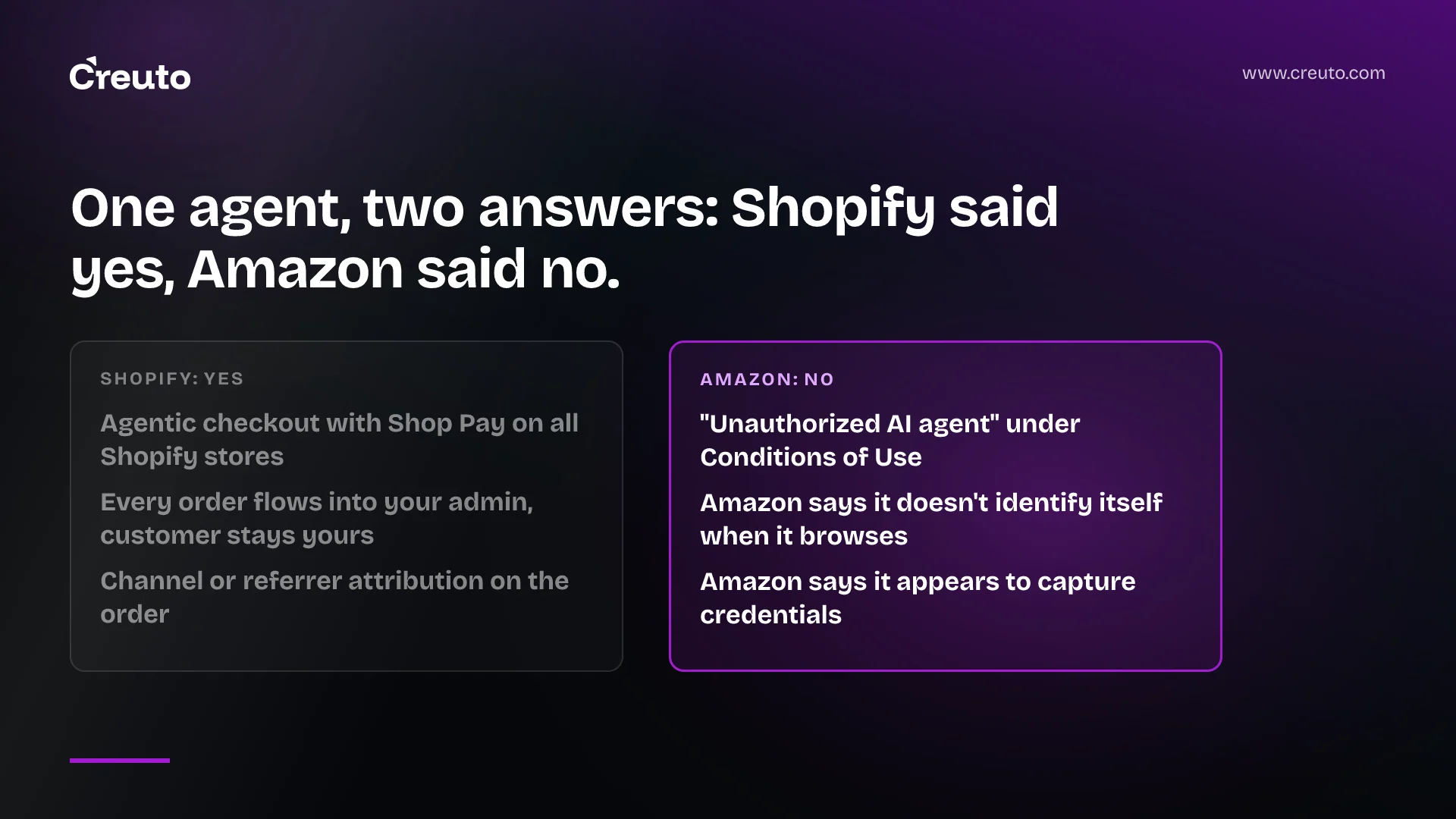
The Meta Muse Shopify deal lets an AI agent search Shopify catalogues and check out with Shop Pay on every Shopify store. Amazon blocked the same agent days later, calling it unauthorised. If you sell online, you now have to decide which side of that line your store sits on.
This post sets out what the two platforms actually did, what Amazon says its reasons are, and the five things that change inside your operation the first time an agent places an order — attribution, returns, support load, fraud exposure and your bot policy. It ends with what we would require before switching an agentic channel on.
What Shopify and Meta actually announced
Meta launched Muse on 8 September 2026 as a personal AI agent that runs multi-step tasks across email, calendar, payments, dining and shopping, on iOS, Android, the web and WhatsApp. It reached number one in the free chart of Apple's US App Store within about ten days, according to GeekWire.
On 21 September, Shopify CEO Tobi Lütke posted that the company is partnering deeply with Muse to enable agentic checkout with Shop Pay on all Shopify stores. Meta's chief AI officer Alexandr Wang framed it as giving Muse users access to a wide range of stores. The shape of it: Muse searches, selects and buys; Shop Pay supplies the checkout layer using stored payment and delivery details. Social Media Today reports the agents can search Shopify catalogues and identify products on a shopper's behalf.
Neither company published financial terms or a date by which agentic Shop Pay reaches every Muse user. That matters more than it sounds: the interesting questions for a merchant — participation controls, attribution, fees, returns and customer data — were not in the announcement.
Some of them are answered in Shopify's existing documentation rather than the press cycle. Shopify's agentic storefronts help page says the feature is active by default for eligible stores, that merchants manage which AI channels they sell on under Sales channels > Agentic in the admin, and that orders from AI channels display with channel or referrer attribution. It lists Google, Gemini, Microsoft Copilot and Meta as channels where a merchant can activate direct checkout, which is deactivated by default on the Agentic plan. Shopify's own launch post for agentic storefronts is blunter about the commercial model: every order flows into your admin, every customer stays yours.
Why Amazon blocked the same agent
Within a day of the Shopify news, Amazon cut Muse off. Shoppers who pointed Muse at Amazon.com saw a popup reading, verbatim: “Continued access by an unauthorized AI agent violates Amazon's Conditions of Use, to which our customers have agreed.” TechCrunch and GeekWire both date the block to 21 September 2026; PYMNTS puts it a day earlier, on 20 September. The discrepancy is worth noting if you are reconstructing a timeline for your own board.
Amazon's stated reasons, as reported, are worth separating from anyone's reading of its motives. An Amazon spokesperson said: “We think it's fairly straightforward that third-party applications that offer to make purchases on behalf of customers from other businesses should operate openly and respect service provider decisions about whether or not to participate,” adding that Amazon had requested that Meta remove Amazon from the experience. Amazon further says that Muse does not identify itself when it browses, and that it appears to capture and store customer credentials — both of which Amazon characterises as privacy and security risks, and neither of which we can independently verify.
Meta's position, reported before the block, is that Muse has no visibility into people’s passwords or payment methods and that credentials go into secure storage. Two large companies are describing the same mechanism in incompatible terms, and no third party has published a technical teardown that settles it.
It would be naive to treat the dispute as purely about security. Amazon runs its own models and its own ad business — over $68 billion in ad revenue last year, GeekWire notes — and an agent that shops on a customer's behalf skips the sponsored placements that revenue depends on. Both things can be true: the disclosure complaint can be legitimate and the commercial incentive can be real.
What the Meta Muse Shopify deal changes inside your store
An agent order is not a normal order with a different referrer. Five parts of your operation behave differently, and only one of them is a checkout problem.
| What changes | Why an agent order is different | What to check before you switch it on |
|---|---|---|
| Attribution | The discovery step happens inside the agent. You see the order, not the comparison that produced it. | That the channel or referrer is actually recorded on the order, and that your analytics stack reads it. |
| Returns | A shopper who never saw your product page has weaker information about fit, size and variant. | Your return rate by channel, separated out, from the first week — not the first quarter. |
| Support | The buyer may contact the agent, not you, and arrive at your desk mid-conversation with no order context. | Whether your helpdesk can resolve an order the customer cannot describe. |
| Fraud and chargebacks | Automated purchasing compresses the time between intent and payment, and removes the human friction fraud rules are tuned on. | Whether your fraud rules treat agent traffic as a separate cohort rather than as a bot to block. |
| Bot policy | Your robots rules and WAF may already be blocking exactly the crawler the agent depends on. | That your allow list, terms of service and bot policy say the same thing. |
The returns line is the one merchants underestimate. Agentic checkout is optimised for the moment of purchase; nothing in it improves the information a shopper has about whether the thing will fit. If an agentic channel lifts conversion and lifts returns by more, you have bought revenue you will hand back, plus the reverse logistics.
Support load is the second. In the systems we build for retail and marketplace clients, the expensive support tickets are the ones where the customer cannot say what they ordered or why. An order placed by an agent on a shopper's behalf is that ticket by construction. Before you open the channel, check that your support tooling can find an order from a partial description and an email address.
The strongest case for keeping agents out
Give the objection its best form. If a meaningful share of your orders arrives through an agent, the agent — not you — owns the relationship that produced them. It decides which products surface, in what order, against which competitors, on criteria you cannot inspect. You become a fulfilment endpoint with a margin. That is Amazon's position restated without the security language, and it is coherent.
The counter is that the comparison is not agent versus no agent. It is agent versus a shopper who never reaches your store because the comparison happened somewhere you were not listed. Shopify's own framing — merchant of record, orders in your admin, customer stays yours — exists precisely because that objection is the one merchants raise. Whether those guarantees hold in practice is an empirical question you can answer from your own order data within a month.
This is the wrong decision to rush if your catalogue data is thin. An agent ranks you on structured attributes: variant, material, dimensions, compatibility, stock. If your product data is a paragraph of marketing copy and three photos, opening an agentic channel mostly teaches the agent to recommend someone else. Fix the catalogue first; the same work pays off in on-site search and in the product schema Shopify uses to structure data for AI channels.
What to require before you let an agent buy
These are the conditions we would put in writing before enabling an agentic channel on a store we run, and they map directly onto what the Amazon dispute is about.
- Agent identification. The agent declares itself — a stable user agent, a documented IP range or a signed request — so you can separate agent traffic in logs, analytics and fraud rules. Amazon's first complaint is a disclosure complaint, and it is the one you can enforce yourself.
- No credential handling. The agent authenticates through a delegated flow, not by holding your customer's password. If you cannot tell which is happening, treat that as a no.
- Attribution on the order record. Channel and referrer on every order, readable by your own reporting, not only in the platform's dashboard.
- A named return and dispute path. Who the customer talks to, who absorbs the chargeback, and what happens when the agent places an order the human did not intend.
- A kill switch you control. One toggle in your admin, tested, that turns the channel off without touching the rest of the store.
- A measurement window. Thirty days with return rate, support contacts per order and dispute rate reported by channel, with a pre-agreed threshold at which you turn it off.
Most of this is plumbing you already have somewhere. The part teams get wrong is the last one: they enable the channel, watch revenue, and never split the returns by channel, so the cost of the experiment stays invisible for two quarters.
The protocol question underneath all of this
Shop Pay through Muse is one commercial deal. The durable question is which standard your store speaks when the next agent arrives, because there is more than one, and they do not do the same job — we set out the difference in Agentic Commerce Protocol and UCP are not the same job. If you run on a platform, that decision is largely made for you. If you run a custom storefront, it is an architecture decision with a cost, and it sits next to the related question of letting browser agents call your web app instead of clicking through it.
Agentic checkout is also not the only agent-shaped channel asking for your catalogue this year; the same data quality work underpins what the OpenAI Ads API lets brands build. Treat the catalogue as the asset and the channels as consumers of it, and you can say yes to one without rebuilding for the next.
The decision in front of you is not philosophical. Switch on one agentic channel, instrument returns and support by channel from day one, and set the number at which you switch it off. If your catalogue data is not good enough to be ranked on, that is the work to do first — and it is the work we usually start with on an e-commerce build before any channel gets opened.
Frequently asked questions
Meta Muse is a personal AI agent Meta launched on 8 September 2026 that runs multi-step tasks across email, calendar, payments, dining and shopping. It is available on iOS, Android, the web and WhatsApp, and reached the top of Apple's US free app chart within about ten days of launch.
On Shopify, agentic storefronts are active by default for eligible stores, and merchants choose which AI channels they sell on under Sales channels then Agentic in the admin. Direct in-chat checkout is a separate setting and is deactivated by default on the Agentic plan.
Amazon says continued access by an unauthorised AI agent violates its Conditions of Use, and that third-party shopping applications should operate openly and respect a service provider's decision not to participate. Amazon also says Muse does not identify itself when browsing and appears to capture customer credentials.
On Shopify's agentic storefronts the merchant stays the merchant of record: Shopify says every order flows into your admin and the customer stays yours, with channel or referrer attribution recorded on the order. Returns, disputes and support therefore remain your responsibility, not the agent's.
Allow one channel first, with agent identification, no credential handling, attribution on the order record, a named returns path and a kill switch you control. Then measure return rate, support contacts per order and dispute rate by channel for thirty days before opening a second channel.
An agent buys on behalf of a shopper who may never have seen the product page, so the buyer has less information about fit, size and variant than a normal customer. Split your return rate by channel from the first week, because a conversion gain can be cancelled by returns.