ChatGPT ads: what the OpenAI Ads API lets brands build
ChatGPT ads run on OpenAI's own product feed and Measurement Pixel. What the Ads API covers and what e-commerce brands must set up before sales campaigns.
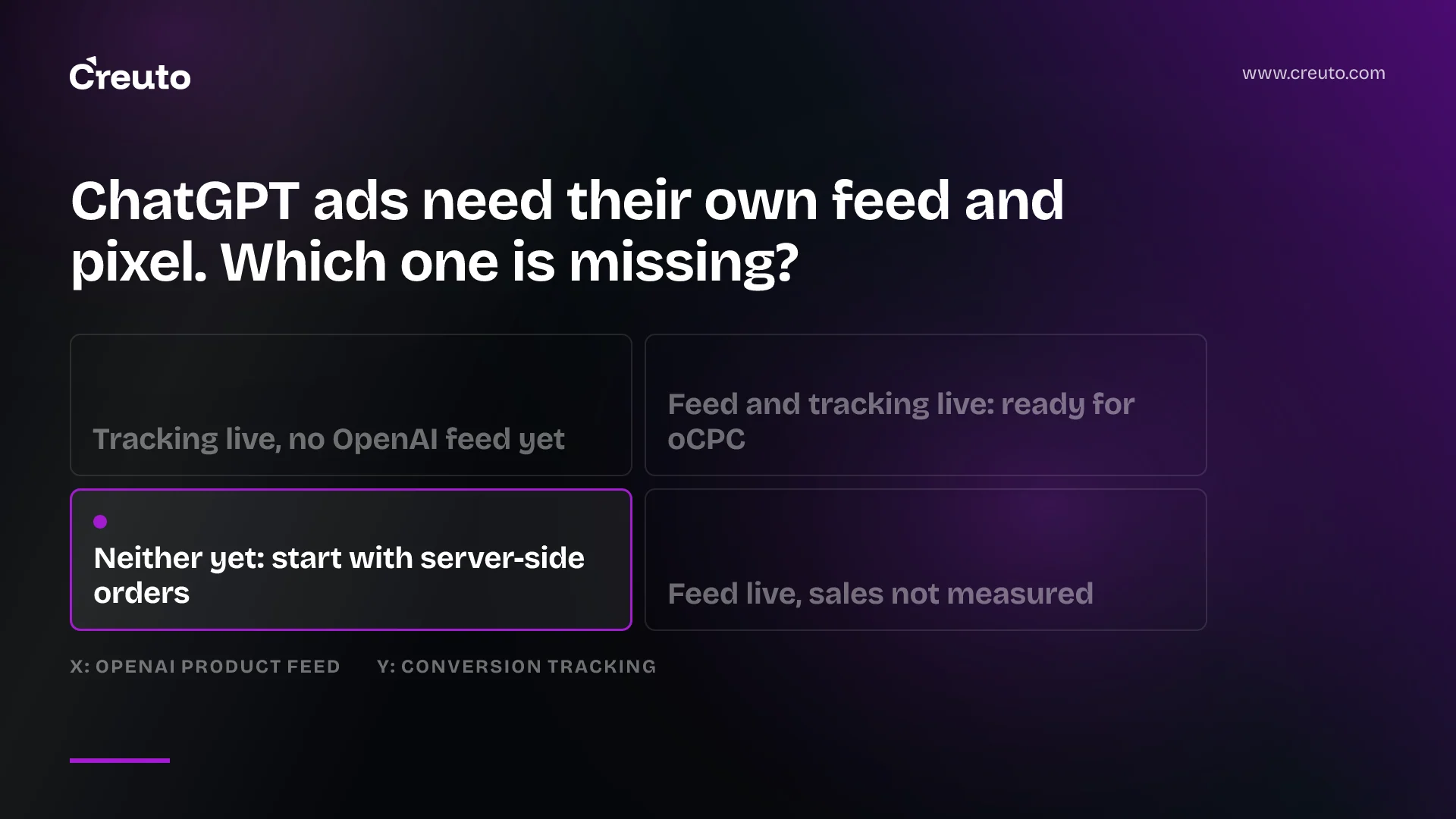
ChatGPT ads are managed through OpenAI's Ads Manager and an Advertiser API at api.ads.openai.com, and for an e-commerce brand the interesting part is not the ad itself. It is the plumbing underneath: a product feed in OpenAI's own schema, uploaded over SFTP, and conversion tracking through a new Measurement Pixel or a server-side Conversions API. Neither comes free with the Google or Meta setup you already run: the feed uses OpenAI's schema unless OpenAI confirms a Google-compatible format for you, and the pixel ID is created in OpenAI's Ads Manager. This post sets out what the OpenAI Ads API covers, what has to be in place before a campaign can optimise for sales, and where custom integration is worth building.
Everything here comes from OpenAI's Ads developer documentation as read on 21 September 2026. We have not relied on announcement pages or press coverage, so this post says nothing about ad pricing, audience size or market availability beyond what the docs state.
| Piece | What the docs say |
|---|---|
| API base URL | https://api.ads.openai.com, bearer-token Advertiser API key |
| Structure | Ad account, campaign, ad group, ad |
| Rate limits | 600 requests a minute per endpoint, 1,200 overall |
| Billing goals | Per 1,000 impressions, per click, or conversion-optimised per click |
| Product feeds | UTF-8 CSV over SFTP; standard uploads currently target the US |
| Conversion tracking | Measurement Pixel in the browser, Conversions API from your server, or both |
| In open beta | Conversion-optimised (oCPC) bidding, including product-feed campaigns |
What is the OpenAI Ads API?
The OpenAI Ads API, which the docs call the Advertiser API, lets you create and manage campaigns, ad groups, ads, product feeds, conversion tracking and reporting from your own software rather than the Ads Manager screens. You need an ad account and an API key created in Ads Manager's settings, and the key belongs on your server.
The hierarchy will look familiar. An ad account holds campaigns, each campaign holds ad groups, and each ad group holds ads. Budget, schedule, geographic and platform targeting, audiences and conversion events live on the campaign. Bids, context hints and product sets live on the ad group. The ad holds the creative and destination URL. Context hints are the ChatGPT-specific piece: short descriptions of the products or needs an ad group serves, which the docs describe as context rather than hard keyword eligibility.
Two engineering details matter early. Create endpoints accept an Idempotency-Key header, so a network retry does not create a duplicate campaign. And creating an ad submits it for review; the account's brand also goes through review, and an account cannot serve ads until its brand review is approved. A missing brand icon is enough to block it.
Can businesses advertise on ChatGPT?
Yes, through an ad account in OpenAI's Ads Manager. The developer docs describe account setup, reviews and spending limits, but they do not set out who is eligible or in which countries accounts are offered, so check that directly with OpenAI before you plan a launch. Agencies have a documented route: the API Partner Setup guide walks through configuring a client's account with that client's own API key, and asks partners to tag every conversion request with a consistent integration_source.
ChatGPT product feed ads: the e-commerce piece
Product-feed campaigns build ads from your catalog. You create a feed, connect over SFTP with a password or SSH key, and upload a UTF-8 CSV with one row per product or variant, following the OpenAI product file schema. That schema has nine required fields, including item_id, title, url, image_url, availability and price, and products are only processed for ads when is_ads_eligible is true. Product pages and images must be public HTTPS URLs.
Three details in the docs will shape your build:
- Market. The schema says the standard OpenAI-format upload currently targets the US, and other markets need OpenAI to confirm the integration first. A Google-compatible feed format exists, but only after OpenAI confirms it for your registered feed.
- Three money formats. CSV prices are major units (
79.99 USD), the Delta API uses integer minor units, and budgets and bids use micros. Mixing them up is the kind of bug that ships a product at a hundredth of its price. - Keeping it fresh. The Delta Feeds API updates price, title and availability for existing variants without a full upload. New products and image changes still need a fresh SFTP upload of the complete catalog.
On the ad side, each product-feed ad group holds at most one product-ad template, filled from macros such as {{product.title}} and {{product.price}}. The product supplies the image and destination URL. A campaign's mode, objective and linked feed cannot be changed after creation, so decide them first.
How do ChatGPT ads track conversions?
ChatGPT ads track conversions through a browser Measurement Pixel, a server-side Conversions API, or both. The pixel loads from OpenAI's CDN, captures an oppref click identifier from the landing URL into a first-party cookie that lasts 30 days, and sends events such as order_created when you call oaiq("measure", ...). If you send the same purchase from both browser and server, you reuse one event ID so OpenAI keeps the first and drops the duplicate.
The details a developer will care about:
- Customer identifiers are normalised and SHA-256 hashed before sending; the docs tell you not to send raw emails, phone numbers or names.
- The pixel has a consent switch; with consent set to false it sends nothing and blocked events are not replayed.
- If your site runs a Content Security Policy, you add OpenAI's pixel domains to
script-src,connect-srcandimg-src. - Amounts are integers in minor units:
8900for USD 89.00. - App installs and opens can only be sent server-side; the pixel does not support them.
Attribution is click-based by default, with a one-day view-through window reported as a separate metric when your account has it. Bidding, billing and CPA stay click-through-based.
Conversion-optimised bidding still bills per click
Once tracking works, you can run a conversion-optimised cost-per-click (oCPC) campaign: delivery favours clicks likely to lead to one chosen conversion event, but you still pay per valid click, never per conversion. The ad group's max_bid_micros becomes a CPA bid used as an optimisation input. The rules are strict: exactly one active standard event such as order_created, no custom events, no switching an existing click campaign to oCPC, and no changing the event later. oCPC is in open beta, and an account without it returns 403 Conversion bidding is not enabled.
OpenAI's own guidance is that the Conversions API is a more reliable tracking source than the pixel alone. For a store, that means sending confirmed orders from the order system, not relying only on the thank-you page firing in the shopper's browser.
Where custom integration pays off, and where it does not
The strongest case against building anything is that Ads Manager exists. A brand with a small, stable catalog and one campaign can set this up by hand, and it should. The API earns its cost when the catalog or the measurement changes faster than a person can keep up. In the e-commerce builds we run, those are the jobs worth automating:
- Catalog sync. Generate the OpenAI-format CSV from your store database, push it over SFTP on a schedule, and call the Delta API when stock or price changes, so ads stop pointing at sold-out products.
- Server-side conversions. Send
order_createdfrom the order service with the capturedopprefand the same event ID the pixel used. - Reporting into your own warehouse. Pull Insights by campaign, product, country and device next to your other channels, instead of reading another dashboard.
- Multi-client setup for agencies. Script the partner flow: brand icon, pixel, Conversions API key, event setting, paused campaigns.
None of this is exotic; it is the same kind of feed and event plumbing that agentic commerce protocols ask of merchants, and the product schema is shared with OpenAI's commerce specs. Keep the Advertiser and Conversions API keys out of browser code, as we argue in our note on OpenAI API key security.
The decision in front of most brands is not which ad to run. It is whether your catalog can produce a clean, US-targeted feed and whether your order system can send a server-side conversion with an event ID. A brand starting today sits in the bottom-left of that grid, with neither in place, because both are ChatGPT-specific. Start with the server-side order event: it serves reporting and oCPC whatever the feed timeline turns out to be. Our e-commerce solutions and API integration teams build exactly that layer.
Frequently asked questions
Businesses can advertise on ChatGPT through an ad account in OpenAI's Ads Manager, managed in the interface or through the Advertiser API. OpenAI's developer docs cover account setup, brand review and spending limits, but do not publish eligibility rules or country availability, so confirm those with OpenAI before planning a launch.
The OpenAI Ads API, called the Advertiser API in OpenAI's docs, is a REST API at api.ads.openai.com for creating and managing ChatGPT ad campaigns, ad groups, ads, product feeds, conversion tracking and reporting. It uses a bearer-token key from Ads Manager and allows 600 requests a minute per endpoint.
ChatGPT ads track conversions with the Measurement Pixel in the browser, the Conversions API from your server, or both with a shared event ID for deduplication. The pixel stores an oppref click identifier in a 30-day first-party cookie. OpenAI says the Conversions API is more reliable than the pixel alone.
OpenAI's product file schema says standard OpenAI-format uploads currently target the US, and that additional markets require OpenAI to confirm the integration and its allowed countries and currencies first. Brands selling in India, the UAE or elsewhere should confirm market support with OpenAI before building a ChatGPT product feed.
No. ChatGPT conversion-optimised (oCPC) campaigns optimise delivery toward one standard conversion event, but OpenAI charges only for valid clicks. The ad group's maximum bid acts as a CPA bid for optimisation, not a conversion charge. oCPC is in open beta and cannot use custom events.