Core Technology Commission: Apple's EU rates from 1 October
The Core Technology Commission replaces Apple's per-install fee on 1 October. The EU rate card, the reporting duty, and which route actually costs least.
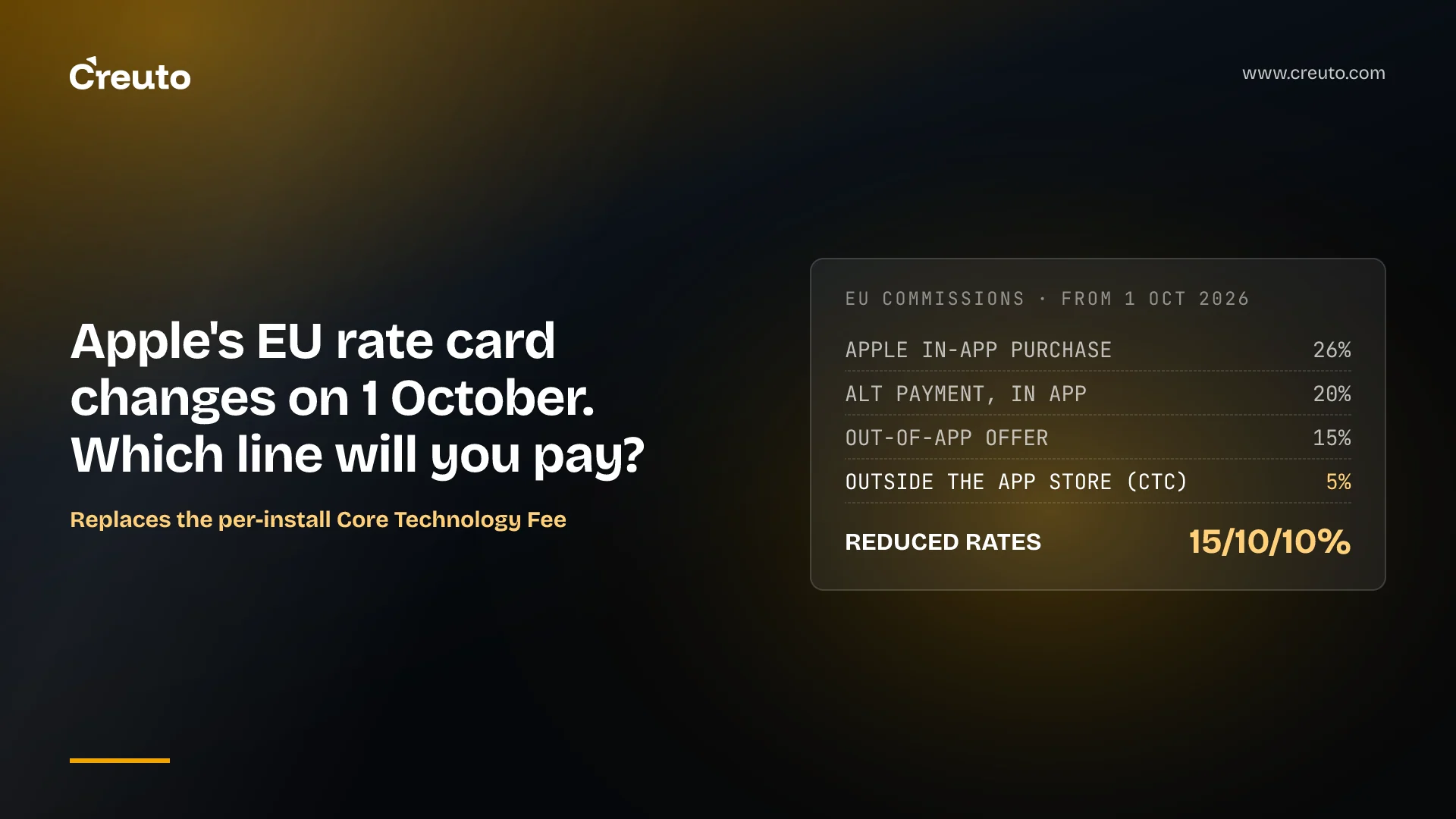
Apple's unified EU business terms take effect on 1 October 2026, and the headline change is that the Core Technology Commission replaces the Core Technology Fee. The old fee was charged per install once a developer reached extraordinary scale. The new one is a flat 5% commission on digital transactions in apps distributed outside the App Store. Per-install becomes per-sale, which changes who pays and when.
If you ship an app into EU storefronts, there are three decisions waiting: which payment route you use, what you now have to report, and what changes for users under 18.
The EU rate card from 1 October
| Route | Standard rate | Reduced rate |
|---|---|---|
| Apple In-App Purchase | 26% | 15% |
| Alternative payment processing inside the app | 20% | 10% |
| Out-of-app offer (link out) | 15% | 10% |
| Distribution outside the App Store (Core Technology Commission) | 5% | 5% |
The reduced rates apply to participants in the App Store Small Business Program, the Mini Apps Partner Program and the Video Partner Program, and to auto-renewable subscriptions after a subscriber's first year. App Store commission rates are calculated on the price the customer pays. The Core Technology Commission applies to alternative app marketplaces, apps distributed through them, and apps distributed via Web Distribution.
Core Technology Commission or link-out: the cheapest percentage is not the cheapest route
Read the table quickly and link-out at 15% looks like the obvious answer against 26% for In-App Purchase. Then read the conditions.
The store services commission on out-of-app offers only applies to sales made within seven days of the link tap. That is a genuine cap on Apple's cut, and it is better than most people expect. But everything the 26% was buying, you now buy yourself: a payment processor's own percentage, chargebacks, fraud handling, tax collection and remittance across EU member states, receipt delivery, refund support and the customer-service load when a purchase fails outside the store. For a small team selling a €5 subscription, the difference between 26% and 15% is often smaller than the cost of the team hours that replace it.
The route that genuinely changes the arithmetic is the 5% Core Technology Commission, because it is the lowest rate by a wide margin — but it only applies if you distribute outside the App Store entirely, through an alternative marketplace or Web Distribution. That is a distribution decision with real discovery consequences, not a payments toggle. The same tension shows up whenever a platform reprices its rails, as Indian merchants found when UPI introduced MDR on larger transactions: the headline rate is rarely the number that decides it.
The reporting obligation most teams will miss
Two duties come with the alternative routes, and neither is optional.
- Alternative payment transactions must be reported to Apple monthly, within 15 days following the end of the calendar month, so Apple can calculate and collect its commission. You are also responsible for collecting and remitting applicable taxes on those sales.
- Every transaction subject to the Core Technology Commission must be reported — including transactions that did not result in a completed sale.
That second line is the one to put in front of whoever owns your billing code. Reporting failed and abandoned transactions is not how most payment integrations are built, and it is not something you can reconstruct later from a ledger that only recorded successes. If you are going down the alternative route, that instrumentation is part of the build, not a finance task afterwards.
The under-18 rules ship with the same terms
Apple is attaching age-based protections to the alternative payment routes, and they are stricter than the general commission story suggests:
- Under 13: alternative payment purchases must sit behind a parental gate, and out-of-app offers are not permitted at all.
- 13 to 17: both alternative payment processing inside the app and out-of-app purchase offers must sit behind a parental gate.
- Storefronts with a higher consent age: where an EU storefront sets parental consent above 13, the same protections apply at that higher age instead — in some storefronts the under-13 rules apply to users under 16, and the 13-to-17 rules to 16 and 17 year olds.
- Kids category apps: purchase flows using an alternative payment processor must be behind a parental gate, and these apps cannot offer an out-of-app purchase on a website.
If your app has any meaningful under-18 audience, this narrows the savings considerably — a parental gate in the purchase path costs conversion, and that cost lands exactly on the users you were routing around Apple to monetise. It is also another instance of a pattern we keep writing about: regulators and platforms no longer accept a self-declared birthday as age assurance.
What to do before 1 October
- Check whether you have agreed to the updated terms. An account moves to the unified EU terms on 1 October or the date it agrees, whichever is later. Until then, nothing changes for you.
- Work out your real blended rate for each route, including processor fees, tax handling and support cost — not the Apple percentage alone.
- Check your age demographics before assuming alternative payments are available to your whole EU user base.
- Scope the reporting work if you are going alternative, including capturing transactions that fail.
- Leave it alone if you are small and selling through In-App Purchase at 15%. For a Small Business Program participant, the gap between 15% and the alternatives is rarely worth the engineering.
That last point is the honest verdict for most teams we build iOS apps for. The unified terms are simpler than what they replace, and replacing a per-install fee with a proportional commission is a real improvement for anyone whose install count outran their revenue. But the alternatives only pay off at scale, with a payments team, or with a distribution strategy that does not depend on App Store discovery.
Note the date pattern too: this lands the same autumn as Google Play's target API level deadline. If you ship on both platforms, both calendars want a look this month.
Rates and rules above are from Apple's developer support pages on the DMA and apps in the EU and apps in the EU, as of September 2026. Verify against Apple's own pages before making a commercial decision.
Frequently asked questions
It is a 5% commission Apple charges on digital transactions in iOS and iPadOS apps distributed outside the App Store, through alternative app marketplaces or Web Distribution. It replaces the Core Technology Fee, which was a per-install charge applied to developers at extraordinary scale.
The unified EU business terms take effect on 1 October 2026. A developer account becomes subject to them on that date or on the date it agrees to the updated terms, whichever is later. From 1 October the earlier terms are superseded by Attachment 14 of the Developer Program License Agreement.
26% on sales processed by Apple In-App Purchase, 20% via alternative payment processing inside the app, and 15% on out-of-app offers. Reduced rates of 15%, 10% and 10% apply to Small Business, Mini Apps and Video Partner Program participants, and to auto-renewable subscriptions after the first year.
Only sales made within seven days of the link tap are subject to the store services commission on out-of-app offers. Sales outside that window are not. This makes link-outs more predictable than many developers assume, though you take on payment processing, tax and support costs yourself.
With restrictions. For users under 13, alternative payment purchases need a parental gate and out-of-app offers are not permitted. For 13 to 17 year olds, both routes need a parental gate. Kids category apps need a gate for alternative payment flows and cannot link out to a website purchase.