UPI MDR charges from 15 October: 0.4% above ₹2,000, capped at ₹300
UPI MDR charges start 15 October 2026: 0.4% on merchant payments above ₹2,000, capped at ₹300. What changes for checkout, reconciliation and accounting.
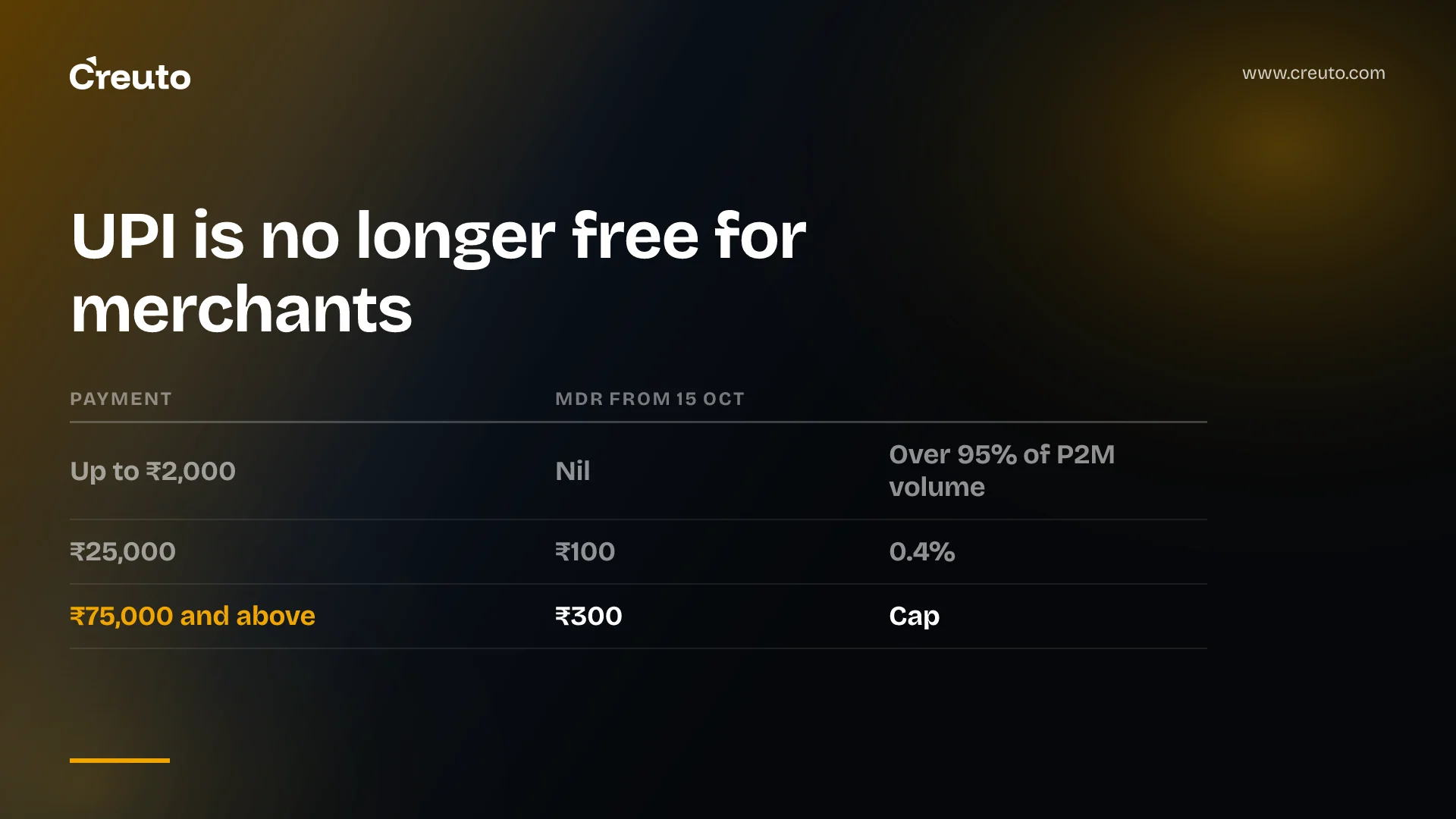
From 15 October 2026, merchants will pay UPI MDR charges for the first time on larger payments: 0.4% on person-to-merchant UPI transactions above ₹2,000, capped at ₹300 per transaction. Customers still pay nothing. For merchants and the platforms that serve them — e-commerce sites, POS systems, billing and accounting software — it is a small fee with a long list of changes behind it. This guide sets out what the rules say and what to update before the date.
UPI MDR charges: what the rules say
The Department of Financial Services published official FAQs on 15 September 2026. The key points:
- Rate: 0.4% MDR on person-to-merchant (P2M) UPI transactions above ₹2,000.
- Cap: for transactions of ₹75,000 and above, MDR is capped at ₹300 per transaction.
- Start date: 15 October 2026. The government says the lead time is to let acquiring banks, payment aggregators, fintech apps and corporate accounting platforms update their software and billing systems.
- Small payments untouched: transactions up to ₹2,000 carry no MDR. According to the FAQs, they make up more than 95% of UPI P2M volume.
- No customer fee: as SCC Online summarises, consumers will not pay a UPI fee, and UPI apps will not charge users a platform fee.
- Small merchants exempt: small merchants under the P2PM framework continue at zero MDR.
- Who decides details: operational parameters and fee distribution are set by the UPI and Services Steering Committee headed by NPCI.
The FAQs compare the rate with card payments: standard credit-card MDRs typically range from 1.5% to 2.5%, and debit-card MDR is capped at up to 0.9%. UPI remains the cheapest way for most merchants to accept digital payments.
How much is UPI MDR on a payment?
| Payment amount | MDR |
|---|---|
| ₹500 | Nil |
| ₹2,000 | Nil |
| ₹5,000 | ₹20 (0.4%) |
| ₹25,000 | ₹100 (0.4%) |
| ₹1,00,000 | ₹300 (cap) |
Figures are calculated from the published rate and cap. Your acquirer's statement will show the exact treatment, including any taxes charged on the fee.
What merchants and payment apps must change
1. Checkout and pricing
Decide whether to absorb the fee or reflect it in pricing. If you run different prices by payment method, check the terms of your acquirer and marketplace agreements first, and remember that customers are not supposed to be charged a UPI fee by apps.
2. Payment routing
For high-value orders, UPI is still cheaper than cards, but no longer free. Businesses that deliberately steered large payments to UPI should re-run the cost comparison per order band.
3. Settlement and reconciliation
Settlements for payments above ₹2,000 will arrive net of MDR (depending on your acquirer's model). Reconciliation logic that expects gross amounts — or that matches settlement to orders by exact value — will start producing mismatches on 15 October. Update matching rules to account for fees, and store the MDR per transaction.
4. Accounting
MDR is a cost that needs its own ledger account, and your accountant will advise on tax treatment. ERP and accounting integrations should post it automatically rather than leaving a daily adjustment for the finance team.
5. Invoicing and marketplace payouts
Platforms that collect on behalf of sellers must decide who bears the MDR, show it clearly in payout statements, and update seller agreements.
6. Reporting
Add MDR to payment dashboards by method and order size, so you can see its real impact after the first month rather than estimating.
Why UPI MDR is being introduced
The FAQs say the fee is distributed within the UPI ecosystem to fund infrastructure resilience, innovation, cybersecurity and customer service, and that government subsidies were designed as short-term bridge funding rather than a permanent model. For scale, the government states UPI processed 2,451 crore transactions worth ₹29.9 lakh crore in August 2026 alone. Revenue from MDR is meant to fund fraud detection and security upgrades on that volume.
Does UPI MDR apply to small merchants?
Not to small merchants under the P2PM framework — described in coverage as small vendors receiving up to about ₹1 lakh a month through UPI QR directly into their accounts — and not to any payment of ₹2,000 or less. The government also plans a dedicated fund, financed from MDR, to support UPI acceptance among small merchants, with the framework to be finalised with the RBI within three months.
A checklist before 15 October
- Confirm with your bank or payment aggregator how MDR will appear in settlements and statements.
- Update reconciliation rules for net settlements above ₹2,000.
- Add an MDR expense account and map it in your ERP or accounting integration.
- Review pricing and payment-method routing for orders above ₹2,000.
- Update marketplace seller terms and payout statements if you collect on others' behalf.
- Test with a small transaction above ₹2,000 on or after 15 October and trace it end to end.
Payment rule changes are becoming a regular engineering task for Indian businesses, just as with the EPF wage ceiling in payroll. If your checkout, reconciliation or ERP integration needs updating, our e-commerce solutions and API integration teams can make the changes and test them before the deadline.
Frequently asked questions
UPI MDR, or merchant discount rate, is a fee paid by merchants on certain UPI payments. From 15 October 2026 it is 0.4% on person-to-merchant UPI transactions above ₹2,000, capped at ₹300 for transactions of ₹75,000 and above.
The UPI MDR framework takes effect on 15 October 2026, according to the Department of Financial Services FAQs published on 15 September 2026. Payments of ₹2,000 or less remain free of MDR.
No. The MDR is paid by merchants, not customers, and UPI apps will not charge users a platform fee for making UPI payments, according to the government's FAQs on the new framework.
UPI MDR on a ₹1 lakh payment is capped at ₹300, because transactions of ₹75,000 and above have a maximum MDR of ₹300. Below that, the fee is 0.4% of amounts above ₹2,000 per transaction.
Small merchants under the P2PM framework continue at zero MDR, and no MDR applies to any UPI payment of ₹2,000 or less, which the government says is over 95% of P2M transaction volume.