UAE e-invoicing: appoint an ASP by 30 October, live 1 January
UAE e-invoicing: appoint an ASP by 30 October 2026 and go live 1 January 2027. Who is in scope, the 51 mandatory fields, ERP routes and penalties.
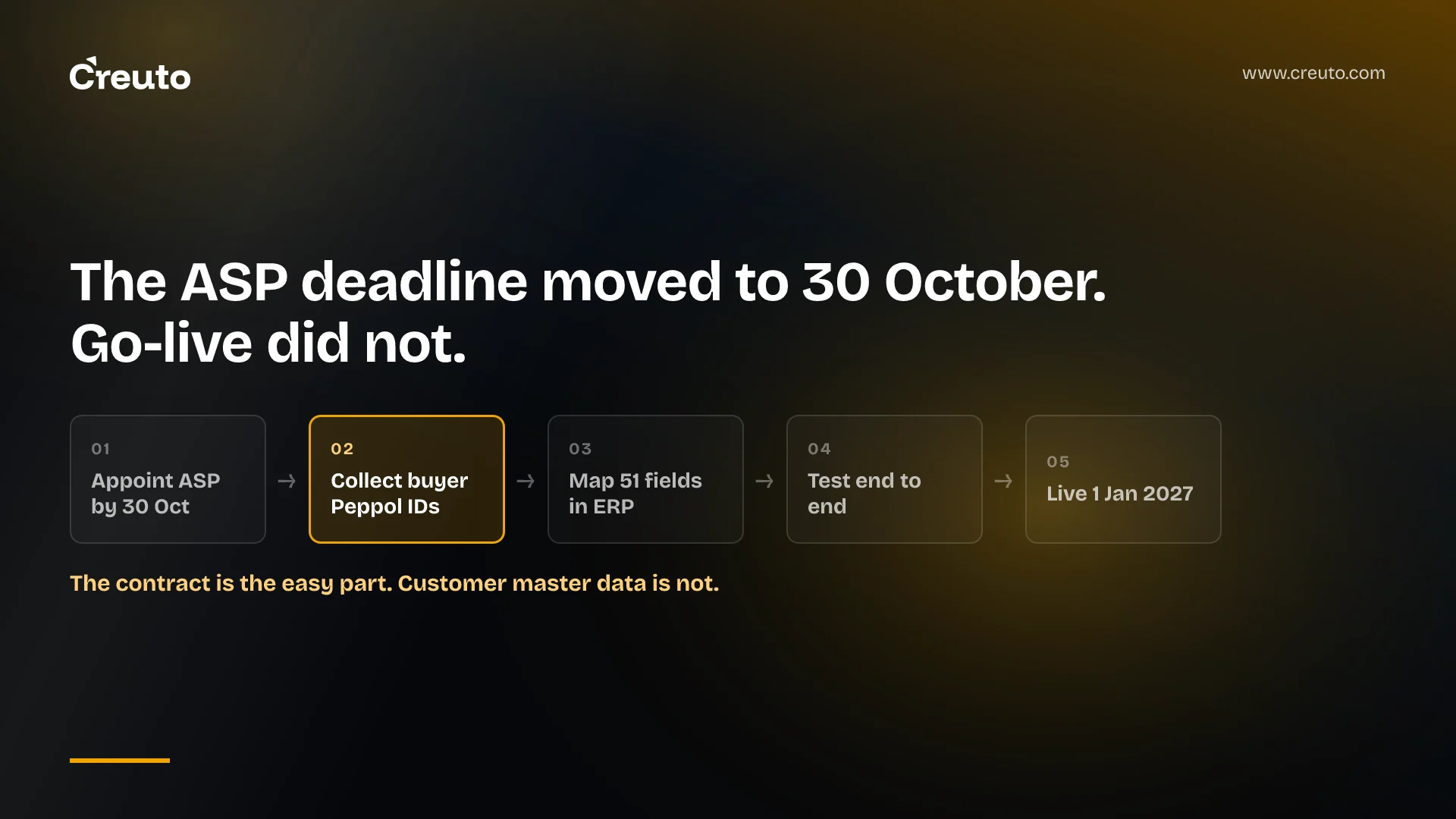
UAE e-invoicing requires 51 mandatory fields on an electronic tax invoice, and one of them is the buyer's electronic address on the Peppol network. If your customer records do not hold it yet, that is where the project starts. If your company's revenue is AED 50 million or more, you must appoint an accredited service provider (ASP) by 30 October 2026 and go live on 1 January 2027. This post covers who is in scope, what the ASP does and does not do for you, what changes inside your ERP, and why the contract is the easy part.
The key dates, from Ministerial Decision No. 244 of 2025 as amended by Ministerial Decision No. 66 of 2026, as of 22 September 2026:
| Who | Appoint an ASP by | Implement e-invoicing by |
|---|---|---|
| Businesses with revenue of AED 50 million or more | 30 October 2026 (was 31 July 2026) | 1 January 2027 |
| Businesses with revenue below AED 50 million | 31 March 2027 | 1 July 2027 |
| Government entities | 31 March 2027 | 1 October 2027 |
A pilot programme and voluntary adoption both opened on 1 July 2026. Revenue here means gross income in your most recent accounting period, based on your financial statements.
The UAE e-invoicing deadline moved, but not in every official document
The Ministry of Finance changed only one date. Decision No. 66 of 2026 replaces the ASP appointment deadline for the first phase with 30 October 2026 and restates that implementation is due by 1 January 2027. Deloitte's summary puts it plainly: the go-live date remains 1 January 2027, and businesses should plan on that basis.
One trap is worth knowing. The Ministry's own UAE Electronic Invoicing Guidelines, version 1.1 dated 1 June 2026, still shows 31 July 2026 in its implementation table, even though the amending decision was announced in May. If a project plan, vendor proposal or board paper was built from the guidelines, check which date it uses. The ministerial decision is the legal instrument; the guidelines are guidance.
The extension is not extra time for the whole project. As Middle East Briefing notes, the window between appointing a provider and going live is now shorter. Appointing on 30 October leaves about nine weeks, including the year-end close, to integrate and test.
Who must comply with UAE e-invoicing in 2027?
UAE e-invoicing applies to any person conducting business in the UAE, for every business transaction, unless the person or transaction is excluded. The guidelines are explicit that this holds regardless of VAT registration status and regardless of whether the business is established in the UAE. Business-to-business and business-to-government transactions are in scope.
Business-to-consumer transactions are outside the system until the Minister decides otherwise, and a business that sells only to consumers is not subject to it yet. Decision No. 243 of 2025 also excludes sovereign government activity that does not compete with the private sector, international passenger flights ticketed electronically and their ancillary services, air cargo under an airway bill for 24 months, and financial services that are exempt or zero-rated for VAT.
Groups need two extra checks. Every member of a VAT group must be onboarded separately, and each uses its own tax identification number (TIN), not the group representative's. Transactions between members of the same VAT group are in scope, but the guidelines grant a 24-month grace period for intra-group transactions starting on 1 January 2027. That grace period covers timing only; your third-party invoices still go live on the phase date.
What is an accredited service provider?
An accredited service provider is a company accredited by the Ministry of Finance to send, receive and report e-invoices on your behalf. The UAE uses a five-corner model: you (corner 1) send invoice data to your ASP (corner 2), which validates it, converts it to the UAE XML format and delivers it to the buyer's ASP (corner 3) and the buyer (corner 4), while both ASPs report tax data to the Federal Tax Authority (corner 5). The model is described step by step in the guidelines.
Three rules in the guidelines shape how you choose:
- You appoint one ASP for both sending (accounts receivable) and receiving (accounts payable).
- You start onboarding yourself, through the Federal Tax Authority's EmaraTax portal, not the ASP. Your ASP then issues your Peppol participant identifier, which is 0235 followed by your 10-digit TIN.
- The ASP handles encryption, looks up the buyer's identifier and generates a UUID for each invoice. Calculating every invoice value stays your responsibility, and so does the compliance obligation.
The Ministry has published a short list of considerations for selecting an ASP. Four questions from it matter most for an engineering team: whether the platform is the ASP's own product or a reseller's, what APIs and data formats it supports for your ERP, where it stores e-invoicing data, and whether the contract includes the 100 free e-invoices a year that the Ministry recommends under Decision No. 64 of 2025. According to Middle East Briefing, 32 providers had been approved by May 2026, with more in the final stage.
What UAE e-invoicing changes inside your ERP
E-invoices are XML documents built to Peppol's PINT AE specification, with no QR code or barcode, according to the guidelines. A PDF emailed to a customer, however well formatted, is not an e-invoice. The Ministry's mandatory fields document lists 51 fields for an electronic tax invoice and 49 for a commercial invoice. Most are standard invoice data. These are the ones that tend to need new work:
| Field or rule | What your ERP has to produce |
|---|---|
| Buyer electronic address | The buyer's Peppol identifier, held against every customer record |
| Invoice transaction type code | A string of flags for free zone, deemed supply, margin scheme, summary invoice, continuous supply, disclosed agent billing and e-commerce supply |
| VAT line amount in AED and invoice line amount in AED | Line-level AED values on invoices issued in another currency |
| Credit notes | An electronic credit note for every cancellation, price reduction, full or partial refund, and administrative or numerical error |
| Timing | Issue and transmit within 14 days of the transaction date, and within the VAT law's timeline if you are VAT registered |
The credit-note and timing rules come from Decision No. 243 of 2025. Two further details catch teams out. There is no provisional invoice category, so a provisional invoice is issued as a normal e-invoice and adjusted later. And if a buyer has not yet onboarded, you still send the e-invoice to a predefined endpoint and also issue a regular tax invoice, so your ERP needs to run both outputs during the transition.
If you have already been through a European mandate, much of this will be familiar. Our note on EN 16931 validation shows how one rule, the VAT rate on a discount, decides whether an invoice validates.
Does my ERP support UAE e-invoicing?
Your ERP supports UAE e-invoicing only if it can produce the mandatory fields and pass them to your ASP, and there are three ways to get there. None is universally right.
| Route | Suits | Watch for |
|---|---|---|
| ERP vendor connector or localisation | A single mainstream ERP on a supported version | Version upgrades before go-live, and which ASPs the connector actually supports |
| ASP portal or file upload | Low volumes and a short-term bridge | Manual steps that break the 14-day rule at month end |
| Custom API integration | Custom ERPs, multiple ERPs across entities, or heavy customisation | Owning validation errors, retries and the ASP's API changes |
If you run Odoo, ask your implementation partner two questions: does your version's UAE localisation emit PINT AE, and which ASP will it talk to? For a custom ERP the work is an integration with your chosen ASP's API. On the custom ERP we built for a large industrial client, finance, CRM, inventory and HR share one source of truth, and that is the property that makes a mandate like this one integration instead of four. That is the part of custom ERP development this deadline tests.
The real bottleneck is customer master data
Signing an ASP is a procurement task. Fixing your customer records is a data project. The guidelines make the supplier responsible for contacting the buyer and gathering their Peppol participant identifier, and they tell businesses to work with their ASP to make sure enough buyer and supplier data is available during the transition. Every B2B customer you invoice needs a valid identifier, TIN and address fields before your first compliant invoice can go out.
That work is outside the ERP team's control. It depends on customers replying, on sales teams chasing them, and on someone deciding what happens to an invoice when the data is missing on 2 January. Our view is that it should start this month, in parallel with ASP selection, not after it. France's mandate has the same shape on the receiving side; see France e-invoicing 2026.
Penalties under Cabinet Resolution No. 106 of 2025
The penalties apply only once you are mandatorily in scope; voluntary adopters are exempt until their phase date. The Ministry of Finance lists:
| Violation | Administrative fine |
|---|---|
| Not implementing the system, or not appointing an ASP on time | AED 5,000 per month |
| E-invoice not issued or sent on time | AED 100 per invoice, capped at AED 5,000 per month |
| E-credit note not issued or sent on time | AED 100 per credit note, capped at AED 5,000 per month |
| Not notifying the FTA of a system failure on time | AED 1,000 per day of delay |
| Not notifying your ASP of changes to data registered with the FTA on time | AED 1,000 per day of delay |
The notification windows are short: two business days to report a system failure to the FTA, and five business days to tell your ASP about a change to your registered data, under Decision No. 243. Deloitte also points to invoice rejection, payment delays and VAT recovery challenges when invoices do not meet requirements, which for most finance teams will cost more than the fines.
A readiness path from now to 1 January
- Confirm scope by entity. Check revenue for each legal entity, list its B2B, B2G and B2C flows, and note VAT group members.
- Start collecting buyer identifiers now. Add fields to the customer master and begin the outreach.
- Appoint an ASP by 30 October. Onboard via EmaraTax and get your participant identifier.
- Map the mandatory fields. Run a gap assessment against the 51 fields, including transaction type flags and AED line amounts.
- Integrate and test end to end. The Ministry's readiness steps put end-to-end testing of exchange and reporting before go-live; include credit notes and a buyer who is not yet onboarded.
- Go live on 1 January 2027 with an agreed process for rejected invoices and system-failure notices.
On storage, one reassurance: Decision No. 243 requires e-invoice data to be stored within the State, but the guidelines interpret that as keeping records retrievable by the FTA irrespective of the geographic location of the servers. Retention is five years for most taxable persons. That is not a reason to relax about hosting, only a reason not to re-platform your archive before January. If your ERP needs work before then, our team in Dubai can scope it; this is general guidance, so confirm your own position with your tax adviser.
Frequently asked questions
UAE businesses with revenue of AED 50 million or more must appoint an accredited service provider by 30 October 2026 and implement e-invoicing by 1 January 2027. The ASP deadline was extended from 31 July 2026 by Ministerial Decision No. 66 of 2026; the go-live date did not move.
UAE businesses with revenue below AED 50 million must appoint an accredited service provider by 31 March 2027 and implement e-invoicing by 1 July 2027. Government entities have the same ASP deadline and must go live by 1 October 2027. Businesses selling only to consumers are outside the system for now.
An accredited service provider is a company accredited by the UAE Ministry of Finance to exchange e-invoices on the Peppol network and report tax data to the Federal Tax Authority. Each business appoints one ASP for both sending and receiving, while remaining responsible for its own invoice values and compliance.
A PDF invoice is not an e-invoice under the UAE system. E-invoices are structured XML documents following the PINT AE specification and exchanged through accredited service providers. A PDF may still be needed alongside the e-invoice when the buyer has not yet onboarded to the system.
Under Cabinet Resolution No. 106 of 2025, failing to implement e-invoicing or appoint an accredited service provider on time costs AED 5,000 per month. Late e-invoices and credit notes cost AED 100 each, capped at AED 5,000 per month, and late failure notifications cost AED 1,000 per day.