France e-invoicing 2026: every business must now receive
Since 1 September, France e-invoicing 2026 rules require every business to receive structured e-invoices. Only issuing is phased. Penalties and ERP impact.
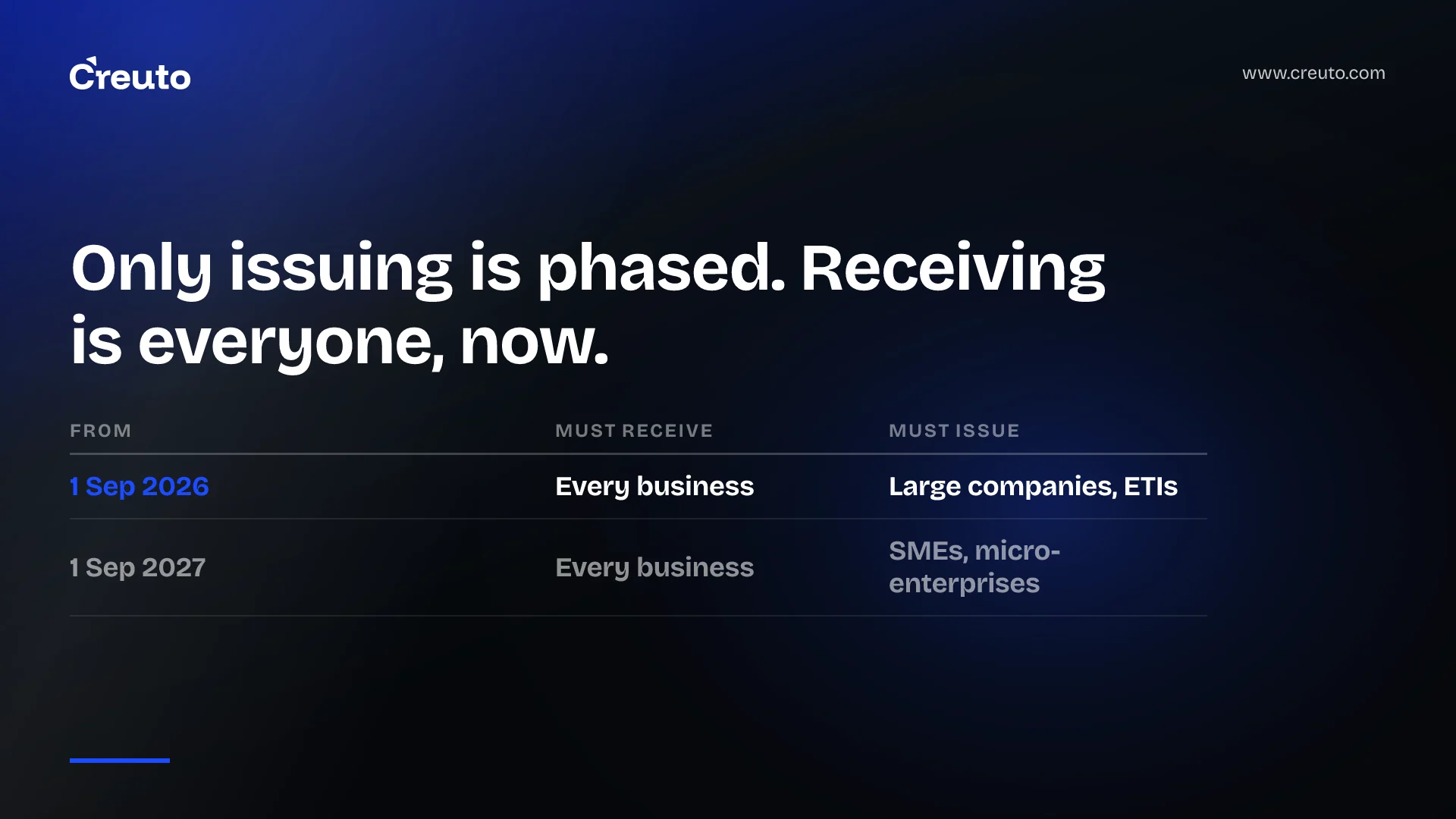
France's e-invoicing reform went live on 1 September 2026, and the most common misreading of it is also the most expensive. Many businesses believe the obligation only applies to large companies. It does not. Under France e-invoicing 2026 rules, every business established in France, whatever its size, must now be able to receive electronic invoices. Only the obligation to issue them is phased.
If your ERP or accounting system cannot receive and process structured invoices from a French supplier today, that is not a 2027 problem.
France e-invoicing 2026: what applies now and next year
The official calendar on impots.gouv.fr is short and unambiguous.
From 1 September 2026: all businesses must receive their invoices in electronic form. Large companies and mid-sized companies (ETIs) must also issue their invoices electronically and transmit transaction and payment data to the tax administration.
From 1 September 2027: small and medium-sized businesses and micro-enterprises take on the same obligations to issue electronically and transmit transaction data.
Invoices travel through plateformes agréées — approved platforms, previously referred to as PDPs — that the tax administration registers. At least one vendor blog still states that only large and medium companies must be able to receive from September 2026. The official text says all businesses. Reading the wrong summary is how companies end up unprepared.
What non-compliance costs
The penalties were raised by the 2026 Finance Law, and Service Public Entreprendre sets them out:
- €50 per invoice not issued in electronic form, up from €15.
- €500 per failure to transmit e-reporting data, up from €250.
- Both capped at €15,000 per calendar year.
- A first failure in a year can be waived if it is corrected spontaneously or within 30 days of the administration asking.
The €15,000 cap makes the direct fines tolerable for a large business. The indirect cost is not capped. An invoice that cannot be received or processed delays payment, creates reconciliation work, and — for the supplier — becomes an invoice the customer cannot pay on time. The waiver for a first, promptly corrected failure is a safety net for honest mistakes, not a plan for a company that has done nothing.
Why receiving is the harder half
Issuing an e-invoice is mostly a formatting problem: your billing system produces a structured file and hands it to a platform. Receiving is a processing problem, and it lands squarely in accounts payable and the ERP.
A structured invoice is only valuable if your system does something with the structure. The common failure is a company that can technically receive an invoice through its platform, then downloads a PDF rendering of it and keys it in by hand. That meets the letter of the obligation and throws away its purpose.
Doing it properly means the received invoice arrives as data — supplier identity, lines, VAT breakdown, totals — and is matched against a purchase order and goods receipt, validated, and posted without anyone retyping it. The permitted formats reported for the French system include UBL, CII and the hybrid Factur-X, all built on the European semantic standard EN 16931, so a system that understands one structure is most of the way to understanding the others.
What this means beyond France
You may not have a French entity and still be affected. A French customer that must receive e-invoices will increasingly ask its suppliers to deliver them through the approved network. And France is not alone: Belgium's Peppol requirement began in January 2026, and Poland's KSeF validates invoices before they count as delivered. The pattern across Europe is the same — invoices are becoming data that a government system checks, not documents a person reads.
That shift exposes a specific weakness in many ERPs. Invoice validation that used to happen during a quarterly review now happens in seconds, at submission, against machine-applied rules. An invoice with a VAT breakdown that does not reconcile is not queried later; it is rejected now.
A practical sequence
- Confirm your obligations by entity and size. Receiving is universal from September 2026; issuing depends on whether each French entity is a large company or ETI.
- Choose an approved platform if you have not, and confirm it connects to your ERP through an API rather than a portal someone logs in to.
- Test receiving end to end with a real supplier: structured invoice in, matched, validated, posted, with no manual keying.
- Check your VAT logic against EN 16931, particularly discounts and charges at document level, which are where otherwise correct invoices fail validation.
- Plan e-reporting data flows for transactions that do not go through e-invoicing, such as B2C and international sales, since failures there carry the higher €500 penalty.
Most of the effort is integration work between a platform and an existing ERP, and it is the same class of problem we see whenever a regulation turns a document into a data feed, from state-by-state payroll rules to export traceability. If your system still treats supplier invoices as PDFs to be read, that is the part worth fixing first — the core of most custom ERP and integration work we do in this area.
Frequently asked questions
All businesses established in France, regardless of size, must be able to receive electronic invoices from 1 September 2026. Only the obligation to issue e-invoices is phased by company size, with smaller businesses issuing from September 2027.
Small and medium-sized businesses and micro-enterprises must issue invoices electronically and transmit transaction and payment data to the tax administration from 1 September 2027. Large companies and ETIs have had to do so since 1 September 2026.
The 2026 Finance Law set €50 per invoice not issued electronically and €500 per e-reporting transmission failure, both capped at €15,000 per calendar year. A first failure in a year can be waived if corrected spontaneously or within 30 days.
A plateforme agréée is an approved platform registered by the French tax administration to exchange electronic invoices between businesses and transmit data to the administration. These platforms were previously referred to as partner dematerialisation platforms, or PDPs.
Reported permitted formats include the structured UBL and CII formats and the hybrid Factur-X format. All are based on the European semantic standard EN 16931, so systems handling one structured format can usually extend to the others.
Often, indirectly. French customers obliged to receive e-invoices increasingly require suppliers to deliver them through approved platforms, and similar mandates operate elsewhere, including Belgium's Peppol requirement from January 2026 and Poland's KSeF validation system.