OpenRouter Auto Router: what this AI model router saves
The OpenRouter Auto Router is an AI model router ranking on community share of spend, not quality. The arithmetic, and when routing is the wrong call.
The OpenRouter Auto Router is an AI model router, and it does not pick the best model for your prompt. It picks the model the OpenRouter community spends the most on for prompts like yours, over a trailing seven-day window. That is a real signal and a cheap one — OpenRouter charges nothing extra for it — but it is a popularity measure, not a quality measure, and knowing the difference tells you exactly which paths in your product it belongs on and which it will quietly break.
This post covers how the routing decision is actually made, arithmetic you can redo from published per-token prices, and the three cases where automatic routing is the wrong call.
How the OpenRouter Auto Router decides
The model id is openrouter/auto, with openrouter/auto-beta as the early-access variant. OpenRouter documents the decision as three steps:
- Classify. A lightweight classifier assigns the prompt to one of roughly thirty task types — the docs name
code:debugging,qa_knowledgeandmathamong them. - Rank by share of spend. Candidate models are ordered by how much the OpenRouter community actually spent on that task type over the trailing seven days.
- Filter by cost tier. Your
cost_tier—low,medium,high,xhighormax— narrows the candidates to a price band. The default behaves as if you asked for roughly thelowband.
After the account's model and provider restrictions, guardrails, zero-data-retention policies and allowed_models list are applied, the top surviving models become the primary pick plus fallbacks. Multi-turn conversations stick: the router remembers the model a conversation landed on, keyed on session_id or message fingerprinting, and prefers it on later turns while still reranking new prompts. The model field in the response tells you what it chose, which is the only reason any of this is auditable at all.
Two documented behaviours matter more than they look. If classification or rankings are unavailable, the router degrades gracefully to a default model set — so a routing outage does not fail your request, it silently changes which model answered it. And the router requires the messages format, not prompt, so legacy completion calls cannot use it.
What the OpenRouter Auto Router costs
Nothing, on top of inference. OpenRouter's wording: you pay the standard rate for whichever model is selected, and there is no additional fee for using the Auto Router. The classification step is not billed as a separate line.
The documentation does not publish the latency the classifier adds, or a p95 for the routing decision. That is the number you need before you put this on a user-facing path, and you will have to measure it yourself.
Can routing cut AI costs? The arithmetic, from published prices
Because the Auto Router bills at the routed model's own rate, you can model the saving from published per-token prices without a single API call. Take a workload of 40M input and 8M output tokens a month — a mid-sized product with retrieval and moderate generation. All figures below are OpenAI's list prices as of 1 October 2026, short-context tier.
| Model | Input / 1M | Output / 1M | 40M in + 8M out |
|---|---|---|---|
| gpt-6-astra | $10.00 | $50.00 | $400 + $400 = $800.00 |
| gpt-6.1-sol | $2.00 | $10.00 | $80 + $80 = $160.00 |
| gpt-6-luna | $0.10 | $0.50 | $4 + $4 = $8.00 |
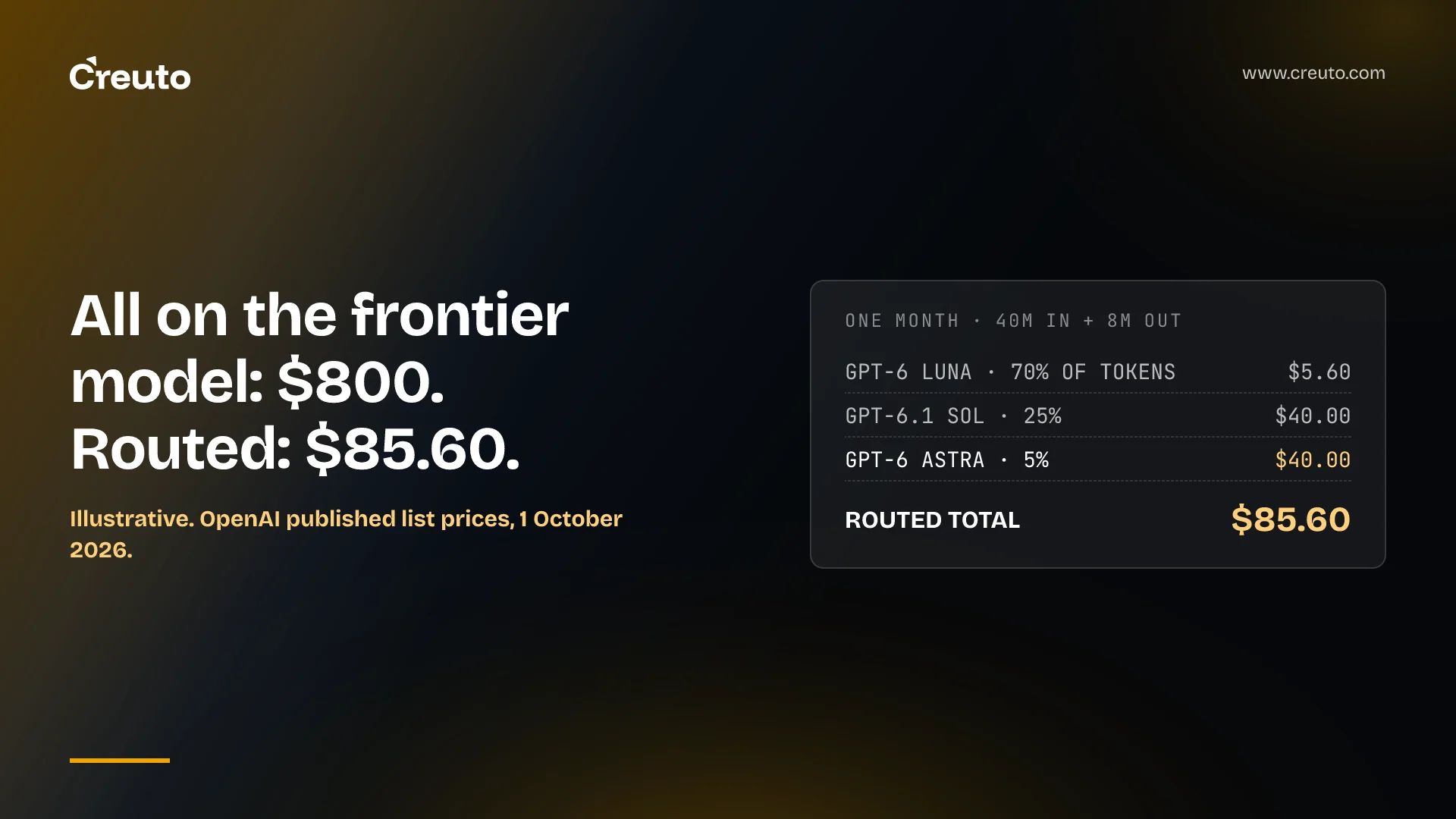
Now split the same traffic the way a low cost tier plausibly would — 70% of tokens to the cheapest capable model, 25% to the mid tier, 5% to the frontier model:
- gpt-6-luna, 28M in and 5.6M out: 28 × $0.10 + 5.6 × $0.50 = $2.80 + $2.80 = $5.60
- gpt-6.1-sol, 10M in and 2M out: 10 × $2.00 + 2 × $10.00 = $20.00 + $20.00 = $40.00
- gpt-6-astra, 2M in and 0.4M out: 2 × $10.00 + 0.4 × $50.00 = $20.00 + $20.00 = $40.00
Routed total: $85.60 against $800 for everything on the frontier model, and $160 for everything on the mid tier. The split is illustrative — the 70/25/5 mix is our assumption, not a measured routing outcome — but the per-token prices are published and the multiplication is yours to check.
The honest reading of that arithmetic: most of the saving comes from not sending cheap work to an expensive model, and routing is one of several ways to achieve that. A hand-written rule that sends classification and extraction to gpt-6-luna gets most of the same money, with none of the unpredictability. We reached the same conclusion measuring real traffic in open-weight models running 56% of tokens on 14% of spend. Routing earns its keep when the traffic mix is genuinely unpredictable — a general assistant, a support inbox, an agent that gets asked anything.
When an AI model router is the wrong choice
The strongest argument for the Auto Router is that it tracks new releases without you doing anything: a seven-day spend window reprices your stack every week for free. That is genuinely valuable and it is also the reason for every objection below.
Latency-sensitive paths. Classification happens before inference and its cost is undocumented. On an autocomplete, an inline suggestion or anything with a sub-second budget, an unmeasured pre-step is a defect waiting to be found in production. Pin the model there.
Reproducibility. Share of spend moves. The same prompt that routed to one model this week can route elsewhere next week, which means a golden-output regression suite built against openrouter/auto tests the market, not your code. Pin the model in evaluation and test environments, always. Session stickiness helps inside one conversation and does nothing across deployments.
Compliance and data residency. The router honours account-level provider restrictions, guardrails and ZDR policies — but only the ones you have configured. If your data processing agreement covers three providers and your account allows thirty, automatic routing will eventually send a request somewhere you have not papered. Set allowed_models before you set anything else.
Anything with a fixed prompt and a known shape. If you already know that extraction runs on the cheap model, routing adds a classifier to a decision you have made. Prompt caching is the better lever on that traffic — see the cheapest LLM cost cut most apps miss.
How to measure it on your own traffic
Run the Auto Router in shadow mode first. Log the model field from every routed response for a week alongside your current model's cost and quality outcome, so you learn which models the router actually picks for your prompts before it decides anything a customer sees. Then compare on cost per successful task, not cost per token — the method we use for every model-choice decision in an AI engineering engagement, and the one we set out in choosing which model your product should run.
If the shadow week shows the router picking the model you would have picked, you have learned that your rules are fine and routing buys you maintenance rather than money. That is still a result worth a week.
Frequently asked questions
A lightweight classifier assigns each prompt to one of roughly thirty task types, candidate models are ranked by the OpenRouter community's share of spend on that task type over a trailing seven-day window, and your cost_tier setting filters the result to a price band before restrictions apply.
OpenRouter charges no additional fee for the Auto Router. You pay the standard rate for whichever model it selects, and the classification step is not billed separately. The documentation does not publish the latency the classifier adds, so measure that before using it on a fast path.
It can, but the saving comes from keeping cheap work off expensive models rather than from routing itself. A workload of 40M input and 8M output tokens costs $800 a month entirely on gpt-6-astra at published prices, against $85.60 on a 70/25/5 split across cheaper tiers.
It is safe for unpredictable general traffic and unsafe on three paths: latency-sensitive calls, because classifier overhead is undocumented; regression tests, because share of spend shifts weekly; and compliance-bound workloads, unless you have set allowed_models and provider restrictions first.
cost_tier sets the price band the router may choose from, with the options low, medium, high, xhigh and max. The default behaves as if you had asked for roughly the low band, which selects a cost-efficient candidate set rather than the most capable available model.
The model field in the API response names the model that answered. Log it for every request during a shadow week alongside your current model's cost and outcome, so you learn the router's actual choices for your prompts before it decides anything a customer sees.