GPT-6 Astra vs GPT-5.6: which model your product should run
GPT-6 Astra vs GPT-5.6 compared on price, context and migration traps: Astra costs 2.5x Sol per token. When it pays, and when Sol or Luna wins.
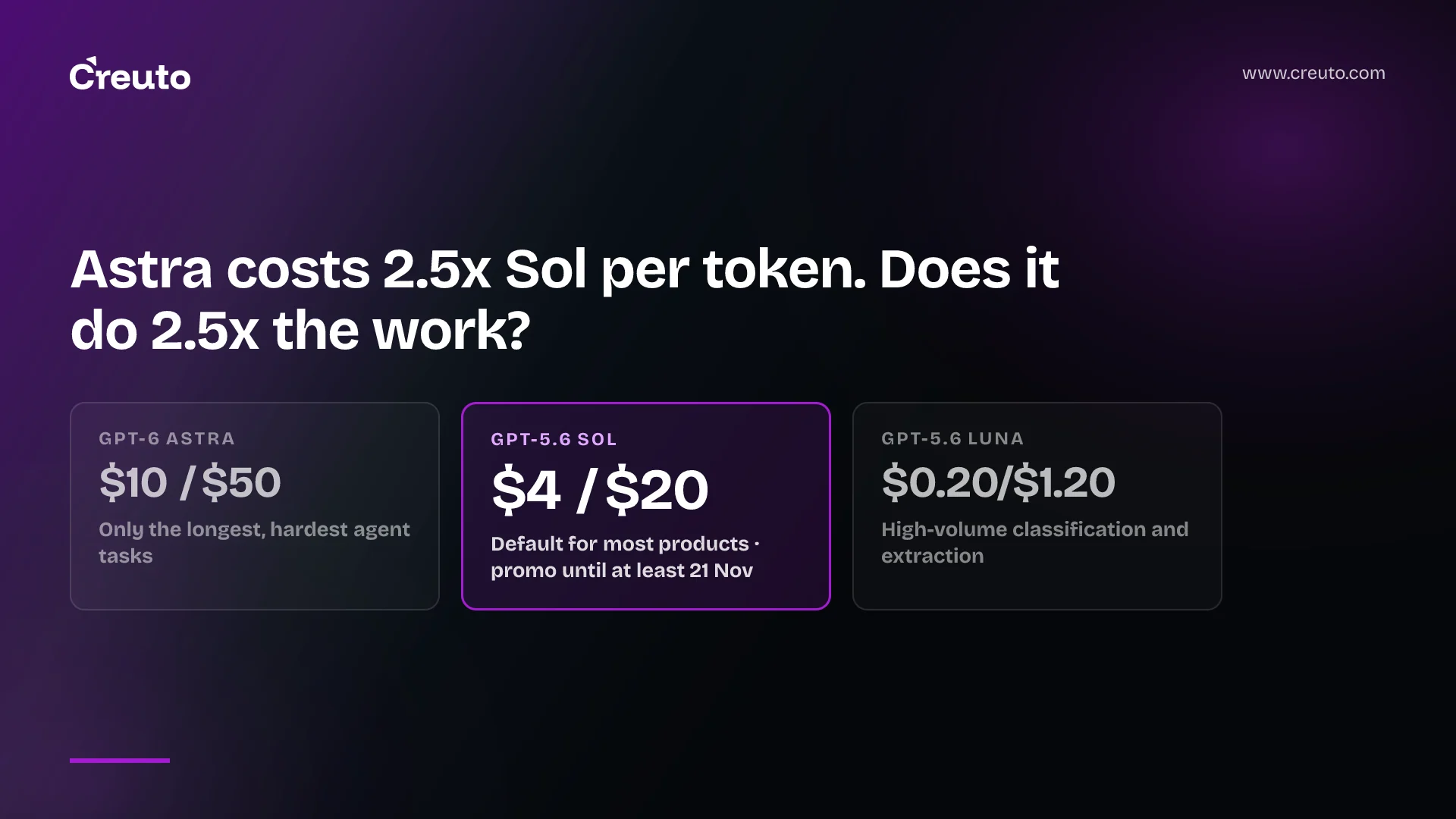
For most products, the answer to GPT-6 Astra vs GPT-5.6 is to stay on GPT-5.6 Sol and send only your hardest long-running tasks to Astra. Astra costs $10 per million input tokens and $50 per million output, exactly 2.5 times Sol's promotional $4 and $20, and it breaks code that sets temperature, uses the none reasoning effort or calls tools through Chat Completions.
By the end of this post you will know what each of the four current OpenAI flagship models costs at every tier, where Astra earns its price, which of your API calls will fail on migration, and why the date 21 November 2026 belongs in your planning. All prices are OpenAI's published list prices as of 21 September 2026.
| Key fact | GPT-6 Astra | GPT-5.6 Sol |
|---|---|---|
| Released | 3 September 2026 | 9 July 2026 |
| Input / output per 1M tokens | $10 / $50 | $4 / $20 (promotional) |
| Context window | 1,050,000 tokens | 1,050,000 tokens |
| Knowledge cutoff | 30 April 2026 | 16 February 2026 |
| Lowest reasoning effort | low | none |
| Custom temperature and top_p | Not supported | Supported |
GPT-6 Astra pricing against Sol, Terra and Luna
GPT-6 Astra pricing sits at the top of a four-model ladder. OpenAI's pricing page lists these standard rates per million tokens for prompts up to 272K input tokens, with the long-context rate applying to the whole request once a prompt goes past that.
| Model | Input | Cached input | Cache writes | Output | Long-context input / output | Batch or Flex input / output |
|---|---|---|---|---|---|---|
| gpt-6-astra | $10.00 | $1.00 | $12.50 | $50.00 | $20.00 / $75.00 | $5.00 / $25.00 |
| gpt-5.6-sol | $4.00 | $0.40 | $5.00 | $20.00 | $8.00 / $30.00 | $2.00 / $10.00 |
| gpt-5.6-terra | $2.00 | $0.20 | $2.50 | $12.00 | $4.00 / $18.00 | $1.00 / $6.00 |
| gpt-5.6-luna | $0.20 | $0.02 | $0.25 | $1.20 | $0.40 / $1.80 | $0.10 / $0.60 |
Three rules sit under that table. The Astra model page says prompts over 272K input tokens are billed at 2x input and cache rates and 1.5x output for the full request, Batch and Flex run at 50% of Standard, and Fast mode costs 2x. The pricing page adds a 10% uplift for regional data residency endpoints on models released on or after 5 March 2026, which covers all four.
Sol's price is the one to watch. On 21 August OpenAI cut GPT-5.6 Sol to $4 input and $20 output, 20% lower on input and 33% lower on output, and states the promotional pricing is available at least through 21 November 2026. The changelog does not say what happens after that date. Working backwards from those percentages, the pre-cut rate was $5 and $30, the same as GPT-5.5 on the Sol model page comparison table.
Astra has to finish in 40% of Sol's tokens to cost less per task
GPT-6 Astra is exactly 2.5 times the price of Sol on short-context input, cached input, cache writes and output. That makes the break-even easy to state: Astra is cheaper per task only when it completes the same task using less than 40% of the tokens Sol needs.
OpenAI makes that claim for it. The Using GPT-6 Astra guide says that in several evaluations Astra achieves stronger results while using substantially fewer output tokens, delivering a lower estimated API cost per task than earlier models despite higher per-token pricing. We could not read the evaluations it links to, so treat this as OpenAI's claim to test on your own workload, not a number to budget against.
Here is the arithmetic on published prices. Assume a task sends 50,000 input tokens and produces 5,000 output tokens, with no caching:
| Model | Input cost | Output cost | Per task | Per 10,000 tasks |
|---|---|---|---|---|
| GPT-6 Astra | 0.05M x $10 = $0.50 | 0.005M x $50 = $0.25 | $0.75 | $7,500 |
| GPT-5.6 Sol | 0.05M x $4 = $0.20 | 0.005M x $20 = $0.10 | $0.30 | $3,000 |
| GPT-5.6 Terra | 0.05M x $2 = $0.10 | 0.005M x $12 = $0.06 | $0.16 | $1,600 |
| GPT-5.6 Luna | 0.05M x $0.20 = $0.01 | 0.005M x $1.20 = $0.006 | $0.016 | $160 |
Reasoning tokens are billed as output, and the number of them depends on the effort you set, so the output column is where real bills drift from estimates. The only honest way to compare is to run the same task set on both models and read the usage fields. In the builds we run, we run each task several times before trusting a pass rate, because one good run on a new model proves little.
Long prompts widen the gap. Assume a 400,000-token input with 10,000 output tokens: Astra bills 0.4M x $20 + 0.01M x $75 = $8.75, and Sol bills 0.4M x $8 + 0.01M x $30 = $3.50. Prompt caching softens the input side; the prompt caching guide says cache writes cost 1.25x the uncached rate and reads 0.1x, so one write and nine full reads cost 2.15x the ordinary input cost rather than 10x.
The context window is not a reason to switch
The GPT-6 Astra context window is 1,050,000 tokens, with a maximum input of 922,000 and up to 128,000 output tokens. Read on its own, that looks like an Astra advantage. It is not one. The Sol, Terra and Luna model pages list the same 1,050,000-token window, 922,000 maximum input and 128,000 maximum output.
The same goes for tools. All four models list computer use, hosted shell, apply_patch, MCP, file search, web search and code interpreter as supported tools in the Responses API. If your reason for moving is "we need a bigger window" or "we need computer use", GPT-5.6 already gives you both at a lower price.
What Astra does have is a later knowledge cutoff, 30 April 2026 against 16 February 2026 for the GPT-5.6 family. For a product that answers questions about recent libraries or regulations without retrieval, that gap matters. For one that grounds answers in your own documents, it mostly does not.
Is GPT-6 Astra worth the price? Where it earns it
GPT-6 Astra is worth the price for long, multistep work where a failed or abandoned run costs you more than the tokens. OpenAI's model page positions it for the hardest end-to-end work across reasoning, coding, computer use, research and document creation, and the guide says it is better than Sol at staying coherent during long tasks.
The 3 September changelog also shipped three controls for long-running work with Astra in the Responses API: async tool calling, so the model keeps working while your application runs a tool; mid-turn steering over WebSockets, so you can correct it while a response is in progress; and changing reasoning effort mid-conversation without breaking the cached prompt prefix. If you run agents that work for minutes rather than seconds, those controls change how you design the harness, and they are the strongest practical argument for Astra.
The strongest case against our position comes from OpenAI itself. Its models overview says that if you are not sure where to start, use GPT-6 Astra. That is sound advice for a prototype, where quality matters more than the bill. It is weaker advice for a product at volume, where 2.5x on every token compounds, and where Astra's documented tendency to ask clarifying questions rather than assume can stall an automated pipeline that has no human to answer.
Astra is the wrong choice if your workload is short, repetitive and well specified: classification, extraction, routing, summarising a support ticket. Those tasks do not use the extra capability, and they are where Luna's $0.20 input price does its work.
Migration traps when you move from GPT-5.6 to Astra
Changing the model string to gpt-6-astra is not enough. The changelog and the migration quickstart list what breaks:
- No
nonereasoning effort. Astra supportslow,medium,high,xhighandmax. OpenAI's guidance for anyone onnoneorminimalis to start atlowand compare results, which also means more reasoning tokens than you were paying for. - GPT-6 Astra temperature is not supported. Remove
temperature,top_pandtop_logprobs, pluslogprobson Chat Completions. Any feature built on log probabilities, such as confidence scores, needs a different design. - Tools need the Responses API. Astra accepts Chat Completions requests, but tool calling requires Responses.
- Prompt caching parameters changed. Coming from GPT-5.5 or earlier, replace
prompt_cache_retentionwithprompt_cache_options.ttlset to30m, and budget for cache-write charges. - Fast mode and EU data residency do not mix. Astra does not support Fast mode with EU data residency, so those requests stay on Standard.
- Misalignment monitoring. In supported Responses API requests, checks run asynchronously during agent work and can trigger safety alerts or stop a conversation for review. Your product needs a path for a conversation that halts.
Does GPT-6 Astra support Chat Completions?
Yes, for plain generation. The endpoint table lists Chat Completions, Responses and Batch as supported, and Realtime, Live, Assistants and fine-tuning as not supported. The catch is tools: if your Chat Completions code passes function definitions, you have a Responses migration to do before you can switch.
Astra's safety profile is its own subject; we covered its Critical cybersecurity rating separately.
GPT-5.6 Sol vs Terra vs Luna: which tier for which job
The difference between GPT-5.6 Sol and Terra is roughly the difference between a flagship and a mini model: OpenAI says Sol corresponds to the unsuffixed tier of earlier GPT-5 families, Terra to the mini tier and Luna to the nano tier. All three share the same context window, tools and reasoning-effort range, including none.
- Sol ($4 / $20) is the default for complex professional work, and the
gpt-5.6alias routes to it. - Terra ($2 / $12) balances intelligence and cost. It is half Sol's input price but 60% of its output price, so output-heavy workloads save less than the headline suggests.
- Luna ($0.20 / $1.20) is for cost-sensitive, high-volume work, and the cheapest GPT model in the current family. Its Tier 5 rate limit is 180,000,000 tokens per minute against 40,000,000 for Sol and Astra.
Two changes this summer moved the ladder. From 30 July Luna costs 80% less and Terra 20% less, and from 21 August Sol dropped to its promotional rate. If you benchmarked tiers before August, your cost comparison is out of date.
How we would route a product across the four models
A single model for every call is rarely the cheapest correct design. The pattern we use in AI engineering work is a router: Luna for classification and extraction, Sol for the main reasoning path, and Astra only for tasks that are long, tool-heavy and expensive to get wrong. Anything that can wait goes through Batch or Flex at half price.
That routing layer is also what lets you move when prices do. We wrote about the wider version of this in our piece on LLM cost optimization. If you are running long agent sessions, OpenAI's new Agents API is worth weighing against your own harness before you pick a model, because the harness decides how much context each step re-sends.
Creuto is an OpenAI Select Partner, and we build on OpenAI, Anthropic and Gemini models. The routing advice above holds whichever vendor sits behind each tier.
GPT-6 Astra vs GPT-5.6: the decision to make before 21 November
Run your real task set on Sol and Astra now, at the effort levels you would ship, and record tokens per completed task. If Astra finishes in under 40% of Sol's tokens, switch the tasks where that holds. If it does not, keep Sol as the default and put a note in the calendar for 21 November 2026, the earliest date Sol's promotional price could end, because that is when your comparison needs rerunning.
Frequently asked questions
GPT-5.6 Luna is the cheapest model in OpenAI's current GPT-5.6 family, at $0.20 per million input tokens and $1.20 per million output tokens on Standard. Batch and Flex processing halve that to $0.10 and $0.60. Older models such as gpt-5-nano list lower prices but belong to a previous generation.
GPT-6 Astra costs $10 per million input tokens, $1 for cached input, $12.50 for cache writes and $50 per million output tokens on Standard. Prompts over 272K input tokens are billed at $20 input and $75 output for the whole request, and Batch or Flex processing costs half the Standard rate.
GPT-6 Astra does not have a bigger context window than GPT-5.6. Astra, Sol, Terra and Luna all list a 1,050,000-token context window, 922,000 maximum input tokens and 128,000 maximum output tokens. Astra's clearer data advantage is its later knowledge cutoff of 30 April 2026.
GPT-6 Astra does not support custom temperature or top_p values, or log probabilities, so requests that set them need those parameters removed. OpenAI's migration guide says to remove temperature, top_p and top_logprobs, plus logprobs in Chat Completions, before switching the model string to gpt-6-astra.
GPT-5.6 Sol is the flagship tier for complex professional work at $4 input and $20 output per million tokens, while GPT-5.6 Terra balances intelligence and cost at $2 and $12. OpenAI says Sol maps to the unsuffixed tier of earlier GPT-5 families and Terra to the mini tier.
OpenAI says GPT-5.6 Sol's promotional pricing of $4 input and $20 output per million tokens is available at least through 21 November 2026. It has not published what happens after that date, so teams should rerun cost comparisons against Astra and Terra when the promotion is reviewed.