OpenAI on AWS Bedrock: GPT-6 Astra via your AWS account
Running OpenAI on AWS Bedrock: GPT-6 Astra Regions, Runtime vs Mantle, IAM auth, same price as direct, and the API features Bedrock does not support.
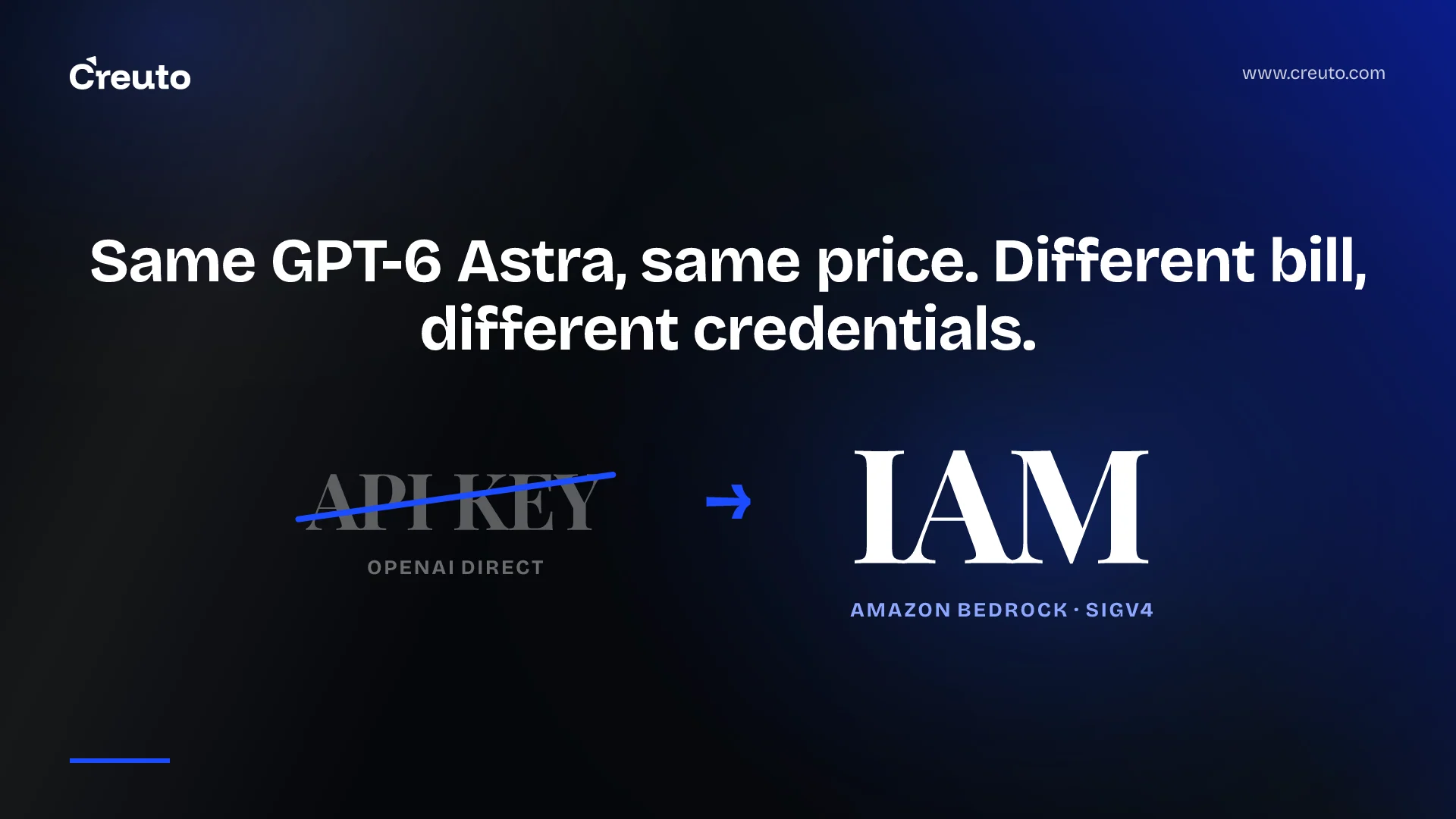
You can now run OpenAI on AWS Bedrock, including GPT-6 Astra, and OpenAI states that Bedrock pricing in commercial regions matches OpenAI direct pricing. The price is not the decision. What changes is who bills you, how you authenticate, and which Responses API features you give up: Bedrock lacks WebSockets, mid-turn steering, hosted file search and remote MCP.
By the end of this post you will know which OpenAI models Bedrock serves, which endpoint and Region GPT-6 Astra needs, how authentication moves from an OpenAI key to AWS credentials, and the feature gaps that should decide whether you call OpenAI through Bedrock or directly. Facts are from OpenAI's Bedrock guide and AWS's launch post, as of 21 September 2026.
| Key fact | Detail |
|---|---|
| Models on Bedrock | GPT-5.4, GPT-5.5, GPT-5.6 Sol, Terra and Luna, GPT-6 Astra |
| GPT-6 Astra launch on Bedrock | Generally available, announced by AWS on 8 September 2026 |
| Endpoints | bedrock-runtime and bedrock-mantle |
| Astra on Mantle | us-west-2 (Oregon) |
| Model ID format | openai. prefix, such as openai.gpt-5.6-sol |
| Price | Matches OpenAI direct in commercial regions; billed through AWS |
What OpenAI on AWS Bedrock actually gives you
Amazon Bedrock runs supported OpenAI models on AWS-managed infrastructure, and AWS manages model access, regional availability, routing, billing and operational controls for the deployment. Your application still speaks the OpenAI API: both Bedrock endpoints support the OpenAI-compatible Responses and Chat Completions APIs for supported models, and the official OpenAI SDKs ship a Bedrock provider.
AWS announced GPT-6 Astra as generally available on Bedrock on 8 September 2026, callable through the Bedrock APIs or used by ChatGPT Work and Codex configured to run on Bedrock. OpenAI's guide lists context windows on Bedrock of 1,000,000 tokens for GPT-5.4 and GPT-5.5, and 1,050,000 tokens for GPT-5.6 Sol, Terra, Luna and GPT-6 Astra.
One discrepancy is worth knowing before you size a workload. AWS's post says Astra can review contracts within a context window of up to 1 million input tokens. OpenAI's model page gives a 1,050,000-token context window but a maximum of 922,000 input tokens and 128,000 maximum output tokens. Plan document jobs against the 922,000 input limit, not the headline million.
GPT-6 Astra on Bedrock: Runtime or Mantle
OpenAI models sit behind two endpoints, bedrock-runtime and bedrock-mantle, and their feature coverage differs. OpenAI's guide says GPT-6 Astra is available through Bedrock Runtime and through Mantle in us-west-2 (Oregon), and tells you to select Astra's supported Region before changing the model ID. Check AWS's model availability table for your account before you commit a Region.
| Capability | Bedrock Runtime | Mantle |
|---|---|---|
| GPT-6 Astra | Available | Available in us-west-2 (Oregon) |
| Computer use | Supported models | Supported models |
| Background mode | Not available | Available, subject to data retention settings |
| Hosted web search | Not available | Supported models |
Continuing with previous_response_id | Send model on every request | Model can be inherited |
The last row is a small trap. Code written against OpenAI direct often omits model when it continues a conversation; on Runtime that request needs the model every time. OpenAI also warns not to reuse a Mantle model ID on Runtime without checking the Runtime requirements.
Bedrock vs the OpenAI API: the features you lose
Most of the Responses API carries over. Text, image and file input, structured outputs, function calling, streaming, reasoning effort, prompt caching, custom tools, client-side tool_search and computer use are all available on Bedrock. The gaps are concentrated in the newest agent features:
| Capability | OpenAI API | Amazon Bedrock |
|---|---|---|
| Asynchronous tool calling | Supported models | Not available |
| WebSocket connections and mid-turn steering | Available | Not available |
| Reasoning updates mid-conversation | Supported models | Not available |
| Pro mode | Supported models | Not available |
| Programmatic Tool Calling and multi-agent | Supported models | Not available |
| Hosted file search, shell, image generation, remote MCP | Available | Not available |
| Hosted web search | Available | Mantle only |
Several of those gaps are exactly what OpenAI lists as new in GPT-6 Astra: async tool calling, mid-turn steering and changing reasoning effort mid-conversation. On Bedrock you get the Astra model, but not every Astra-era API feature. If your agent leans on remote MCP servers or hosted file search, Bedrock means rebuilding those as your own function tools.
From API keys to IAM: authentication and data controls
Bedrock does not use your OpenAI API key. OpenAI's examples authenticate with a Bedrock API key in AWS_BEARER_TOKEN_BEDROCK, and for long-running applications recommend the standard AWS credential chain instead: the JavaScript, Python, Go, Java and Ruby providers resolve fresh AWS credentials and sign each request with SigV4. That chain includes shared profiles, workload roles and instance or container credentials, so a service on ECS or EC2 can call GPT-6 Astra with no long-lived secret. The .NET SDK has no equivalent Bedrock provider yet.
For teams that have fought static key sprawl, this is the strongest argument for Bedrock. AWS's post says access is governed by your IAM policies, with every invocation logged in AWS CloudTrail, and traffic can run through VPC endpoints using AWS PrivateLink. We covered the direct-API alternatives, key expiry and mTLS, in our post on OpenAI API key security, and the wider pattern in AI gateway model routing without giving agents keys.
Data handling is AWS's, not OpenAI's. OpenAI's guide says AWS does not share request or response content with OpenAI when the effective retention mode is default or none. Two details are easy to miss. Setting store: false does not guarantee zero data retention. And an AWS Region is not an OpenAI data residency jurisdiction, so check the destination Regions of your inference profile, not only the Region in the endpoint URL. AWS adds that classifier-flagged traffic is retained for up to 30 days for abuse detection, and that zero data retention is requested through your AWS account team.
Is OpenAI cheaper on Bedrock?
No. OpenAI's pricing page says Bedrock pricing in commercial regions matches OpenAI direct pricing for equivalent services, so GPT-6 Astra lists at the same $10 per million input tokens and $50 per million output either way. The Bedrock guide adds one exception: a region-specific service on Bedrock is priced at the same rate as Regional processing in the OpenAI API, which OpenAI charges at a 10% uplift for eligible models released on or after 5 March 2026. If that applies to your Astra deployment, $10 input becomes $11. Confirm the actual rate on the Amazon Bedrock pricing page and the model card.
The money argument is about procurement, not price. Usage lands on the AWS bill under Amazon's commercial terms, which can matter if your finance team would rather not onboard another vendor. Whether it draws down an existing AWS commitment depends on your agreement; ask your AWS account team before you assume it does.
Should you use Bedrock or the OpenAI API?
Use OpenAI on AWS Bedrock when your workloads already run on AWS, your security team wants IAM roles and CloudTrail instead of a new secret, and your agent needs only core Responses API features: function calling, structured outputs, streaming, caching and computer use. That describes most document-processing and internal-tool builds we see.
Call OpenAI directly when you need the newer agent features, such as async tool calling, WebSocket steering, remote MCP or hosted file search, or when you want to adopt new API features without first checking whether Bedrock supports them. It is also the simpler path if Astra's Region does not suit your latency or residency requirements.
The honest counter-argument is that the direct API is the reference implementation, and every provider layer adds a second set of docs, quotas and support channels. Bedrock quotas and Region availability are maintained by AWS, not OpenAI. If you choose Bedrock, keep the SDK's provider abstraction thin so switching back is a configuration change. Our AWS, GCP and Azure consulting team usually starts by mapping which of your planned features sit in the "not available" column above, because that list, not the price, settles the question. For the model choice itself, see GPT-6 Astra vs GPT-5.6.
Frequently asked questions
OpenAI models run on AWS through Amazon Bedrock, including GPT-5.4, GPT-5.5, GPT-5.6 Sol, Terra and Luna, and GPT-6 Astra. You call them with the OpenAI SDK's Bedrock provider using model IDs prefixed with openai., authenticate with AWS credentials or a Bedrock API key, and pay through your AWS bill.
OpenAI on Bedrock is not cheaper: OpenAI states that Bedrock pricing in commercial regions matches direct pricing for equivalent services. A region-specific service on Bedrock is priced like OpenAI's Regional processing, which carries a 10% uplift for eligible models released on or after 5 March 2026. Billing runs through AWS.
GPT-6 Astra is available on the Bedrock Mantle endpoint in us-west-2, the Oregon Region, according to OpenAI's Bedrock guide, and it is also available through Bedrock Runtime. OpenAI tells you to select Astra's supported Region before changing the model ID, so check AWS's model availability table for your account.
Bedrock suits AWS-first teams that want IAM, CloudTrail and one AWS bill and only need core Responses API features. The OpenAI API is the better choice if you need asynchronous tool calling, WebSocket steering, remote MCP servers, hosted file search or pro mode, none of which Bedrock currently offers.
Bedrock Mantle is one of two Amazon Bedrock endpoints serving OpenAI models, alongside Bedrock Runtime. Mantle adds background mode and hosted web search on supported models and lets a continued response inherit its model. Its base URL takes the form bedrock-mantle, then the Region, then api.aws/openai/v1.
OpenAI's Bedrock guide says AWS does not share request or response content with OpenAI when the effective retention mode is default or none. Setting store to false alone does not guarantee zero data retention, and AWS retains classifier-flagged traffic for up to 30 days for abuse detection.