Android developer verification: 30 Sep blocks stores, not APKs
Android developer verification from 30 Sep 2026 blocks installs from seven stores in four countries. Sideloaded APKs wait for 2027; enterprise rules inside.
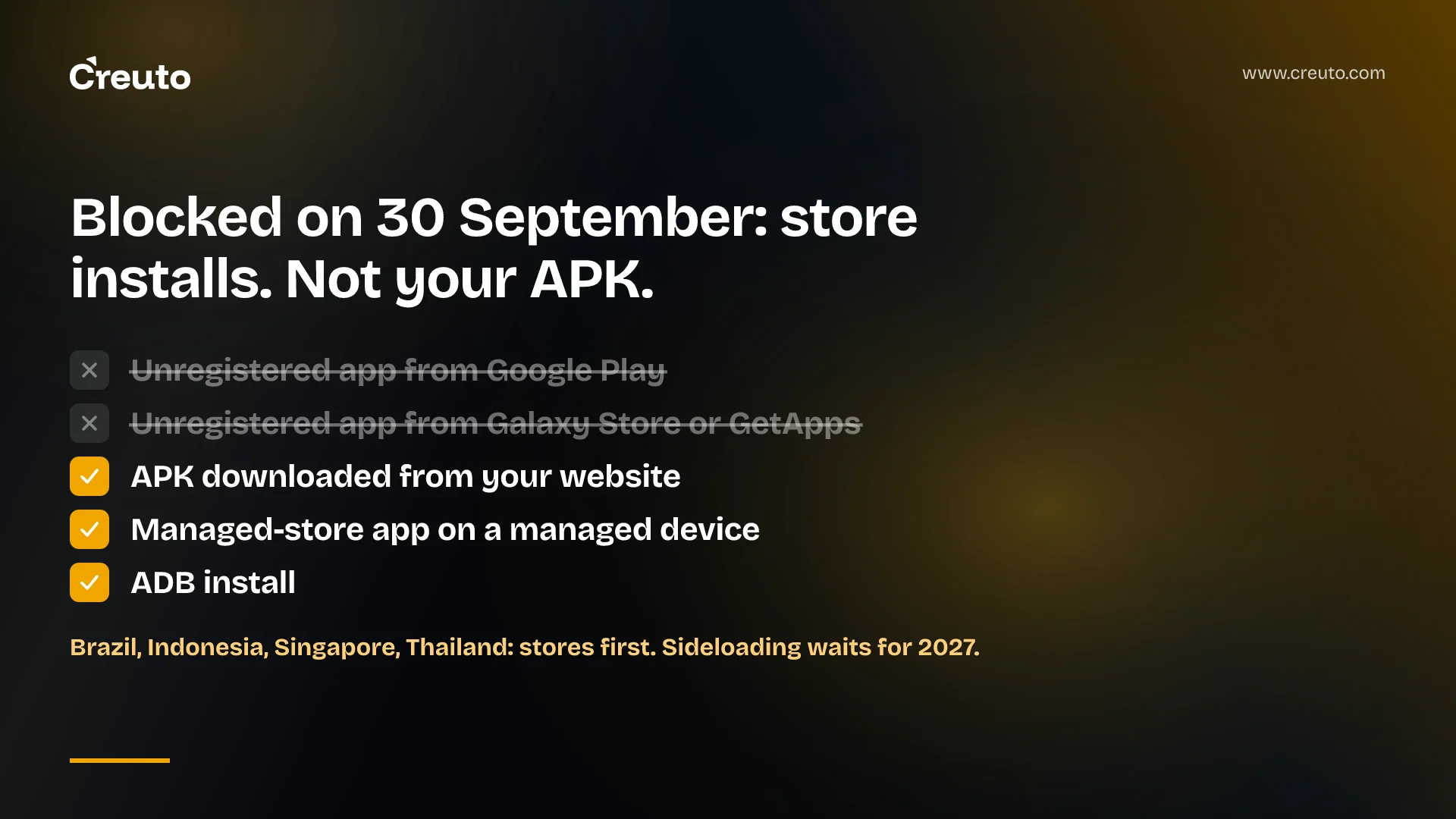
If you distribute an APK from your own website to users in Brazil, Indonesia, Singapore or Thailand, Android developer verification does not block it on 30 September 2026. Google's FAQ says the deadline only applies to the participating stores, and that sideloaded apps are not affected yet. What does change on 30 September is installs from seven app stores in those four countries, and, for apps on Google Play, registration everywhere. Here is what is blocked, what is not, and what enterprise apps need.
The key facts, as of 22 September 2026:
- Where: Brazil, Indonesia, Singapore and Thailand, on certified Android devices.
- Which installs: apps downloaded from Google Play, HONOR App Market, OPPO App Market, Galaxy Store, Palm Store, V-Appstore and GetApps, according to Google's guide.
- What happens: apps from developers who have not verified and registered are unavailable for new installation, and the Android Help Center says they must be registered to be installed and receive updates.
- Next: a global rollout across all install sources in 2027.
What Android developer verification enforces on 30 September
Android developer verification links every app on a certified device to a developer whose identity Google has checked. Google compares it to an ID check at the airport that confirms who the traveller is without screening the bags: it verifies the developer, not the app's content. The check runs on the device, through a system service called Android Developer Verifier that Google began pushing to phones in June, as The Hacker News reported.
On 30 September that check starts blocking installs, but only for apps coming from the seven participating stores. The FAQ is direct about everything else: if you use a store that is not on the list, the requirements won't be enforced for your apps during this initial phase. For distribution outside Google Play, enforcement also covers only phones and tablets.
Google Play developers face a different 30 September deadline, and it is global. Google's July update says Play developers should register any remaining apps by 30 September to avoid global removal from Google Play. Google also says 99% of apps on Play were registered automatically, so for most teams this is a check of the Play Console, not a project.
Will my sideloaded app still install?
Your sideloaded app will still install after 30 September, in the four launch countries and everywhere else. Google's FAQ, updated on 15 July 2026, says that if users sideload your app directly, these new verification requirements won't apply to your app yet, and that your users' install experience won't change in September.
That changes in 2027. The Android Help Center describes the global rollout as across all install sources. From then, an unregistered app installs only through Android Debug Bridge (ADB) or the advanced flow, a one-time setup for power users. The FAQ describes the flow: turn on developer mode, confirm nobody is coaching you, restart and reauthenticate, wait out a one-day protective period, then confirm with biometrics or PIN. Once enabled, it can stay on for seven days or indefinitely.
For a field-force app on a hundred phones, that flow is not a distribution strategy. Worse, the FAQ says that if the advanced flow is disabled, updates to unregistered apps will fail. An app you cannot update is a support problem long before it is a security one.
Does developer verification apply to enterprise apps?
Google exempts enterprise apps explicitly, with conditions. The Android Developer Console help says apps distributed through your organisation's store, on managed devices, won't need to complete verification because your IT admin has vetted them. Google still recommends registering them if they may be distributed outside a managed store or to non-managed devices.
What the documentation does not do is define its terms. As of 22 September 2026 we could not find a Google page that says what counts as "your organisation's store", whether an APK pushed directly by a mobile device management (MDM) tool outside a managed store qualifies, or how a personal phone with a work profile is treated. If your deployment sits in any of those grey areas, treat it as unexempted and register.
One more exemption is narrower than it looks. The Help Center says AOSP and non-certified devices are exempt. Check whether each device model in your fleet is certified before relying on it.
Google's own pages disagree on the Android version
The developer site says the requirements apply to certified devices running Android 7 or higher. The user-facing Help Center says the initiative applies to certified devices running Android 8 and up, and The Hacker News reported the Verifier service going to Android 8 and newer. The gap matters only if part of your fleet still runs Android 7. Plan for the stricter reading, Android 7, until Google reconciles the two.
Registering: Play Console or Android Developer Console
Which console you use depends on where you distribute. If you have a Play Console account, the FAQ says you can use it as the single place to manage verification, including apps you distribute outside Play, and apps using Play App Signing are registered automatically. If you distribute only outside Play, you need an Android Developer Console account, which costs a one-time $25 fee.
Three steps take longer than the form suggests:
- D-U-N-S number. Organisations need one, and Dun & Bradstreet can take up to 28 days to issue it. Organisations also verify their website through Google Search Console.
- Signing keys. You register a package by providing an APK signed with your private key, and if you lose your signing key you won't be able to register. A package can have several keys.
- Automation. Google says the Developer ID Status API and Developer Console API support bulk registration and CI/CD pipelines, useful if you ship many white-label builds.
Students and hobbyists have a separate lane. Limited distribution accounts let you share apps with up to 20 devices without a government-issued ID or registration fee. That is a lab or classroom tool, not a route for a business app, and Google does not support converting a full account back to limited.
A checklist for apps distributed outside Google Play
- List every Android app you ship, and for each one note the channel: Play, an OEM store, direct APK, or MDM.
- For anything in a participating store with users in the four countries, verify and register now; there are eight days left.
- For Play apps, open the Play Console and register any app that was not registered automatically, before 30 September.
- For direct APKs and MDM deployments, find who holds the signing key and who owns the developer identity, then register before 2027.
- Start the D-U-N-S application if you do not have one; it is the longest lead time on the list.
We covered the store list and the Play side in our earlier Android developer verification explainer; this post goes deeper on sideloading and enterprise distribution. When we build Android apps for clients, we recommend that the signing key and the developer account sit with the client, for exactly this reason. If a vendor still holds yours, 2027 is the deadline to fix that, and it is the same ownership question that decides how smoothly any mobile app survives the next platform change, like the target API level 36 deadline on 1 November.
Frequently asked questions
A sideloaded APK will keep installing after 30 September 2026. Google's FAQ says the deadline applies only to seven participating app stores in Brazil, Indonesia, Singapore and Thailand. Sideloaded apps are covered by the global rollout in 2027, after which unregistered apps need ADB or the advanced flow.
Android developer verification is enforced first on installs from Google Play, HONOR App Market, OPPO App Market, Galaxy Store, Palm Store, V-Appstore and GetApps. Enforcement starts on 30 September 2026 for users in Brazil, Indonesia, Singapore and Thailand, on certified Android devices.
Enterprise apps distributed through an organisation's store on managed devices do not need Android developer verification, according to Google. Google recommends registering them anyway if they may reach non-managed devices or other channels, and its documentation does not define every MDM deployment model.
Android developer verification through the Android Developer Console costs a one-time $25 fee for a full distribution account. Limited distribution accounts, which let students and hobbyists share apps with up to 20 devices, are free and need no government ID. Play developers verify through the Play Console.
An app whose signing key is lost cannot be registered for Android developer verification, because registration proves ownership with an APK signed by that key. Google says developers should use a secure key management solution; without the key, the package name cannot be claimed.