Zed Delta pull requests are gone: code review when agents write the diff
Zed Delta pull requests are gone: review happens in shared agent threads with the agent's context. What it changes, and how to review AI-written code today.
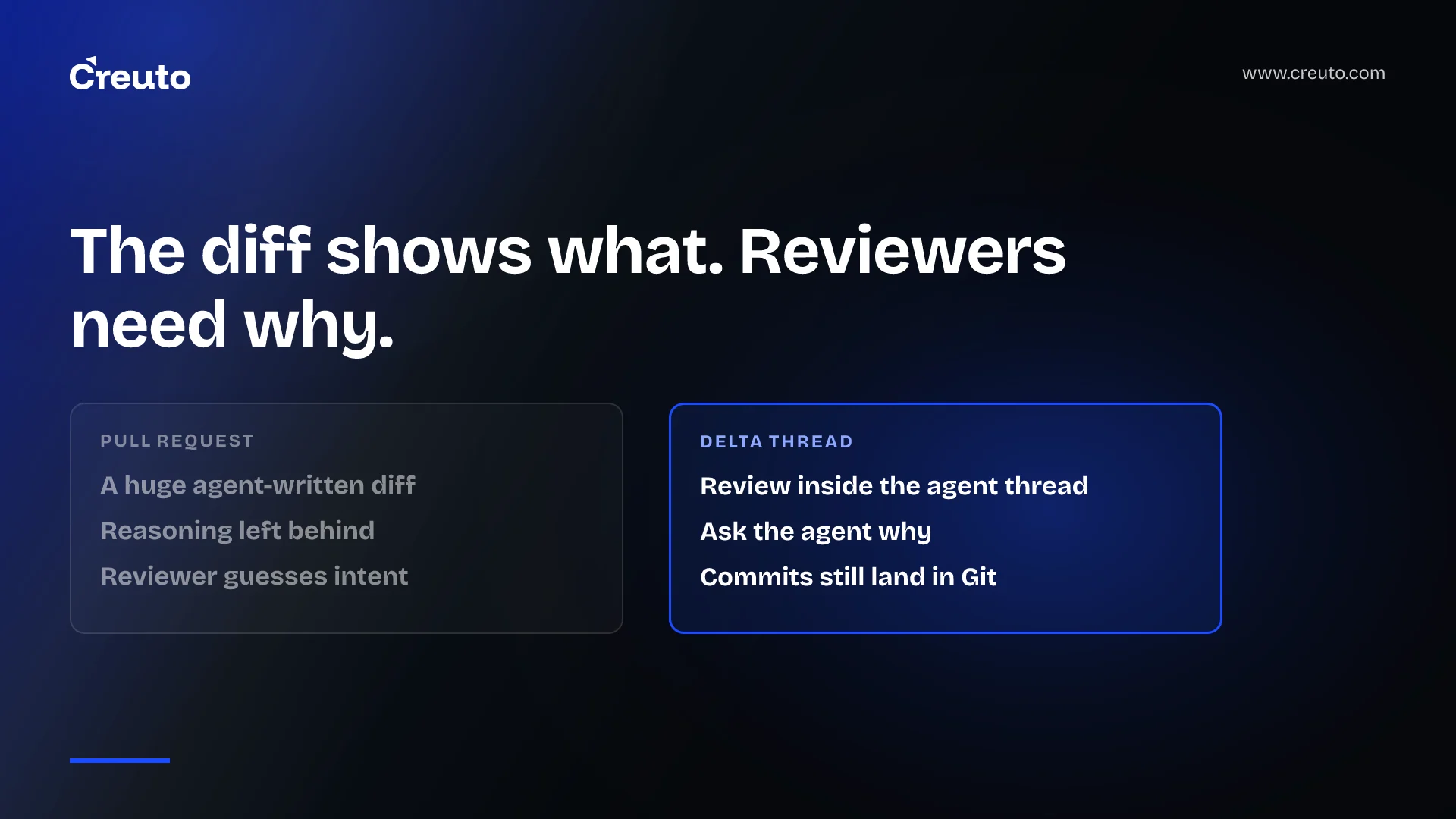
Zed Delta pull requests do not exist: the code editor company has replaced them with shared agent threads on one of its own repositories. Delta launched in public beta this week, and Zed's team now builds and reviews code inside those threads instead of pull requests. Whether or not you adopt the tool, the problem it targets is one every team using coding agents now has: pull requests show reviewers what changed, but not why — and when an agent wrote most of the diff, the "why" is the part that matters.
What Zed announced
In its launch post, Zed describes Delta as "a multiplayer environment for coding with agents and reviewing what they build", available for macOS, Linux, Windows and the web, free during the public beta. The key points:
- Collaboration without push. Teammates join your conversation with an agent directly and see the same worktrees you do.
- Reviews with the agent's context. A review runs in its own isolated copy of the thread's worktrees, with access to the original agent's context, so a reviewer can ask the agent why it chose one approach over another.
- DeltaDB. Delta is built on a store that extends Git's content-based versioning with incremental deltas, recording edits between commits alongside messages from humans and agents. Commits remain the checkpoints you push, pull and build from.
- Git compatibility. Teammates who never open Delta still see a normal Git repository; Zed's main repository stays on GitHub for community contributions.
Zed says 33 people have landed 570 changes to main since it turned off pull requests on Delta's repository. The announcement drew active debate on Hacker News.
Why pull requests struggle with AI-written code
Zed's argument is simple: agents generate far more code, so diffs have "mushroomed", and splitting them into smaller pieces does not supply the missing context. The decisions — why this data structure, why this error handling, why this library — were made in a conversation with the agent that the reviewer never sees. The reviewer may feed the diff to another agent to understand it, which then has to guess at reasoning the author already worked through.
That matches what we see. Review has become the bottleneck in AI-assisted teams, as we argued in coding agents move the bottleneck to review, and the failures that slip through are usually about intent — missed requirements, wrong assumptions — rather than syntax.
How to review code written by AI agents
You do not need Delta to apply the principle. Practical steps for any team:
- Attach the reasoning. Require the agent session summary — the prompt, key decisions and rejected alternatives — in the pull request description or as a linked artifact.
- Review the specification first. Check the acceptance criteria before the diff; if the spec is wrong, a correct diff is still wrong. See acceptance criteria review.
- Keep changes scoped. One intent per change, even when an agent could do five at once.
- Automate the mechanical checks. Tests, types, linting and security scans should pass before a human looks; some teams go further and auto-approve low-risk changes.
- Spend human attention on decisions. Architecture, data handling, security boundaries and product behaviour.
Zed Delta pull requests vs stacked diffs
Stacked diffs — splitting a large change into a chain of small, dependent pull requests — have been the usual answer to oversized reviews. They make changes easier to navigate but, as Zed points out, they do not carry the decisions behind the code. Delta's answer is to keep the conversation that produced the change attached to it, so the reviewer can interrogate the reasoning rather than reconstruct it.
The two ideas are not exclusive. Teams can keep small, focused changes and still attach the agent's reasoning to each one. What matters is that a reviewer never has to guess why a change looks the way it does.
Can you replace pull requests?
For most teams, not yet — and not all at once. Pull requests are woven into CI, compliance, audit trails and open-source contribution. Delta itself keeps Git underneath and Zed keeps its main repository on GitHub. A realistic path is to trial thread-based review on an internal project, keep PRs as the landing and audit step, and see whether review quality and speed improve.
Is Delta free?
Delta is free during the public beta. Zed says paid plans for individuals and teams are coming, and that there will always be a free version.
The bigger shift
Zed calls its approach "continuous engineering": idea, implementation, review and landing happening in one thread instead of in batches. Whether threads become the new unit of software development or not, the lesson is clear — when agents write the code, review needs the reasoning, not just the result. Our AI engineering services team helps engineering organisations set up agent-assisted workflows where review keeps up with generation.
Frequently asked questions
Zed Delta is a multiplayer environment from Zed for coding with AI agents and reviewing what they build. Teammates join agent threads, share worktrees and review changes with the original agent's context. It launched in public beta in September 2026 and is free during the beta.
Most teams cannot replace pull requests immediately because CI, compliance and open-source workflows depend on them. A practical path is to trial thread-based review internally while keeping pull requests as the landing and audit step.
Review AI-written code by attaching the agent's reasoning to the change, checking the specification before the diff, keeping each change to one intent, automating mechanical checks, and focusing human attention on architecture, security and product behaviour.
Zed Delta is free during its public beta. Zed says paid plans for individuals and teams will follow, and that a free version will always be available.