Why Most Software Development Projects Fail - And How to Build Products That Scale
Why software development projects fail: unclear scope, feature bloat, weak architecture, skipped testing. Eight practices for products that scale.
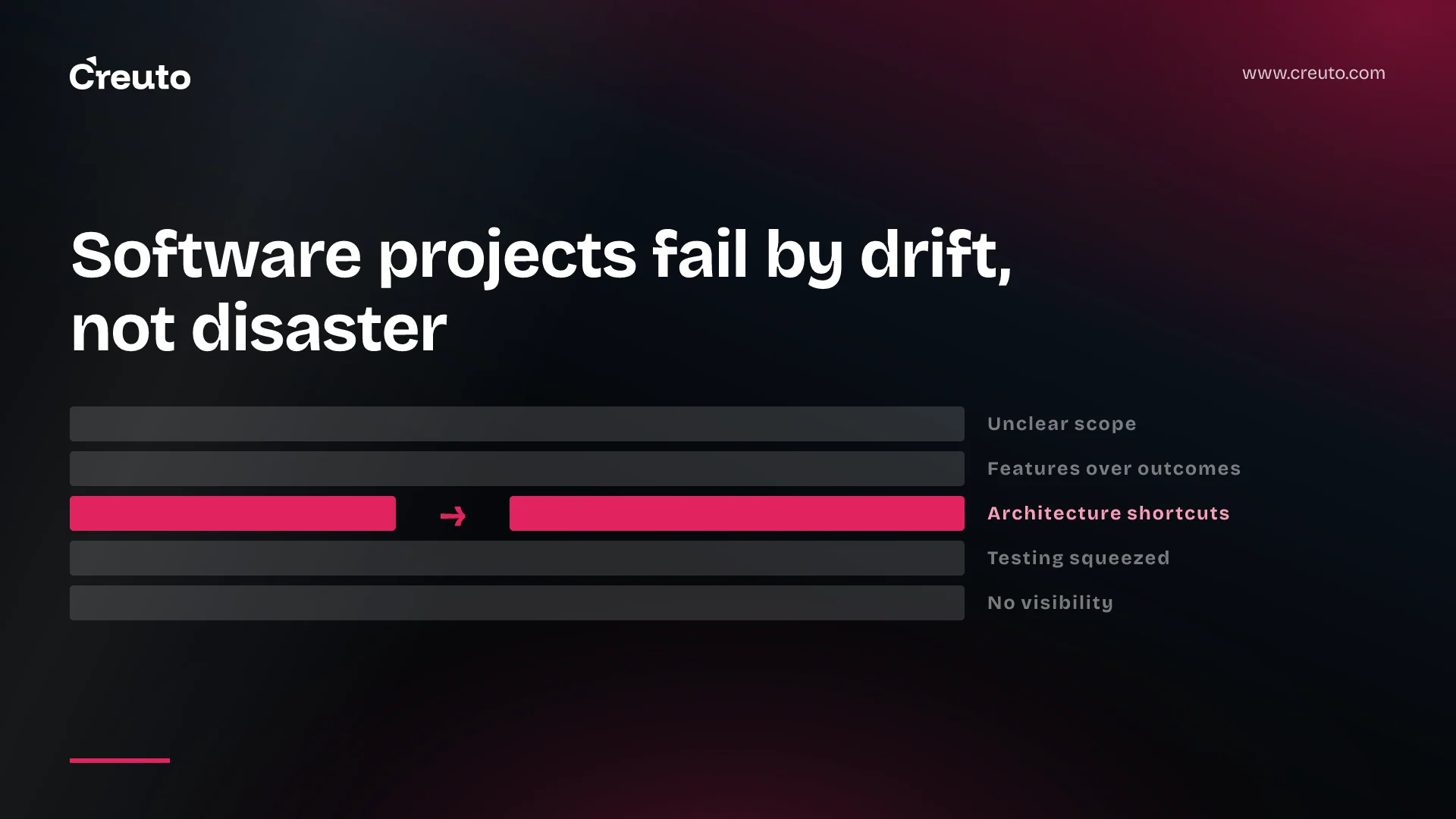
Software projects rarely fail in one dramatic moment. They drift: requirements shift, shortcuts pile up, testing gets squeezed, and a product that looked fine at launch cannot handle growth. Understanding why software development projects fail is the first step to building products that scale. This guide covers the causes we see most often and the practices that prevent them.
A note on numbers: you will often see precise failure-rate statistics quoted for software and ERP projects. Many of them are hard or impossible to trace to a real study, as we found when we tried to source the famous ERP failure rate. The causes below come from practice, not from a borrowed percentage.
Why software projects fail
1. Unclear requirements and moving scope
Many projects start with a clear why — "we need a better system" — and a vague what and how. As development progresses, requirements change without anyone assessing the impact on time, cost or architecture. The result is delays and a product that tries to do everything.
2. Building features instead of solving problems
Teams measure progress in features shipped rather than problems solved. The product becomes complex, users adopt a fraction of it, and effort is wasted on functions nobody needed.
3. Weak technical architecture
Early shortcuts speed up the first release and slow down every one after it. Systems not designed for growth struggle with performance, integrations and change. We cover the business impact in the true cost of poor software architecture.
4. Stakeholders who are not aligned
When business owners, product managers and engineers work in silos, priorities clash and the product ends up technically sound but commercially wrong.
5. Testing and quality squeezed by deadlines
Under pressure, testing is the first thing cut. Bugs, security gaps and performance problems then surface in production, where they are most expensive to fix.
6. Poor visibility
Without regular demos, honest progress tracking and a shared view of risks, problems are discovered only when they have become crises.
How to build software products that scale
1. Validate the problem before writing code
Run discovery: interviews, workshops and a clear problem statement. For new products, a focused MVP tests the idea before the full budget is spent.
2. Agree a product vision and a phased roadmap
Break the vision into releases with measurable outcomes, so the team always knows what the next milestone must achieve.
3. Choose architecture that fits the growth you expect
Modular design, clear APIs and cloud infrastructure that can scale. That does not mean microservices on day one; a well-structured modular monolith is often the right start, as we explain in our guide to scalable architecture.
4. Work iteratively
Short cycles with working software at the end of each one expose problems early and let priorities change safely.
5. Treat UX as part of engineering
Research, prototypes and usability testing are cheaper than rebuilding screens users do not understand.
6. Design for integration
Most business software must talk to CRMs, ERPs, payment systems and other tools. Plan those interfaces early.
7. Automate testing and delivery
Automated tests, CI/CD pipelines and monitoring make frequent, safe releases possible. With AI-assisted coding, the quality of requirements and review matters even more — see our piece on reviewing acceptance criteria.
8. Keep governance transparent
Regular demos, sprint reviews and a visible risk log keep everyone honest and allow early decisions.
The big picture
Software failure is usually preventable. It comes from misalignment between business goals, user needs and technical decisions, and it is fixed by making those three meet early and often. Our custom software development team works that way: discovery first, architecture that fits the roadmap, and visible progress from the first sprint.
Frequently asked questions
Software development projects most often fail because of unclear or changing requirements, building features instead of solving user problems, weak architecture, misaligned stakeholders, testing cut under deadline pressure and poor visibility of progress and risk.
Prevent software project failure by validating the problem before building, agreeing a phased roadmap with measurable outcomes, choosing architecture that fits expected growth, working iteratively, automating testing and delivery, and holding regular demos and risk reviews.
Scope creep is the gradual expansion of a software project's requirements without matching changes to time, budget or architecture. It is managed by assessing the impact of every change and deciding explicitly whether to add, swap or defer work.
No. Most products should start with a well-structured modular monolith with clear boundaries, then split services out when scale or team size requires it. Adopting microservices too early adds operational complexity without benefit.