What Is an MVP and Why Your Startup Should Build One First
What is a minimum viable product, and why should startups build one first? The MVP development process, common mistakes and how long it takes.
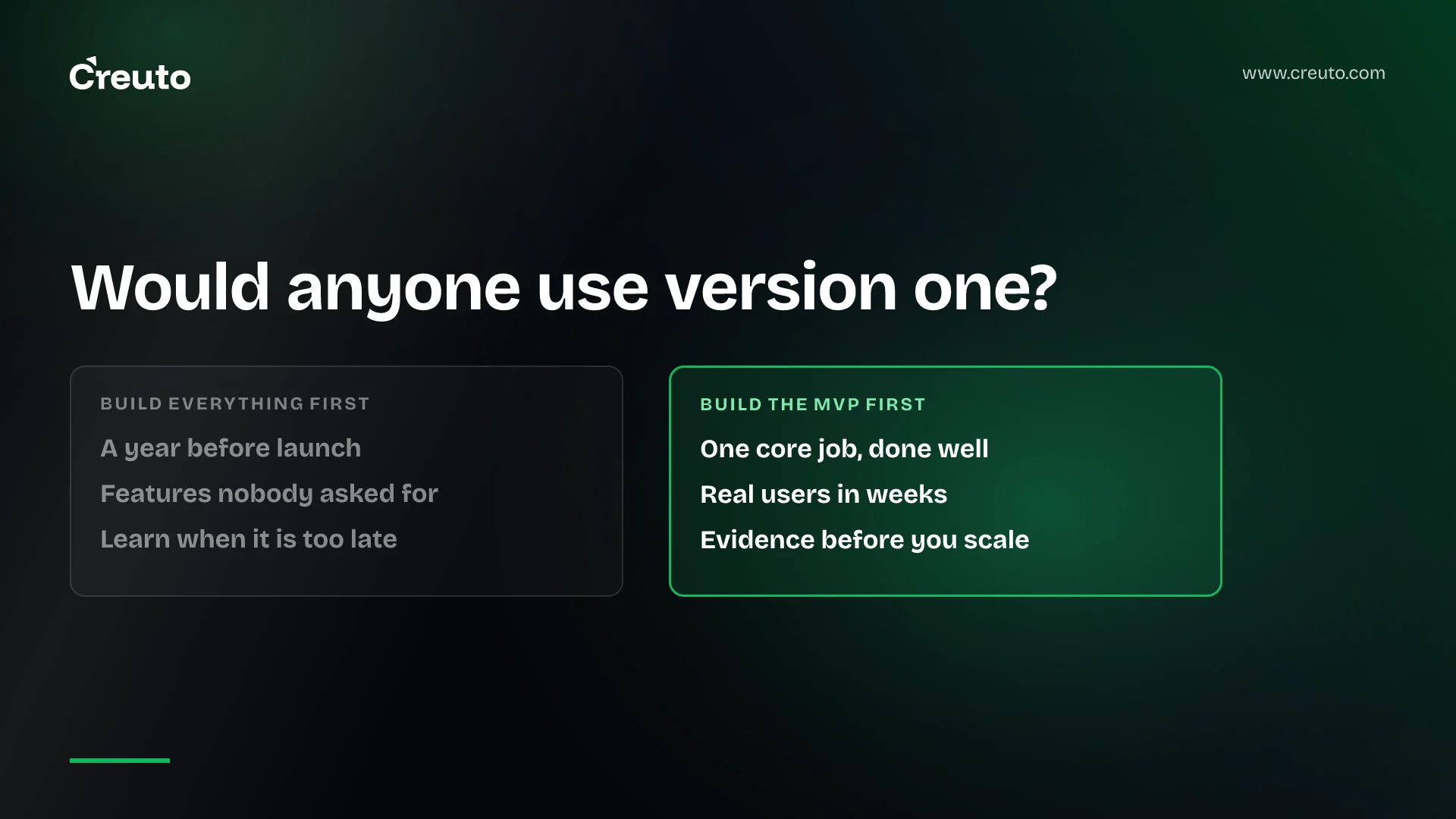
Most startups do not fail because the idea was bad. They fail because they spent their money building something before finding out whether anyone wanted it. A minimum viable product (MVP) is the cheapest way to find out. This guide explains what an MVP is, what it is not, and how to build one that actually teaches you something.
What is a minimum viable product?
A minimum viable product is the smallest version of your product that delivers its core value to a real user, so that you can learn whether that value is worth building on. The term was popularised by the lean startup movement, and the important word is viable: an MVP is not a mock-up or a broken prototype. Someone must be able to use it to solve the problem it exists for.
If you are building a ride-booking app, the MVP lets a rider request a ride and a driver accept it. Loyalty points, surge pricing and in-app chat can wait. If riders do not come back to book a second ride, none of those features would have saved the product.
Why build an MVP first?
Because every feature you build before you have evidence is a bet. An MVP turns bets into data quickly and cheaply.
- Lower risk. You spend a fraction of the full budget before learning whether the core idea works.
- Faster launch. A narrow product ships in weeks or a few months, not a year.
- Real feedback. Users show you what they value by what they do, not by what they say in a survey.
- Sharper focus. Deciding what to leave out forces the team to agree on what the product is for.
- A better pitch. Investors respond to traction and usage data far more than to slide decks.
MVP vs full product development
A full product is built for scale: polished design, complete feature set, integrations, admin tools. It assumes you already know what users need. An MVP is built for learning: it assumes you do not know yet and designs the fastest route to finding out.
The two are not opposites. A good MVP is built on foundations that can grow — sensible data models, clean code, a deployable architecture — so that when it works, you extend it rather than throw it away. What it leaves out is scope, not quality.
The MVP development process
- Define the problem. Write one sentence describing whose problem you are solving and why current options fail them. If you cannot, you are not ready to build.
- Talk to users. Interview people who have the problem. Look for how they solve it today and what that costs them.
- Choose the core job. Pick the single task the MVP must do well. Everything else goes on a later list.
- Decide what success looks like. Set a measurable signal before launch — sign-ups that convert, repeat use in the first week, a paid pilot — so the result cannot be argued away afterwards.
- Build narrowly, build properly. Use proven tools and a simple architecture. Cut features, not testing or security.
- Launch to real users. A small, well-chosen group is better than a large, random one.
- Measure and decide. Keep going, change direction, or stop. All three are good outcomes if they are based on evidence.
Common MVP mistakes
- Too many features. If the MVP takes a year, it is not minimum.
- Too little product. A landing page tests interest, not whether the product works. Both are useful; they answer different questions.
- No success metric. Without one, every result looks encouraging.
- Throwaway engineering. Shortcuts in data design and security are the ones that force a rebuild just when growth arrives.
- Ignoring what users do. Analytics and session data matter more than feature requests.
How long does it take to build an MVP?
It depends on scope, but a focused MVP for a web or mobile product commonly takes somewhere between six and sixteen weeks, including design and testing. The fastest way to shorten that is to cut scope, not to cut discovery. Our guide to mobile app development cost covers the factors that drive both time and budget.
After the MVP: from validation to scale
An MVP that works is the start of product development, not the end. The next stage is turning early users into a repeatable model and the codebase into something that scales, which we cover in how to build and scale a SaaS product. If you are still earlier than this — with an idea but no plan — start with where to begin with a business idea.
Our MVP development team helps founders define the core job, build a focused first version on foundations that can grow, and set the metrics that tell you what to do next.
Frequently asked questions
A minimum viable product is the smallest version of a product that delivers its core value to real users, built to learn whether that value is worth developing further. It must be usable, not just a mock-up, but deliberately leaves out non-essential features.
A startup should build an MVP first to test its core idea with real users before spending the full budget. It lowers risk, speeds up launch, produces real usage data and gives investors evidence of traction rather than assumptions.
A focused MVP for a web or mobile product commonly takes around six to sixteen weeks including design and testing. Scope is the biggest driver, so the fastest way to shorten the timeline is to narrow the core feature set.
A prototype demonstrates how a product might look or work, often without real functionality. An MVP is a working product that real users can use to solve their problem, so it produces genuine evidence about demand and behaviour.
An MVP should include only the features needed for its core job, basic security and data handling, and analytics to measure a success metric agreed before launch. Secondary features, heavy customisation and polish can follow once the idea is validated.