When to use AI agents: 4x tokens, 40% canceled
When to use AI agents: agents use about 4x the tokens of chat, multi-agent 15x. Priced on Claude, plus Gartner's 40% canceled forecast and a decision ladder.
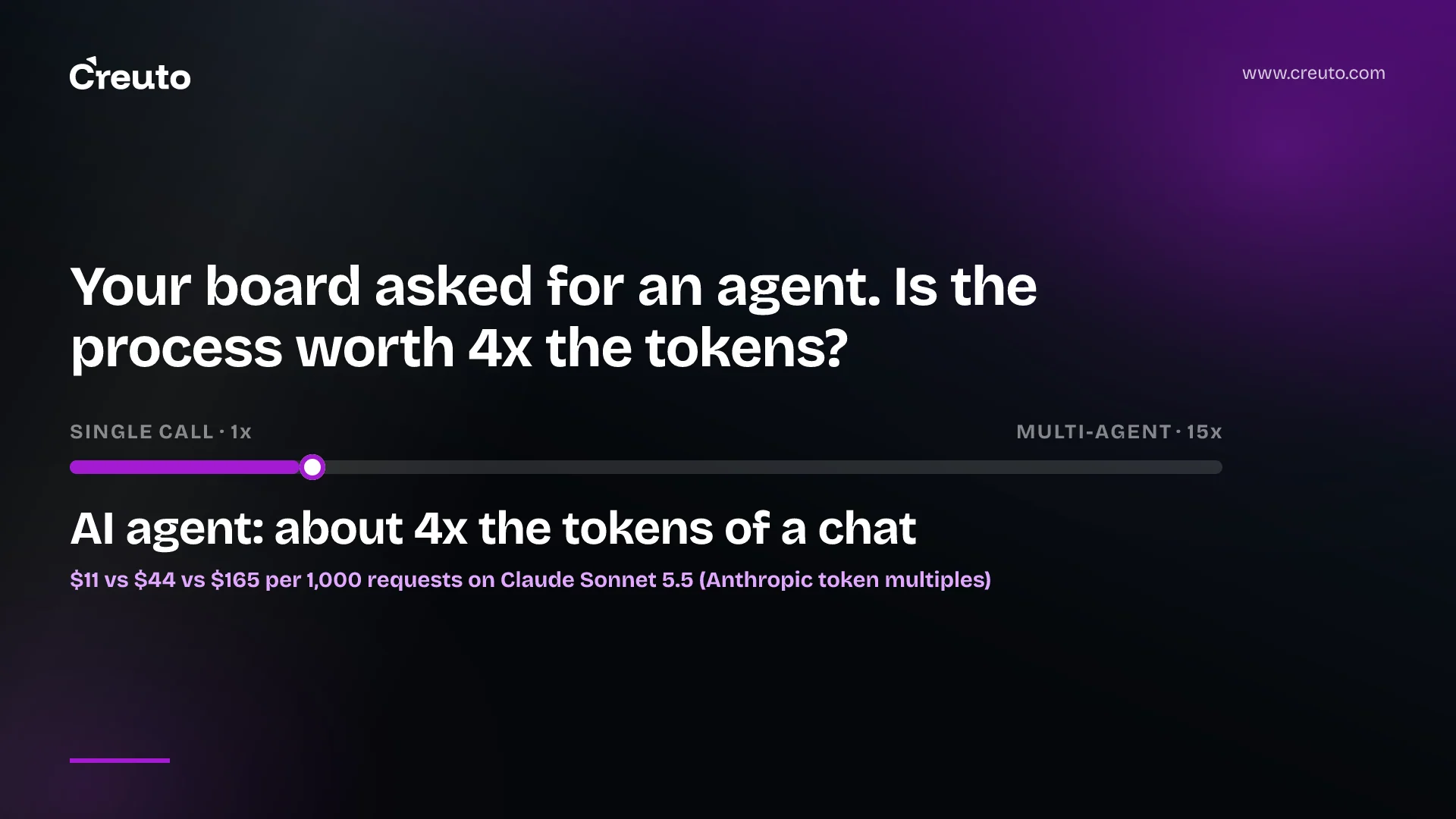
When to use AI agents comes down to one test: can you write the steps down in advance? If you can, a single model call or a fixed workflow will do the job for a fraction of the cost. Anthropic's own data says agents use about 4x the tokens of a chat, and multi-agent systems about 15x.
By the end of this post you will have those multiples priced in dollars per 1,000 requests on current Claude pricing. You will also know why Gartner expects more than 40% of agentic AI projects to be canceled, and how to decide which of three designs a given process needs before your board's agent initiative becomes one of them.
What an AI agent costs compared to a single model call
Anthropic published the multiples in its engineering post on its multi-agent research system (13 June 2025): "agents typically use about 4× more tokens than chat interactions", and "multi-agent systems use about 15× more tokens than chats." The same post found that token usage alone explained 80% of the variance in performance on its research evaluation. Agents do better partly because they spend more, and you pay for every token of it.
We priced those multiples on Claude's API pricing as listed on 20 November 2026. Our assumption for one chat-style request is 3,000 input tokens and 500 output tokens, and we assume the agent's extra tokens keep the same input-to-output mix. Your prompt sizes will differ, so treat the ratios as the finding and the dollar figures as an example.
| Design | Token multiple | Claude Haiku 5.5 ($0.10 / $0.50) | Claude Sonnet 5.5 ($2 / $10) | Claude Opus 5.5 ($4 / $20) |
|---|---|---|---|---|
| Single model call | 1x | $0.55 | $11 | $22 |
| Agent | about 4x | $2.20 | $44 | $88 |
| Multi-agent system | about 15x | $8.25 | $165 | $330 |
Figures are per 1,000 requests, with prices per million input and output tokens. At 100,000 requests a month on Sonnet 5.5, that is $1,100 for single calls, $4,400 for an agent and $16,500 for a multi-agent system. We left out prompt-caching discounts, which would lower every row, and Haiku's higher rate for prompts over 100,000 tokens.
Why the agent's bill is harder to forecast
A single call's cost is fixed by its prompt. An agent's is not. Anthropic's "Building effective agents" (19 December 2024) defines agents as systems where "LLMs dynamically direct their own processes and tool usage". The model decides how many steps to take, so it also decides how many tokens you buy. "About 4x" is a typical figure, not a ceiling. If you are running agents already, monitoring AI spend for model overuse is the control that catches a loop before the invoice does.
When to use AI agents, and when a workflow is enough
Anthropic's guidance is a ladder, and most business processes stop on the first or second rung. The same post recommends "finding the simplest solution possible, and only increasing complexity when needed", and notes that "optimizing single LLM calls with retrieval and in-context examples is usually enough" for many applications.
- A single model call with retrieval. Summarize a document, draft a reply, classify a ticket, extract fields from an invoice. One request, a known input, a checkable output. If your generative AI feature in production does this today, it is already on the right rung.
- A fixed workflow. Anthropic defines workflows as "systems where LLMs and tools are orchestrated through predefined code paths". It names five patterns: prompt chaining, routing, parallelization, orchestrator-workers and evaluator-optimizer. Your code decides the order of steps. The model fills them in.
- An agent. Reserved for "open-ended problems where it's difficult or impossible to predict the required number of steps", in Anthropic's words.
The test between rungs two and three is whether you can draw the flowchart. If an operations lead can describe the process as "check this, then look that up, then if X do Y", that is a workflow, and writing it as one gives you a fixed step count, a fixed cost and a place to log each step. A workflow is not automatically cheap: a three-step prompt chain at our example size costs about 3x a single call, or $33 per 1,000 on Sonnet 5.5. But you know it costs 3x before it runs.
Which business processes need an AI agent
An agent earns its multiple when two conditions hold together. The steps cannot be listed in advance, because the next step depends on what the last one found. And a wrong step is recoverable, because something checks the result before it reaches a customer or a ledger. Research across many sources, debugging an unfamiliar failure and investigating an anomaly in operational data fit that shape. Approving an invoice, onboarding a supplier or answering a policy question usually do not: their steps are known, and the risk is in getting one wrong.
Anthropic is direct about the second condition: "The autonomous nature of agents means higher costs, and the potential for compounding errors." An error in step two of a ten-step loop becomes the input to step three. A workflow with a validation check after each step stops that error where it happens.
Agentic AI vs generative AI is the wrong question for a business
The useful distinction for a buyer is not agentic AI vs generative AI. Both use the same models. The difference is who decides the next step: your code or the model. A summarizer is generative AI. A fixed pipeline that summarizes, routes and drafts is still a set of generative calls arranged by your code. An agent hands the arranging to the model.
That matters because vendors use the word "agent" for all three. Reuters, reporting Gartner's forecast, describes "agent washing": rebranding products such as AI assistants and chatbots that lack significant agentic capabilities. Gartner estimates "only about 130 of the thousands of agentic AI vendors are real." If a vendor's "agent" follows a fixed script, you are buying a workflow, which may be exactly what you need, but you should price it as one.
Why Gartner expects 40% of agentic AI projects to be canceled
Gartner forecast in June 2025 that "more than 40% of agentic artificial intelligence projects will be canceled by the end of 2027", citing "escalating costs and unclear business value", according to Reuters' report of 25 June 2025. Gartner's own press release was not accessible when we checked (gartner.com refused our requests), so the figures here come from Reuters' account. Gartner's related research note, "When to Use or Not to Use AI Agents", is paywalled, and we cite it by title only.
Gartner senior director analyst Anushree Verma told Reuters that "most agentic AI projects right now are early stage experiments or proofs of concept." The two causes Reuters names line up with the two halves of this post. Escalating cost is the 4x and 15x token multiple, applied to processes that never needed it. Unclear value is an agent built where a workflow would have produced the same output for less.
The forecast is not anti-agent. In the same report, Gartner predicts that at least 15% of day-to-day work decisions will be made autonomously through agentic AI by 2028, up from 0% in 2024, and that 33% of enterprise software applications will include agentic AI by 2028. The cancellations are about fit, not about the technology.
The strongest case for building the agent anyway
The best argument for skipping the ladder is that tokens are cheap and engineering time is not. At $44 per 1,000 requests on Sonnet 5.5, a low-volume internal agent can cost less in tokens than the engineering time it takes to design and code the equivalent workflow. A workflow also breaks when the process changes, and someone has to rewrite the code paths. An agent adapts to the new case without a release.
That argument holds at low volume and for internal tools where a person reviews the output. It fails in three places. It fails at volume, where the 4x multiple turns $1,100 a month into $4,400. It fails where errors are expensive and compounding errors reach a customer. And it fails where you need to explain a decision afterward, because a workflow logs a fixed sequence and an agent logs whatever it chose to do.
Multi-agent designs need even more care. Anthropic's post reports that its multi-agent system outperformed single-agent Claude Opus 4 by 90.2% on its internal research evaluation, but notes that "most coding tasks involve fewer truly parallelizable tasks than research", and that domains requiring all agents to share the same context are not a good fit today. A 15x bill is worth paying for broad parallel research. It is the wrong choice for a process that is one long chain of dependent steps. Where you do need coordination, who should run the loop is the next design question.
What this looks like in a system we built
Our AI-powered Sales CRM has an AI market-intelligence engine: location-based demand insights, predictive lead scoring, smart ad targeting suggestions and campaign recommendations. The case study describes it as a decision-support layer built into the platform's data architecture. It scores and recommends, and the sales team acts. We cite it here for the design choice, not as an agent: when the output is a score or a suggestion a person reviews, the bottom rungs of the ladder are usually where the value is.
Deciding when to use AI agents for your next process
Before you commit to an agentic AI initiative, run each candidate process through four questions. Can someone write the steps down? If yes, start with a workflow. Is a wrong step recoverable before it reaches a customer or a ledger? If no, keep a human or a validation step in the loop. What is the monthly request volume, multiplied by 4x for an agent? Does that number still beat the cost of the manual process?
If your board has asked for agents and you have a generative AI feature already in production, our AI engineering team can run your shortlist of processes through that ladder and cost each one as a single call, a workflow and an agent before anyone writes the agent. A focused MVP typically takes 6-10 weeks, so the first process can be in front of users while the rest are still being scored.
Frequently asked questions
An AI agent is worth using when the steps of a task cannot be written down in advance and a wrong step can be caught before it causes harm. When the steps are known, a single generative AI call or a fixed workflow does the same job at a lower and more predictable cost.
An AI agent typically uses about 4x the tokens of a chat interaction, and a multi-agent system about 15x, according to Anthropic. On Claude Sonnet 5.5 at $2 and $10 per million tokens, our example request costs about $11 per 1,000 as a single call, $44 as an agent and $165 multi-agent.
Gartner forecasts that more than 40% of agentic AI projects will be canceled by the end of 2027 because of escalating costs and unclear business value, according to Reuters' June 2025 report. Gartner's analyst said most agentic AI projects are still early experiments or proofs of concept.
Agent washing is Gartner's term, reported by Reuters, for rebranding AI assistants, chatbots and similar products as agents when they lack significant agentic capabilities. Gartner estimates that only about 130 of the thousands of vendors selling agentic AI are real, so buyers should check whether a product decides its own steps.
A fixed workflow is better than an AI agent when someone can describe the process as a sequence of steps, when errors are costly, or when decisions must be explained afterward. Anthropic defines workflows as LLMs and tools orchestrated through predefined code paths, which gives a fixed step count and cost.