What CTOs Should Look for in a Software Development Partner (Before It’s Too Late)
What CTOs should look for in a software development partner: architecture, transparency, quality, security, AI tool policy, code ownership and warning signs.
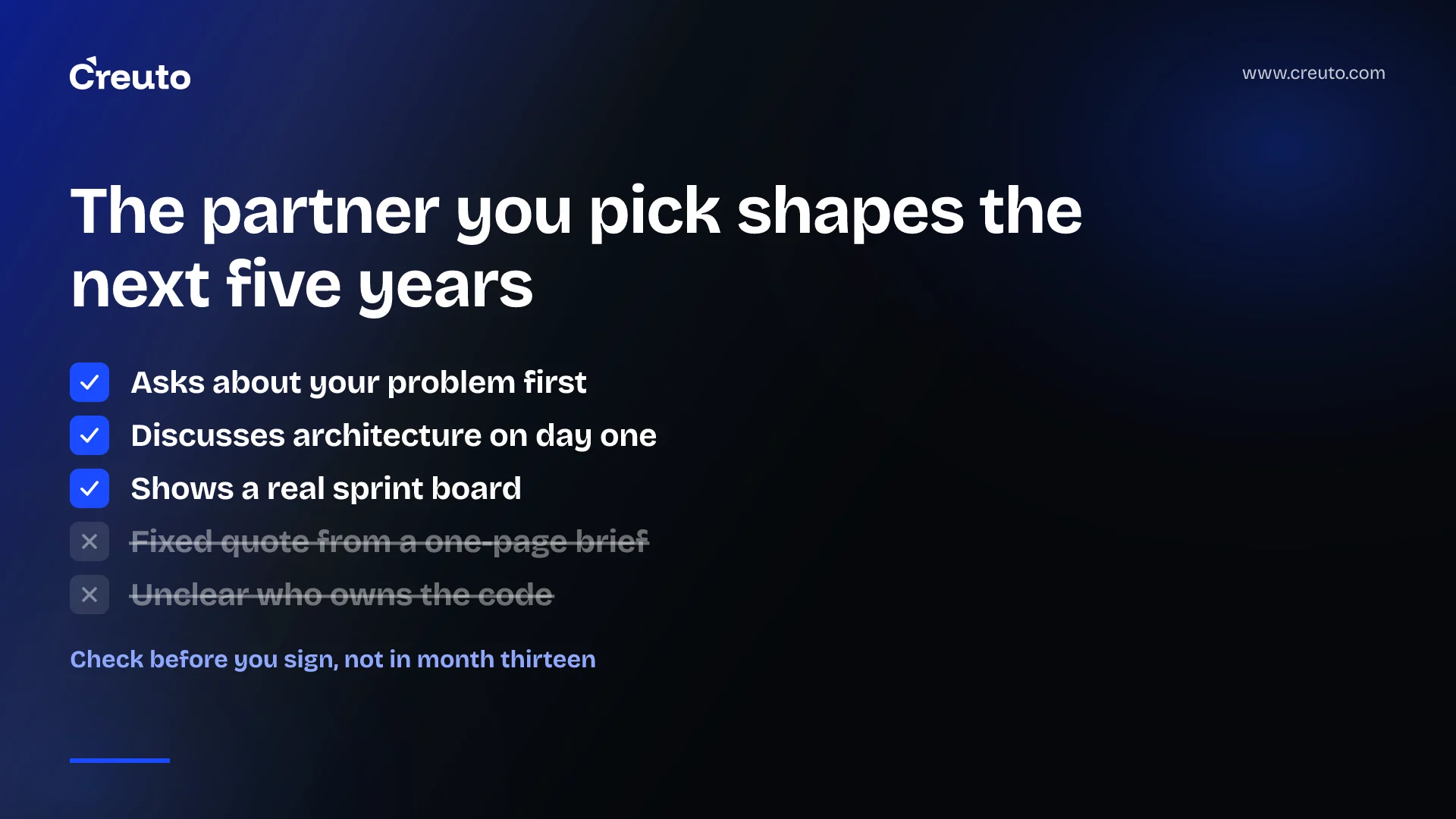
The wrong development partner does more than delay delivery. It leaves behind architecture, code and habits that limit what your product can become. For a CTO, choosing a software development partner affects scalability, security, technical debt and your team's capacity for years. This guide sets out what to evaluate before you sign, and the warning signs that only show up months later.
1. Do they think in systems, not just features?
A strong partner starts with the business problem, the users and how the product will evolve. A vendor starts with a feature list. Ask them to explain your problem back to you before they talk about screens.
2. Is architecture discussed from day one?
Listen for early questions about scale, data flow, integrations, APIs and hosting. Teams that jump straight to UI mock-ups often build systems that need re-engineering at the first growth spurt. See the true cost of poor architecture.
3. How transparent is their process?
Ask to see a real sprint board, a real demo and a real status report from another project. A partner who shares problems early is worth more than one who only reports success.
4. Do they plan for performance and scale?
Ask how they would handle ten times the users or data. Good answers cover database design, caching, load testing and observability, not just "the cloud scales".
5. Is quality built into the workflow?
Look for code review, automated tests, CI/CD pipelines and security checks as standard. Ask what test coverage they deliver and how they judge test quality.
6. How strong is their security practice?
Authentication, secrets handling, dependency management, data protection and compliance should be routine. Ask how they manage secrets and what they do when a dependency has a critical vulnerability.
7. Which AI tools touch your code?
Most teams now use AI coding assistants. Ask which tools, under what account type, whether they retain or train on your code, and how secrets are kept out of them. The ZCode Git-history upload case shows why this belongs in due diligence.
8. Do they collaborate like a long-term partner?
Look for clear communication, willingness to challenge your ideas constructively, and a plan for support after launch. Ask what happens in month thirteen.
9. Can you leave if you need to?
You should own the code, the infrastructure accounts and the documentation. Ask how a handover to another team or your in-house engineers would work.
Warning signs during selection
- A fixed quote from a one-page brief, with no discovery.
- No questions about your users, data or integrations.
- Reluctance to let you speak to past clients or engineers who would work on your project.
- Vague answers about testing, security or who owns the code.
The cost of choosing wrong
A poor partner's cost accumulates quietly: slower releases, fragile systems, rising technical debt and, eventually, a rebuild. By the time it is visible, recovery is expensive.
The big picture
Choosing a development partner is a technology strategy decision, not procurement. For a shorter list of questions to take into calls, see questions to ask before hiring a software development partner, and for the selection process itself, how to choose the right custom software development company. If you would like to see how we work — process, code ownership and all — our custom software development team is happy to walk you through it.
Frequently asked questions
A CTO should look for a partner that starts with the business problem, discusses architecture early, runs a transparent process, builds in testing and security, has a clear AI tool policy, plans for long-term support, and gives you full ownership of code and infrastructure.
Red flags include fixed quotes without discovery, no questions about users or integrations, reluctance to share references or the actual team, vague answers on testing and security, and unclear ownership of code and cloud accounts.
Yes. Ask which AI coding tools the partner uses on your code, whether those tools retain or train on it, how secrets are kept out of them, and to be told before any new tool is adopted. These tools can send code off developer machines.
The client should own the source code, documentation and infrastructure accounts when outsourcing software development. Confirm this in the contract, and ask how a handover to another team would work before you sign.