VISHWAS 2026: settle EPF damages before 28 December
VISHWAS 2026 cuts EPF damages on pre-14 June 2024 defaults to 0.25-1% a month, down from 25% a year. What the gazette says, and what reconciliation takes.
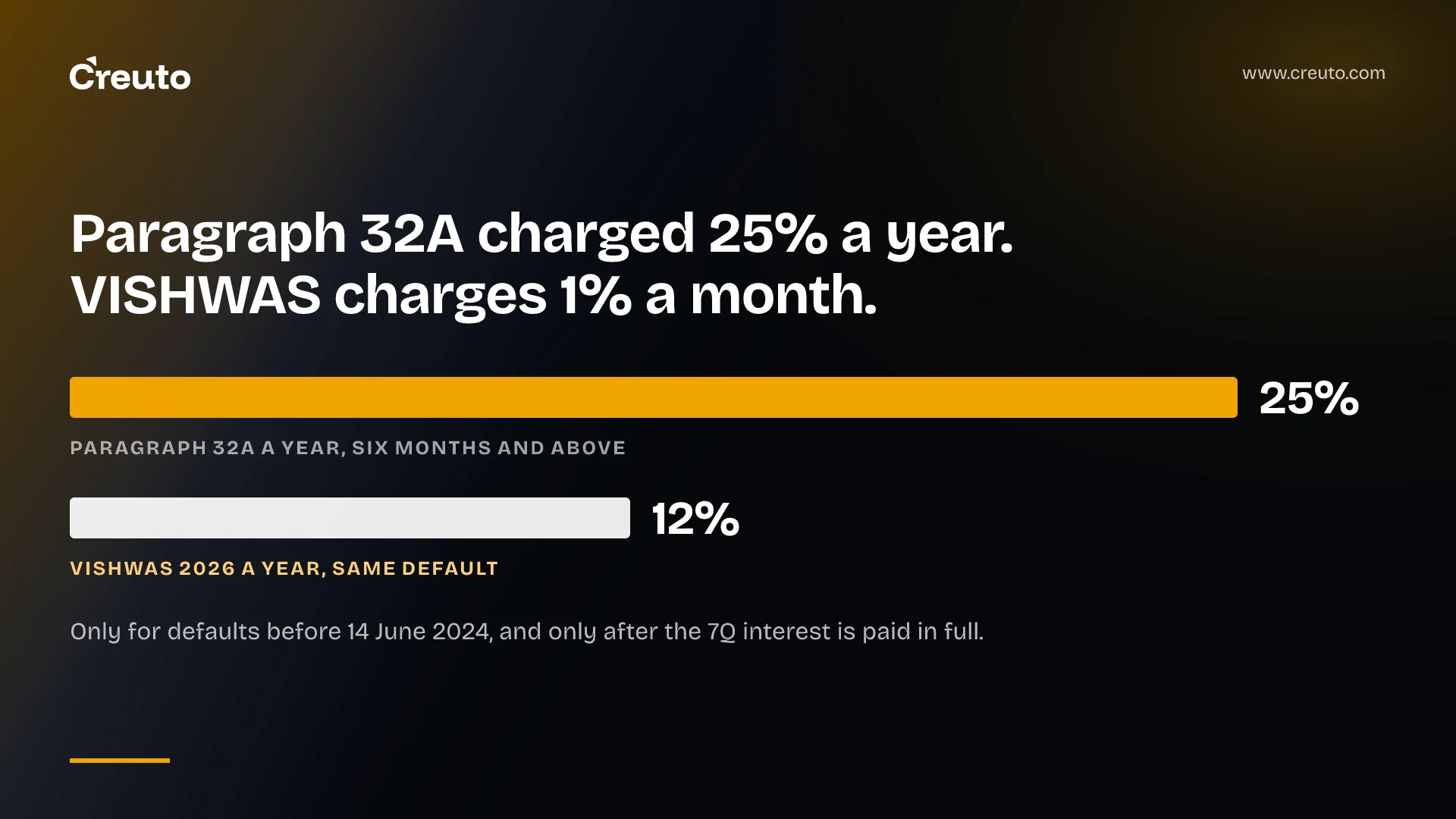
VISHWAS 2026 lets an employer settle EPF damages on defaults from before 14 June 2024 at 0.25% to 1% of arrears per month, instead of the 5% to 25% a year that paragraph 32A charged. The window runs six months from 29 June 2026, which EPFO has put at 28 December. The rate is the easy part; proving which months you actually defaulted on is not.
Two things in the published text are worth knowing before you plan around the date. The scheme is written with a power to extend it, which contradicts the widely repeated line that it cannot be extended. And a second, nearer window — the Employees' Enrolment Campaign, 2026 — closes on 31 October 2026, four weeks from now.
What VISHWAS 2026 changes, in rates you can check
The scheme is Part B of the Annexure to the Employees' Provident Funds Scheme, 2026, notified as G.S.R. 525(E) dated 29 June 2026 and gazetted on 1 July 2026 under the Code on Social Security, 2020. It covers damages under section 14B of the repealed 1952 Act and section 128 of the Code, and it applies only to default in payment of contribution for the period prior to 14 June 2024.
Paragraph B(7) of the Annexure does not restate a rate. It says that notwithstanding the rate otherwise applicable at the relevant time, the rate under VISHWAS, 2026 shall be the one in paragraph 23(1) of the new Scheme. Paragraph 23(1) sets out a three-row table, as a percentage of arrears per month:
| Period of default | Rate under paragraph 23(1) | Paragraph 32A, before 14 June 2024 |
|---|---|---|
| Less than two months | 0.25% per month | Five per cent per annum |
| Two to less than four months | 0.50% per month | Ten per cent per annum |
| Four to less than six months | 1% per month | Fifteen per cent per annum |
| Six months and above | 1% per month | Twenty-five per cent per annum |
The units differ, and most coverage of this scheme sets "1% a month" against "25% a year" without saying so. Annualise both and the long-default comparison is 12% of arrears a year against 25% — a little over half. On a six-month default the arithmetic is 6% of arrears under the scheme against 12.5% under the old table. Real money, but not the order-of-magnitude saving the phrasing implies.
The old slabs are worth sourcing properly, because a second set of numbers circulates. EPFO's own consolidated text of the Employees' Provident Funds Scheme, 1952, as published on its site before the June 2024 amendment, gives paragraph 32A as Five, Ten, Fifteen and Twenty-five per cent of arrears per annum. An older edition of the same document carried 17, 22, 27 and 37 per cent. The 37% figure still appears in commentary on VISHWAS; it belongs to a table that was already superseded well before the defaults this scheme covers. If you are modelling an exposure, use 25%.
Note also what paragraph 23(2) does: the same graded rates apply to paragraph 32A defaults with effect from 14 June 2024. For anything after that date, 0.25% to 1% a month is simply the normal rate. VISHWAS does not give you a discount — it extends today's rate backwards over history.
Interest is not reduced, and that is the condition most employers miss
Condition B(9)(a) requires that interest under section 7Q of the repealed Act, or section 127 of the Code, for the specific period of delayed remittance is fully remitted or recovered before the benefit applies. EPFO's own announcement repeats this. Interest is not waived, not reduced and not negotiable, and it has to be paid month by month against the periods in question — which is where the reconciliation work lands.
The other conditions are short and absolute. The employer undertakes that no further appeal will be filed. Appeals and orders under section 7-I abate on remittance. Where part payment already exceeds the recalculated damages there is no refund and no adjustment against another order for the same period of delay. Cases where the entire amount has already been deposited are out, as are cases involving fraud or deliberate falsification of records. Applications go through the EPFO employer portal with a digital signature or e-Sign.
Three schemes, three different sets of employers
The Annexure carries three special provisions and they are routinely run together in summaries. They bind different people.
- Employees' Enrolment Campaign, 2026 (Part A) — for employers who never enrolled eligible employees. It requires a UAN created with face authentication through the UMANG app for each declared employee and payment through an Electronic Challan-cum-Return, and it ceases to operate on 31 October 2026. Read its dates carefully, because three clauses give two different start points and the gazette does not reconcile them.
- VISHWAS, 2026 (Part B) — for employers with damages or penalty exposure on pre-14 June 2024 defaults, whether the order is under appeal, partly recovered, noticed but not yet ordered, or not yet noticed at all.
- AMNESTY, 2026 (Part C) — for establishments running a provident fund trust recognised under the Income Tax Act but holding no formal exemption notification. EPFO's release on it sets out the two categories, the waiver of headcount and corpus thresholds, retrospective regularisation from the trust's inception, and a chartered accountant audit with compliance audits to be completed within three months of application. If you do not run an exempted trust, this one is not yours.
The enrolment campaign's dates do not line up, and it matters
Sub-paragraph (2)(b) permits an employer to enrol employees "who joined the establishment between 1st day of April, 2009 and 31st day of March, 2026", who are employed as on the date of declaration but were never enrolled. Sub-paragraph (17) waives the member's share "for the period beginning the 1st day of April, 2009 and ending the 31st day of March, 2026", provided it was never recovered. Both start on 1 April 2009.
The damages Table at sub-paragraph (18) does not. It prices the concession — one hundred rupees — against a period of default stated as "Between the 1st day of July 2009 to the 31st day of March 2026". Three months later at the front end, for no reason the text explains.
For an employee who joined in, say, May 2009, eligibility to enrol is clear and the waiver of the member's share is clear. What the flat hundred-rupee damages line does for the first three months of that default is not clear on the face of the instrument. If your declaration includes joiners from before 1 July 2009, put the question to your jurisdictional regional office in writing before you file rather than after. For joiners from 1 July 2009 onward the three clauses agree and there is nothing to resolve.
One more disambiguation, because the names collide in search. VISHWAS, 2026 has nothing to do with the Jan Vishwas (Amendment of Provisions) Act, 2026, which received assent on 7 April 2026 and decriminalises offences across a schedule of enactments.
Will the VISHWAS 2026 deadline be extended?
Here the sources disagree, and the disagreement matters. Trade coverage — Business Today, among others — reports that the deadline will not be extended. The published scheme says the opposite is possible: paragraph B(3) provides that the duration may be further extended for a period not exceeding six months by the Central Provident Fund Commissioner for reasons to be recorded in writing, to be placed before the Central Board for information. The Ministry of Labour and Employment's annual report describes the same provision, noting the scheme runs six months "with a provision for extension by a further six months". AMNESTY, 2026 has a parallel power exercisable on the Central Board's recommendation.
So an extension is lawful and has not been granted. Treat 28 December 2026 as the date, because a power that depends on a Commissioner recording reasons is not a plan. The gazette itself expresses the window as six months from the date of notification rather than naming a day, so do not spend the last fortnight arguing about whether you have a few extra days.
What reconciling months of contributions against EPFO actually takes
We build and maintain HR and payroll systems, including the enterprise payroll platform we shipped as Nomina, so the part we can speak to first-hand is not the law but the data. An application under this scheme asks a question most establishments cannot answer quickly: for each month before 14 June 2024, what was due, what was remitted, and on what date. Four things make that hard.
ECR history is a payment trail, not a liability ledger
The Electronic Challan-cum-Return records what you filed and paid. It does not record what you should have paid. To compute a default you need the month's actual liability reconstructed from the payroll register of the time, then matched to the challan that settled it, then dated. Where a month was paid in two challans, or one challan covered arrears for three months, the mapping is manual. EPFO's own revamped ECR, live from the September 2025 wage month, separates return filing from payment generation, adds validations, makes section 7Q interest payable alongside monthly contributions and auto-calculates damages under section 14B — all described in the annual report. That helps from 2025 onward. It does nothing for 2019.
UAN mismatches turn a reconciliation into an identity problem
A member whose UAN changed, who holds two UANs, or whose Aadhaar seeding failed, appears in your payroll as one person and in EPFO's records as two or none. The 2026 Scheme leans harder on this: members must furnish Aadhaar, an Aadhaar-seeded bank account, the PAN and the UAN, and employers must link UANs on transfer and facilitate UAN generation. Each unresolved identity is a month you cannot reconcile, and a month you cannot reconcile is a month you cannot include in an application.
The wage definition moved under you
The 1952 Scheme computed contributions on basic wages plus dearness allowance. The 2026 Scheme computes them on "wages" as the Code on Social Security, 2020 defines the term, and the Code's definition carries a proviso that where excluded allowances exceed one-half of total remuneration, the excess is added back into wages. Contributions are calculated on wages actually drawn or payable in the month, subject to the notified wage ceiling — a ceiling we wrote about separately when it moved to ₹25,000. The practical effect is that the liability base for 2019 and the liability base for 2026 are computed by different rules, so a reconciliation script that applies today's definition to historical months will produce numbers that are wrong in a direction you will not notice.
Structure changes break the join
Establishment code changes, branch registrations, contractor employees moved onto direct rolls, a payroll migration that did not carry PF history: each of these severs the link between a person-month in your system and a person-month in EPFO's. The same problem shows up across payroll compliance under the labour codes, where state-level variation means the record you need is rarely in one place.
Why establishments find the gap too late to use a window like this
Nobody runs a historical PF reconciliation for fun. The trigger is almost always external: a section 7A inquiry, a due-diligence request before a funding round or an acquisition, a 14B notice, or an auditor who asks for the challan against a specific month and does not get it. By then the window is weeks away, the people who ran payroll in the default years have left, and the system of record may be a spreadsheet nobody owns.
The scheme also rewards knowing your exposure precisely rather than approximately. Category (d) in paragraph B(5) covers cases where a notice has not yet been issued — you can settle a default EPFO has not yet come to you about. That is only useful if you have found it yourself. And because part payments above the recalculated amount are neither refunded nor adjusted, an application built on a guess can cost more than it saves.
If you are deciding what to do in the next eight weeks, the order is: fix the enrolment gap first, because the Employees' Enrolment Campaign closes on 31 October; then reconcile month by month and pay the section 7Q interest, because the VISHWAS benefit does not exist until that interest is remitted; then apply. Most of that is a data exercise, and the systems that make it tractable — a payroll of record that keeps liability and remittance as separate, dated facts — are the kind of custom software we build for exactly this reason. Confirm the eligibility of your specific cases with your adviser or your jurisdictional regional office before you file an undertaking that you will not appeal.
Frequently asked questions
The gazette gives VISHWAS, 2026 a validity of six months from the date the Employees' Provident Funds Scheme, 2026 was notified on 29 June 2026, which EPFO and press coverage date as 28 December 2026. The Central Provident Fund Commissioner may extend it by up to six further months, but has not.
Paragraph 23(1) of the Employees' Provident Funds Scheme, 2026 sets damages at 0.25% of arrears per month for defaults under two months, 0.50% for two to four months, and 1% beyond four months. VISHWAS, 2026 applies those rates to defaults from before 14 June 2024.
Employers facing damages or penalty under section 14B or section 128 for default before 14 June 2024, whether the order is disputed, partly recovered, noticed without a final order, or not yet noticed. Cases already fully deposited, or involving fraud or falsified records, are excluded.
VISHWAS, 2026 recalculates damages for employers who defaulted on contributions. AMNESTY, 2026 regularises establishments running a provident fund trust recognised under the Income Tax Act without a formal exemption notification. They bind different employers, and running an exempted trust is the dividing line.
No. The scheme requires that interest under section 7Q of the 1952 Act, or section 127 of the Code on Social Security, for the delayed months is fully remitted or recovered before the reduced damages apply. Interest is neither reduced nor waived, and it is a precondition to applying.
For every month before 14 June 2024 you need the liability reconstructed from the payroll register of that period, the Electronic Challan-cum-Return that settled it, the remittance date, and resolved UANs for each member. Unreconciled months cannot be included in an application.
Part A of the Annexure says the Employees' Enrolment Campaign, 2026 ceases to operate on 31 October 2026. It permits enrolment of employees who joined between 1 April 2009 and 31 March 2026, though its damages table states the period of default as 1 July 2009 to 31 March 2026.