UAE WPS rules 2026: salaries due on the 1st, no new-hire grace
UAE WPS rules 2026 under Resolution 340: wages due on the 1st, no new-hire grace period, 85% threshold, and permit suspensions from day five.
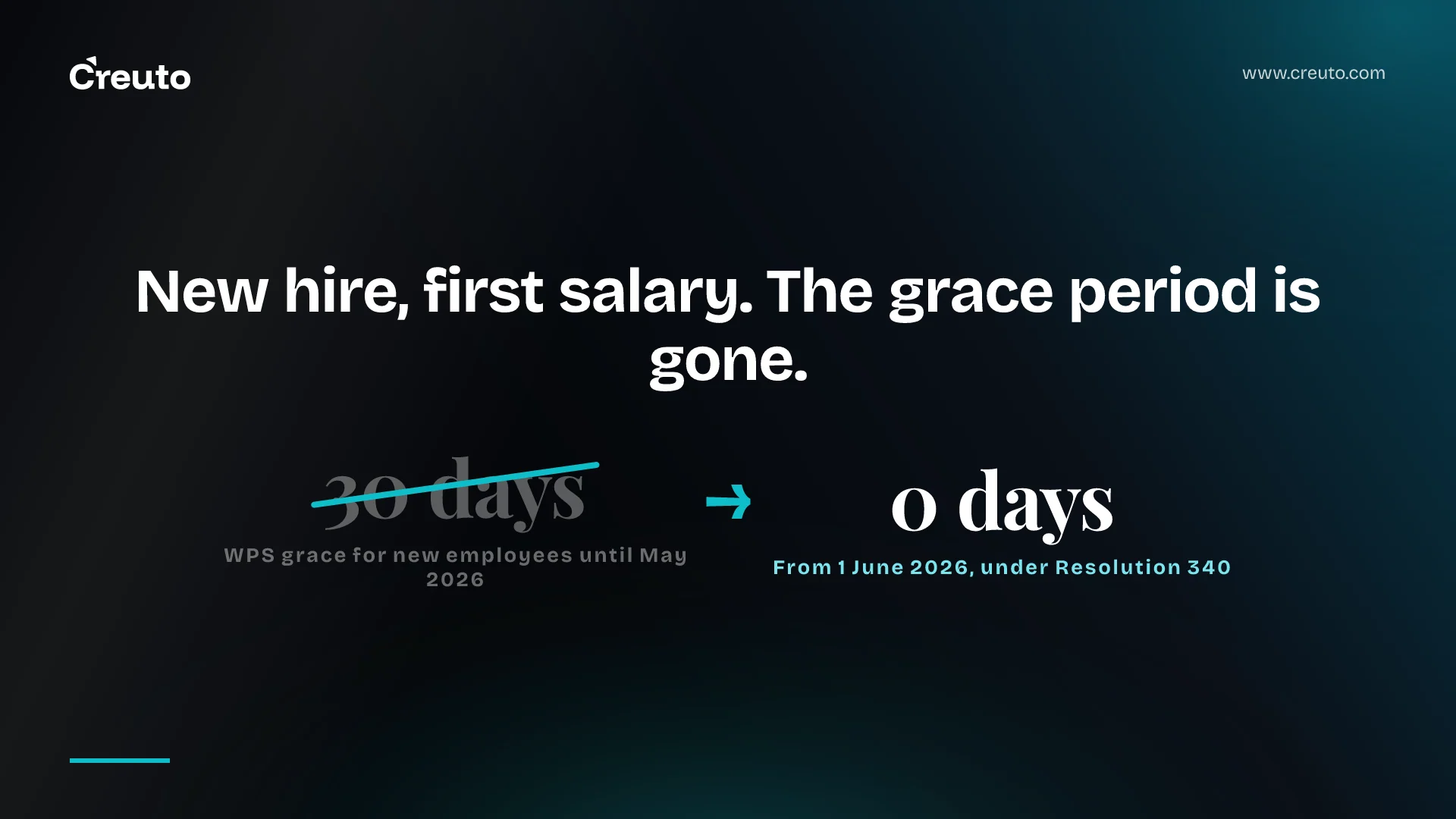
The UAE WPS rules 2026 changed how every private-sector employer licensed with MOHRE runs payroll. Since 1 June 2026, salaries for the previous month are due on the 1st of each month, new employees no longer get a 30-day grace period, and enforcement is automatic, escalating from a warning on day two to possible travel bans by day 21. For companies still running payroll from spreadsheets or an ERP that was never built for the Wage Protection System, this is now a software problem with a daily clock.
What Ministerial Resolution 340 of 2026 changed
The Ministry of Human Resources and Emiratisation issued Ministerial Resolution No. 340 of 2026 on 12 May 2026. It took effect on 1 June 2026 and repeals Resolution No. 598 of 2022. The main changes, as summarised by Morgan Lewis and EY:
- One due date for everyone. Wages for the preceding Gregorian month must be paid on the first day of each Gregorian month. Anything later counts as delayed. Morgan Lewis understands that paying early — at the end of the month — will be treated as compliant.
- No grace period for new hires. The previous exemption for new employees during their first 30 days has been removed. New joiners fall under WPS immediately.
- A higher threshold. An establishment is compliant only if it transfers at least 85% of total wages due by the deadline, up from 80%. A worker counts as paid if they receive at least 85% of wages, with any shortfall due only to lawful deductions.
- Delegation allowed, responsibility retained. Payroll can be outsourced to a third party if MOHRE is given the delegate's details and scope, but the employer remains responsible for timely payment.
- Documentation. Employers must keep and submit supporting evidence of wage payment as MOHRE requires.
What is the WPS penalty for late salary?
The resolution sets a day-by-day escalation from the due date. According to Morgan Lewis:
- Day 1: electronic monitoring begins where salary has not been paid.
- Day 2: MOHRE may issue notifications and warnings.
- Day 5: MOHRE may suspend the issuance of new work permits.
- Day 11: repeated violations within six months may trigger administrative fines and reclassification into the Third Category of MOHRE's establishment classification.
- Day 16: MOHRE may automatically register labour disputes and suspend work permits for employers with 25 or more employees in specified sectors, such as construction, security and cleaning.
- Day 21: in certain cases, precautionary attachment, travel bans against responsible individuals and referral to the Public Prosecutor.
The resolution singles out sectors seen as higher risk, including construction, transport and storage, security services, cleaning, recruitment agencies and domestic worker recruitment offices.
Does WPS apply to new employees?
Yes, from their first pay cycle. This is the change most likely to catch employers out. Previously, a new hire's first salary could fall outside WPS for 30 days, which gave HR time to complete onboarding, open a bank account or card, and add the employee to the Salary Information File (SIF). Now a person who joins mid-month must be paid through WPS by the 1st. Morgan Lewis recommends ensuring that salary payments for new employees can be arranged as soon as possible after they start.
In system terms, onboarding and payroll can no longer be separate processes run by separate teams on separate schedules.
The 85% threshold limits deductions
A less obvious effect: UAE labour law permits deductions of up to 20% of salary in some cases, and up to 50% where there are several grounds. But because a worker only counts as paid at 85%, Morgan Lewis notes that the resolution will in practice restrict deductions to 15% of monthly wages for WPS compliance. Loan recoveries and other deductions configured at higher rates now put the employer in breach, even if they are lawful under the labour law.
UAE WPS rules 2026: what payroll teams must change
- Move the payroll calendar. Companies that paid in arrears around mid-month are the most affected. Close attendance and variable pay early enough to fund salaries by the 1st, or pay at month-end.
- Connect onboarding to payroll. A new-joiner record should trigger the steps needed for WPS payment — bank details, labour card, SIF inclusion — with alerts if any are missing before the cut-off.
- Cap deductions at 15%. Review loan repayment schedules and deduction rules; configure the payroll engine to warn when a worker would receive less than 85%.
- Monitor from day one. Build a dashboard that shows, on the 1st, which employees have not been paid and why. MOHRE is watching from day one; your finance team should be too.
- Keep evidence. Store SIF files, bank confirmations and exception reasons per pay run, ready for MOHRE requests.
- Govern outsourcing. If a payroll provider runs WPS for you, register them with MOHRE and get daily confirmation of transfers — the liability stays with you.
Free zones are a grey area. Morgan Lewis notes it remains to be seen whether free zones that run their own WPS arrangements, such as DMCC or JAFZA, will amend their rules. Check with your free-zone authority.
Why this is a systems problem
The new rules reward employers whose payroll, HR onboarding and banking are connected and punish those where they are not. A late salary that once meant an awkward conversation now triggers automated consequences within five days that affect the whole company's ability to hire. The same pressure is visible in India, where labour code payroll compliance now varies by state: statutory rules are moving into systems, and systems need to be built for them.
We built an enterprise payroll management system around exactly this kind of rule-driven, auditable pay run, and our Dubai team works with UAE employers on WPS-ready payroll. If your ERP's payroll module was not designed for SIF generation, deduction caps and day-one monitoring, our custom ERP development team can add them.
Frequently asked questions
Under Ministerial Resolution 340 of 2026, UAE private-sector salaries for the previous month must be paid through WPS on the first day of each Gregorian month. Payments after that date count as delayed, and paying at the end of the month is understood to be compliant.
WPS penalties for late salary escalate automatically: monitoring on day one, warnings from day two, suspension of new work permits from day five, fines and reclassification for repeat violations from day 11, labour disputes from day 16 and possible travel bans or prosecution referral by day 21.
WPS applies to new employees immediately under the 2026 rules. Resolution 340 removed the earlier 30-day exemption for new hires, so a person who joins mid-month must be paid through WPS by the next first-of-month due date.
A UAE company can outsource payroll under WPS if it gives MOHRE the delegate's details and scope of delegation. The employer remains fully responsible for paying wages on time and for compliance, so it should monitor the provider's transfers closely.
The WPS 85 percent threshold means an establishment is compliant only if it pays at least 85% of total wages due by the deadline, up from 80%. Because a worker counts as paid at 85%, deductions are effectively limited to 15% of monthly wages.