UAE payment gateway integration: what tables leave out
UAE payment gateway integration decided on routing, idempotency, refunds and Jaywan support, not headline rates. Primary sources, read 9 October 2026.
On 9 October 2026, Telr's own pricing page listed four UAE plans priced by monthly processing volume, with international cards charged as a +0.50% surcharge on whichever tier you sit in. The comparison article that ranks for this query prints a flat 2.49% for local cards and 3.49% for international. UAE payment gateway integration keeps getting decided on numbers like that, and the numbers are wrong.
Rates are the least durable thing about a gateway. What survives a two-year build is whether it accepts the cards your customers will actually be holding, whether its retry semantics are safe to build against, and how many engineering days its refund and recurring-billing model costs you. Those things are comparable. Here they are, from primary sources, with read dates.
The rate in the comparison table is the wrong number and the wrong shape
Read on 9 October 2026, Telr's UAE pricing page bands its UAE pricing by monthly volume, not by card origin:
- Startup, AED 0–9,999 a month: AED 249 monthly fee, 0% + AED 0 per transaction, international cards also 0% + AED 0.
- Entry, AED 10,000–24,999: AED 199 monthly fee, 2.45% + AED 1, international cards +0.50%.
- Small, AED 25,000–49,999: AED 99 monthly fee, 2.35% + AED 0.50, international cards +0.50%.
- Medium, AED 50,000 and above: no monthly fee, 2.25% + AED 0.50, international cards +0.50%.
Above AED 500,000 a month the page says the plan is tailored, so there is no published rate at all for a large merchant.
Now compare a widely cited UAE gateway comparison, dated 22 April 2026. It gives Telr a “Starter plan” at AED 349 a month and a “Pro plan” at “about AED 99 per month plus 2.49 percent plus AED 0.50”, with UAE cards at 2.49% + AED 0.50 and international cards at 3.49% + AED 0.50. Neither plan name appears on Telr's page, nor does the AED 349 fee, nor the 2.49% rate. The international figure is not a rate at all on Telr's page: it is a half-point surcharge added to whichever tier you are on, which at the top tier works out to 2.75%, not 3.49%.
The worse error is harder to see. The article gives no volume bands, and the band is the variable that decides your bill. A merchant doing AED 8,000 a month pays Telr AED 249 and nothing per transaction. A merchant doing AED 60,000 a month pays nothing fixed and 2.25% + AED 0.50. The fixed fee and the variable rate move in opposite directions as you grow, and no single percentage can represent that.
The strongest case for leading with rate anyway is that it is the one term you can negotiate and the only one that scales linearly with revenue. At AED 2 million a month, twenty basis points is AED 4,000 every month forever, and no amount of elegant API design earns that back. That case is correct, and it is an argument for getting a quote in writing from the provider — not for reading a rate off a blog post. The structural questions below are the ones a comparison post could answer and never does.
Which payment gateways work in the UAE, according to Apple
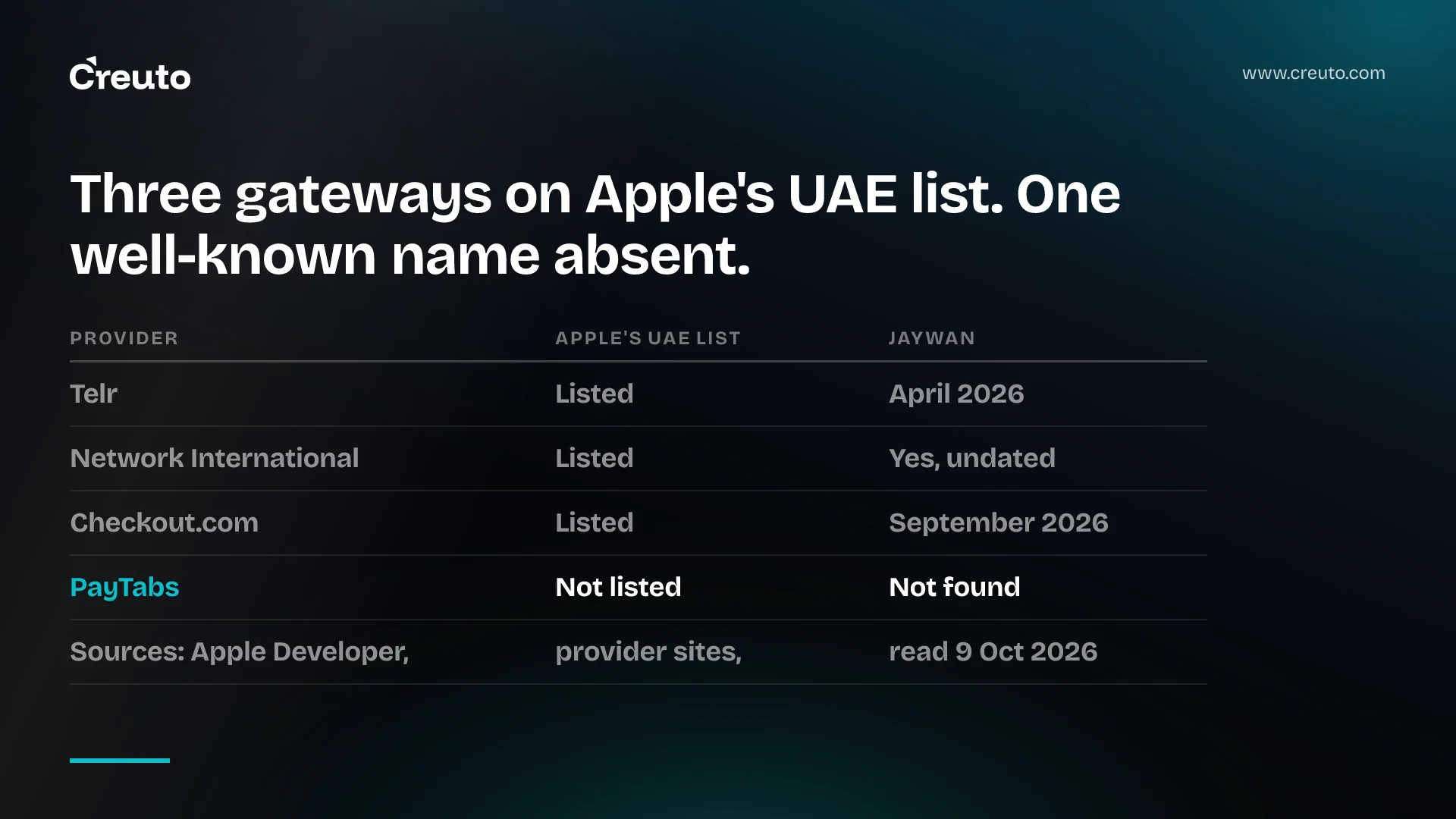
If Apple Pay matters to your checkout, and in the UAE it is close to table stakes, then Apple's own list is the cheapest check available. Apple's Payment Platforms page for developers, read 9 October 2026, names 17 providers for the United Arab Emirates: Adyen, CellPoint Digital, Checkout.com, CyberSource, emerchantpay, Mastercard Payment Gateway Services, Network International, noon payments, NORBr, Payfort, PayOne, Payrails, Solidgate, Stripe, Tap, Telr and Worldpay.
PayTabs is not on it. PayTabs does publish its own Apple Pay support: a post titled “PayTabs now offers Apple Pay as an alternative payment method”, dated 30 May 2021 and updated 22 June 2023, and a current support-portal article listing the UAE among the markets where Apple Pay can be enabled. Both things can be true at once. A provider can support Apple Pay without appearing on Apple's platform list, which is a partnership artefact as much as a technical one, and we are not going to resolve that discrepancy from the outside.
What matters is that the comparison article we read marks Apple Pay as supported for PayTabs and tells readers that “all major UAE gateways support Apple Pay and Google Pay in 2026”. That sentence closes a question instead of opening one. Ask your shortlisted provider for its Apple Pay status in writing, naming the merchant entity and the currencies, and check Apple's list on the day you sign.
| Provider | On Apple's UAE payment platforms list (read 9 Oct 2026) | Jaywan acceptance announced |
|---|---|---|
| Telr | Listed | Reported live 30 April 2026 |
| Network International | Listed | In its e-commerce gateway, per Gulf News |
| Checkout.com | Listed | Integrated into its UAE acquiring platform, September 2026 |
| PayTabs | Not listed | Not found in any source we could read |
Jaywan changes the routing question, and no comparison table mentions it
Jaywan is the UAE's domestic card scheme, operated by Al Etihad Payments, a Central Bank of the UAE subsidiary that also runs the national switch, UAESWITCH. Al Etihad Payments says the scheme officially launched in July 2026, that nationwide issuance by banks, licensed financial institutions and exchange houses commenced at the inauguration, and that institutions are still rolling cards out. We could not find a dated press release for the inauguration on the operator's own site, so treat the month as its wording and the day as unconfirmed.
The integration consequence lives in the card product, not the brand. Al Etihad Payments' own announcement of co-badged cards says licensed institutions offer customers two types of Jaywan card: a mono-badge card, Jaywan only, for use in the UAE and the GCC; and a co-badge card partnered with an international scheme for use locally and globally. Al Etihad Payments has signed co-badging agreements with Discover, Mastercard, UnionPay and Visa, and in July 2026 it added a co-badged Jaywan–Mastercard credit card.
A co-badged Jaywan–Visa card routes over your existing Visa acquiring and you will never notice. A mono-badged Jaywan card will not route anywhere on a gateway that only speaks Visa and Mastercard. It declines. That is a scheme-level capability you cannot add in application code, and it is the one axis on this list where the wrong provider choice is unrecoverable without a migration.
Which is why gateway Jaywan support became news this year rather than a footnote. Telr's Jaywan integration was reported live on 30 April 2026. Checkout.com announced in September 2026 that it had integrated Jaywan into its UAE acquiring platform, saying it “will automatically recognize transactions and route them through Jaywan payment rails” with the transition “managed behind the scenes”. Network International carries Jaywan in its e-commerce gateway; its group chief product and marketing officer, Pinar Alpay, told Gulf News that merchants on that gateway pay no extra fees for it.
Nobody has published how many mono-badged Jaywan cards are in circulation, and neither Al Etihad Payments nor the acquirers we read give a date-certain deadline for banks to issue them. Checkout.com's release refers to “the UAE's mandate” without naming a date, and the Gulf News report describes a phased rollout with no deadlines. This is not a reason to panic. It is a reason to make Jaywan acceptance a written question on your shortlist while the answer is still cheap to act on.
Aani is not a checkout button yet
Aani, the UAE's instant payment service, is the other rail people assume they can integrate this quarter. Al Etihad Payments' own Aani page, read 9 October 2026, reports 12.5 million enrolled users, 750,000 enrolled merchants and 74 active licensed financial institutions, with a maximum of AED 50,000 per transaction, processing in under 10 seconds, available 24/7.
The same page says merchants “will soon experience a new way of accepting payments through innovative Aani services based on QR codes and Requests to pay”. “Soon”, on the operator's own page, is not something you put in a sprint. Treat Aani as a question for your gateway's roadmap conversation, not a payment method you can ship against a launch date.
What to compare instead of the headline rate
Routing and acquirer relationships
Establish whether the provider is the acquirer or sits in front of one, and which one. Network International acquires directly in the UAE; a gateway that fronts somebody else's acquiring adds a party to every chargeback conversation and a hop to every outage. Ask who holds the merchant agreement, whether you can be moved between acquirers without re-integrating, and whether domestic transactions can be routed domestically. The failure modes that follow from that extra hop are the ones we wrote about in chaos engineering for payment systems, and they start below the API.
Retries and idempotency
The most expensive gateway behaviour to discover late is what happens when your request times out after the gateway has already authorised. You need an idempotency key on the authorisation call, honoured for a documented window, and a webhook stream you can replay in order. Most providers guarantee less here than teams assume, which is the subject of our piece on webhook retry patterns and idempotency. Read the provider's documentation on this before you read its pricing page.
Refunds and partial refunds
Full refunds work everywhere. The cases that bite are partial refunds against a captured authorisation, several partial refunds against one payment, refunds after the settlement batch has closed, and whether a refund returns the per-transaction fee or keeps it. Each is a branch in your order state machine, and each one a provider does not support is a manual finance process you have just inherited.
Recurring billing and tokenisation
If you bill on a schedule, the token is the asset. Ask who owns it, whether it is portable to another provider, whether network tokenisation is used, and what happens to stored credentials when you switch. A non-portable token means your migration cost is asking every customer to re-enter a card — the largest hidden switching cost in payments, and the reason gateway choices outlive the teams that make them.
3-D Secure
3-D Secure 2 is where conversion goes to die when it is implemented carelessly. Ask whether the gateway applies exemptions and risk-based authentication or challenges everything, whether you can see your own challenge and abandonment rates, and whether the mobile SDK handles the app-to-browser handoff cleanly. A gateway that challenges every transaction costs you more in abandoned carts than twenty basis points ever will.
Settlement timing and reporting
Settlement is a treasury question and a reconciliation question, and the two have different answers. No UAE provider publishes a uniform settlement cycle, so get yours in writing with the currency, the daily cut-off and the behaviour across weekends and public holidays. Then ask whether the settlement report reconciles to the transaction API on a stable identifier. If finance cannot tie a payout line to a payment, your team builds that mapping, and it never stops needing maintenance.
Sandbox fidelity
Ask what the sandbox cannot do, not what it can. The common gaps are no real 3-D Secure challenge, no Apple Pay, no Jaywan, no settlement files, no webhook retries and a single decline code. Every gap is work you can only do in production, against real money, under a launch deadline.
Integrating a licensed gateway is normally not licensable for you
This is the question that stalls UAE payment projects, and the regulation answers it plainly. The Central Bank's Retail Payment Services and Card Schemes Regulation, Circular C 15/2021, effective 6 June 2021 and shown as in force, sets out its exclusions before Article 1. Clause 6.1 excludes “services, provided by any technical service provider that supports the provision of any payment service, but does not at any time enter into possession of any money under that payment service”.
Build a checkout that hands the card to a licensed gateway and never comes into possession of the money, and you are the technical service provider in that clause. Clauses 6.2 to 6.7 go on to exclude data processing and storage, IT security and privacy protection, data and entity authentication, information technology services, communication networks, and the provision and maintenance of terminals. Between them, that is most of what an engineering team does on a payments project.
The boundary is possession and function, not technology stack. The regulation's licensable retail payment services include Payment Aggregation Services and Payment Initiation Services, and clause 6 is framed as “any service other than Payment Initiation and Payment Account Information Service”. So if your product holds customer funds, aggregates settlement out to sub-merchants, or initiates payments from a customer's account, the exclusion stops applying to you. Our reading here comes from the published regulation and the Central Bank's own rulebook text, not from legal advice; take that from a UAE-licensed adviser before you design a flow that touches funds.
UAE payment gateway integration costs engineering days, not basis points
The honest answer to “what does this integration cost” is a list of work, not a number. A checkout with Apple Pay, 3-D Secure 2, webhook handling, an idempotent authorisation path, partial refunds, a reconciliation job against settlement reports and a token migration plan is a different piece of work from dropping in a hosted payment page. We will not publish a day range for it: the variables above change it by a factor, and a range you could quote back at us would be dishonest.
What we will say is that the cost sits in the second half of that list, and that choosing a provider on rate puts all of it in the wrong column of the spreadsheet. The decision in front of you is not which gateway is cheapest. It is which gateway will give you written answers on Jaywan acceptance, the idempotency window, token portability and the settlement cut-off, and whether it is on Apple's list today. We do this kind of work as API development and integrations, usually alongside an e-commerce build, and our Dubai page is where you can see the shape of it. Get those four answers first. The rate conversation is much shorter once you know which providers can do the job.
Frequently asked questions
No UAE gateway is best in general. The provider that fits is the one that acquires the card types your customers hold, including mono-badged Jaywan, appears on Apple's UAE payment platforms list, documents its idempotency window, and will put its settlement cut-off and token portability terms in writing.
Apple Pay is close to table stakes for a UAE checkout, and Apple lists 17 payment platforms for the United Arab Emirates as of 9 October 2026. Not every well-known UAE gateway appears on that list, so confirm your provider's current Apple Pay status in writing before you commit.
A UAE payment gateway integration involves the checkout and Apple Pay flow, 3-D Secure 2 handling, an idempotent authorisation path, webhook processing with replay, full and partial refunds, card tokenisation for recurring billing, and a reconciliation job that ties settlement reports back to transactions.
Usually not. Clause 6.1 of the Central Bank's Retail Payment Services and Card Schemes Regulation, Circular C 15/2021, excludes a technical service provider that never comes into possession of money. Holding funds, aggregating settlement to sub-merchants or initiating payments is the licensable version.
No UAE provider publishes a uniform settlement cycle, so there is no figure worth quoting. Get your own cycle in writing, with the settlement currency, the daily cut-off time and the behaviour across weekends and public holidays, then check that reports reconcile to the transaction API.
A co-badged Jaywan card routes over the partnered international scheme, so existing Visa or Mastercard acquiring handles it. A mono-badged Jaywan card, issued for use in the UAE and the GCC, will decline on a gateway that does not accept Jaywan, and no application code fixes that.