Test automation ROI: the 68% to 26% AI figure, checked
Test automation ROI when AI writes the code: Atlassian's 68% to 26% drop mixes thresholds. The testing-burden data and a payback formula make the real case.
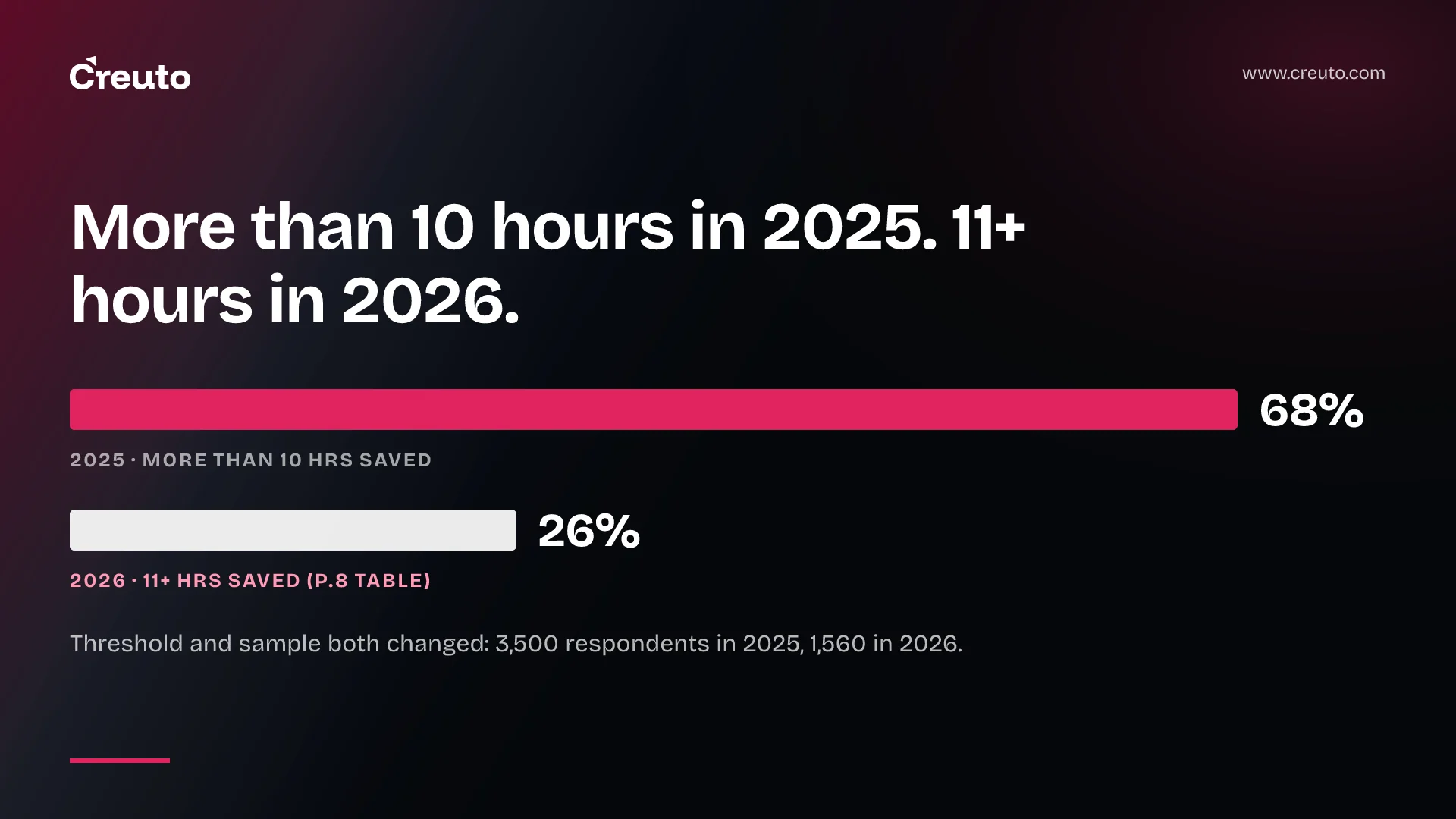
Atlassian's 2026 developer survey states its headline AI time-savings figure three different ways in one PDF, and none of them is measured the way the 2025 number was. That matters for test automation ROI. The drop from 68% to 26% is not the evidence for funding a regression suite. The testing and review burden in the same report is, and you can build an honest business case on it.
By the end of this post you'll know what the 2026 report actually measured, which of its figures bear on QA spending, and how to calculate whether regression automation pays back for your release cadence, with every assumption visible so you can swap in your own numbers.
The 68% to 26% drop rests on three versions of the 2026 number
The headline comes from the executive summary of Atlassian's State of Developer Experience 2026 PDF: "In 2025, 68% of developers reported saving 10 or more hours a week with AI. In 2026, that figure is 26%." InfoQ ran it on 27 October 2026 as "Developers Reporting Double-Digit Weekly Time Savings from AI Fell from 68% to 26%". We read the primary PDF page by page, and the 2026 figure does not hold still.
| Where it appears | Threshold as worded | Figure |
|---|---|---|
| 2025 report, 3,500 developers and managers in six countries | "more than 10 hours a week" | 68% |
| 2026 PDF, executive summary (p.4) | "10 or more hours a week" | 26% |
| 2026 PDF, section 01 text (p.6) | "10+ hours per week" | 25% |
| 2026 PDF, data table (p.8) | "Save 11+ hours per week using AI" | 26% of developers, 31% of leaders |
The 2025 report said "68% saving more than 10 hours a week" from a survey of 3,500 developers and managers across six countries. The 2026 methodology page lists 1,155 individual contributors and 405 engineering leaders. Every 2026 data table we found uses 11+ hours, including the later tables that break the figure down by AI strategy and seniority. Read literally, the 2025 "more than 10 hours" and the 2026 "11+ hours" may be the same bucket, which would make the 26% in the table the closest like-for-like number. The executive summary's "10 or more" is the outlier, and the 25% in the body text matches neither.
InfoQ deserves credit for flagging the sample change: it notes the base moved from 3,500 people to 1,560 and that neither edition publishes fieldwork dates. It does not mention the 25% figure or the 11+ hour threshold. The PDF is also loose elsewhere. It gives the share who say AI-assisted output is higher quality as 60% on one page and 59% two pages later. The report landing page says 75% of developers have more responsibility for validating AI output, while the PDF's own table gives 41%.
The direction of the drop is probably real; a fall of more than 40 points is hard to explain by wording alone. Its precise size is not something you should put in a budget slide. The methodology page says plainly that the findings "reflect self-reported experience and perception, not system-level telemetry such as deployment frequency, cycle time, or revenue impact."
Does AI-generated code increase testing effort? The same report says yes
The more useful data sits in the table that also holds the 11+ hour figure. In the 2026 PDF, 65% of developers say they spend time correcting AI-generated work that missed the original intent, and 72% of leaders say the same. 49% of developers spend 4+ hours a week managing AI tools. 73% say AI-driven speed can come at a cost to quality.
Atlassian draws the conclusion itself. AI output "often lacks context, introduces bugs or vulnerabilities, or hallucinates answers entirely, increasing the burden of testing, review and validation." Separately, 29% of developers name reviewing or managing AI-generated code as a source of friction. For comparison, 51% cite finding information and 50% cite meetings, so treat review load as a growing cost rather than the dominant one.
The strongest signal is not from the survey at all. The PDF cites the DX Q2 2026 State of AI Impact report, where code maintainability rose 3.8% between Q1 and Q2 2026 while change confidence fell 6.1%, across a sample of 500+ companies. DX defines change confidence as developers' "trust that modifications won't cause production failures", and notes that median pull request sizes have "nearly doubled" over the period AI adoption rose. Developers understand the code better and trust their changes less.
That pattern is older than this year's tools. The 2024 DORA report estimated that a 25% increase in AI adoption was accompanied by a 1.5% decrease in delivery throughput and a 7.2% reduction in delivery stability. Change confidence is exactly the thing a regression suite exists to restore.
How to calculate test automation ROI when AI writes the code
Test automation ROI is the manual regression effort a suite removes each year, minus what the suite costs to build and maintain, divided by the build cost. Measure it in engineering hours first and convert to money last, so the argument doesn't depend on whose salary bands you use.
- Manual pass cost (M): person-hours for one full manual regression pass before a release.
- Coverage share (C): the fraction of that pass the suite can replace. It is never 100%; exploratory testing stays manual.
- Release count (R): releases per year that need a regression pass.
- Build cost (B): engineering hours to write the suite and wire it into your CI pipeline.
- Maintenance (K): hours per year spent fixing broken selectors, flaky tests and outdated fixtures.
Annual hours saved = M × C × R − K. Payback in years = B ÷ (M × C × R − K). First-year ROI = (M × C × R − K − B) ÷ B.
A worked example, with every input labeled as an assumption
These numbers are illustrative assumptions, not data from any survey or client. Replace each one with your own before you take it into a budget meeting.
| Input (assumed) | 12 releases a year | 26 releases a year |
|---|---|---|
| Manual pass, M | 30 hours | 30 hours |
| Coverage share, C | 70% | 70% |
| Hours replaced per year, M × C × R | 252 | 546 |
| Maintenance per year, K | 100 hours | 100 hours |
| Build cost, B | 400 hours | 400 hours |
| Net hours saved per year | 152 | 446 |
| Payback | about 2.6 years | about 11 months |
Release cadence is the input that moves the answer most. That is where AI coding tools change the case: if your team now ships fortnightly instead of monthly with the same QA headcount, the manual pass is no longer a fixed cost you absorb, it multiplies. Notice what is absent from the formula. The share of developers who say they save 10 or 11 hours a week never enters it.
When does regression automation pay for itself?
Regression automation pays for itself when the hours it replaces each year clearly exceed its maintenance hours, and the build cost divided by that difference is shorter than the life of the code it protects. On the assumptions above, that happens inside a year at fortnightly releases and takes well over two years at monthly ones. If your maintenance hours approach the hours replaced, the suite never pays back.
The strongest case against funding a suite now
The best argument for adding manual QA instead is that the code under test is changing faster than ever, and automated suites are brittle against change. Every AI-driven refactor that renames a component or reshapes an API can break dozens of end-to-end tests at once. A suite written against an unstable interface turns into a maintenance tax, and flaky tests teach the team to ignore red builds, which is worse than having no suite. We've written about spotting flaky tests before they bite because this failure mode is common.
There's a second objection: if AI writes the tests too, they may simply restate what the code does. High coverage from generated tests can hide weak assertions, which is why we check AI generated unit tests with mutation testing rather than trusting the coverage number.
Both objections are real, and both point at scope rather than at the decision itself. Automate the stable, high-value paths first: login, permissions, money movement, and the integrations between modules. Keep exploratory and UI-polish testing manual. Regression automation is the wrong choice if your product is pre-market and its core flows change weekly, or if you release a handful of times a year. In those cases the maintenance term eats the savings.
Where regression risk concentrates in a cross-module system
Our own evidence here is qualitative, and we'll keep it that way. We built a custom ERP for a large-scale industrial client that unifies HR, CRM, inventory and finance in one browser-based platform, with four departments working from one source of truth. That design is the point of the system and also its regression risk. A change in one module can reach data that the other three departments depend on.
In a system shaped like that, the tests that earn their keep are the ones that cross module boundaries: an inventory change that should show up in finance, or a role change in HR that should alter what someone can see in CRM. Those are also the checks a reviewer reading a single AI-generated pull request is least likely to catch, because the failure lives outside the diff. If you're deciding where the first block of automation effort goes, put it there.
Fund the regression suite or add manual QA: making the call
Start with three numbers from your own pipeline: how many hours a full manual regression pass takes, how many releases you shipped this quarter against the same quarter last year, and how many escaped defects traced back to a module the change didn't touch. If release count rose after AI adoption while QA headcount stayed flat, the formula above tends to favor automation on your core cross-module flows. If it didn't, keep testing manually and revisit when cadence changes.
Don't cite the 68% to 26% figure in that conversation. Cite the testing burden: the 65% correcting AI work, the 6.1% fall in change confidence, and your own release count. If you want a second opinion on the inputs, our QA and automation team will map your manual regression pass, estimate coverage share and maintenance for your stack, and tell you whether the payback clears your bar before you commit headcount either way.
Frequently asked questions
Test automation ROI is the manual regression hours a suite replaces each year, minus its yearly maintenance hours, minus the build cost, divided by the build cost. Work in engineering hours first, then convert to money. Payback in years is the build cost divided by net hours saved per year.
Atlassian's State of Developer Experience 2026 does not show that cleanly. Its 68% to 26% drop compares a 2025 'more than 10 hours' figure from 3,500 respondents with 2026 figures stated as 10 or more, 10+ and 11+ hours from 1,560 respondents, all self-reported. The direction is plausible; the exact size is not reliable.
Survey evidence says AI-generated code adds review and testing work. In Atlassian's 2026 report, 65% of developers say they correct AI-generated work that missed the original intent, and 73% say AI-driven speed can cost quality. DX data cited in the report shows change confidence fell 6.1% between Q1 and Q2 2026.
Regression automation pays for itself when the manual hours it replaces each year clearly exceed its maintenance hours and the build cost recovers within the life of the code. Release cadence matters most: the same suite that takes years to pay back at monthly releases can pay back within a year at fortnightly ones.
Test automation is usually worth it for a team using AI coding tools if release cadence rose while QA headcount stayed flat, because each extra release multiplies the manual regression pass. It is a poor fit for a pre-market product whose core flows change weekly, where test maintenance consumes the savings.