Superintelligence timelines: what the labs have actually said
Every public superintelligence timeline claim, quoted, dated and linked to a primary source, including the forecasts that already slipped. We give no date.
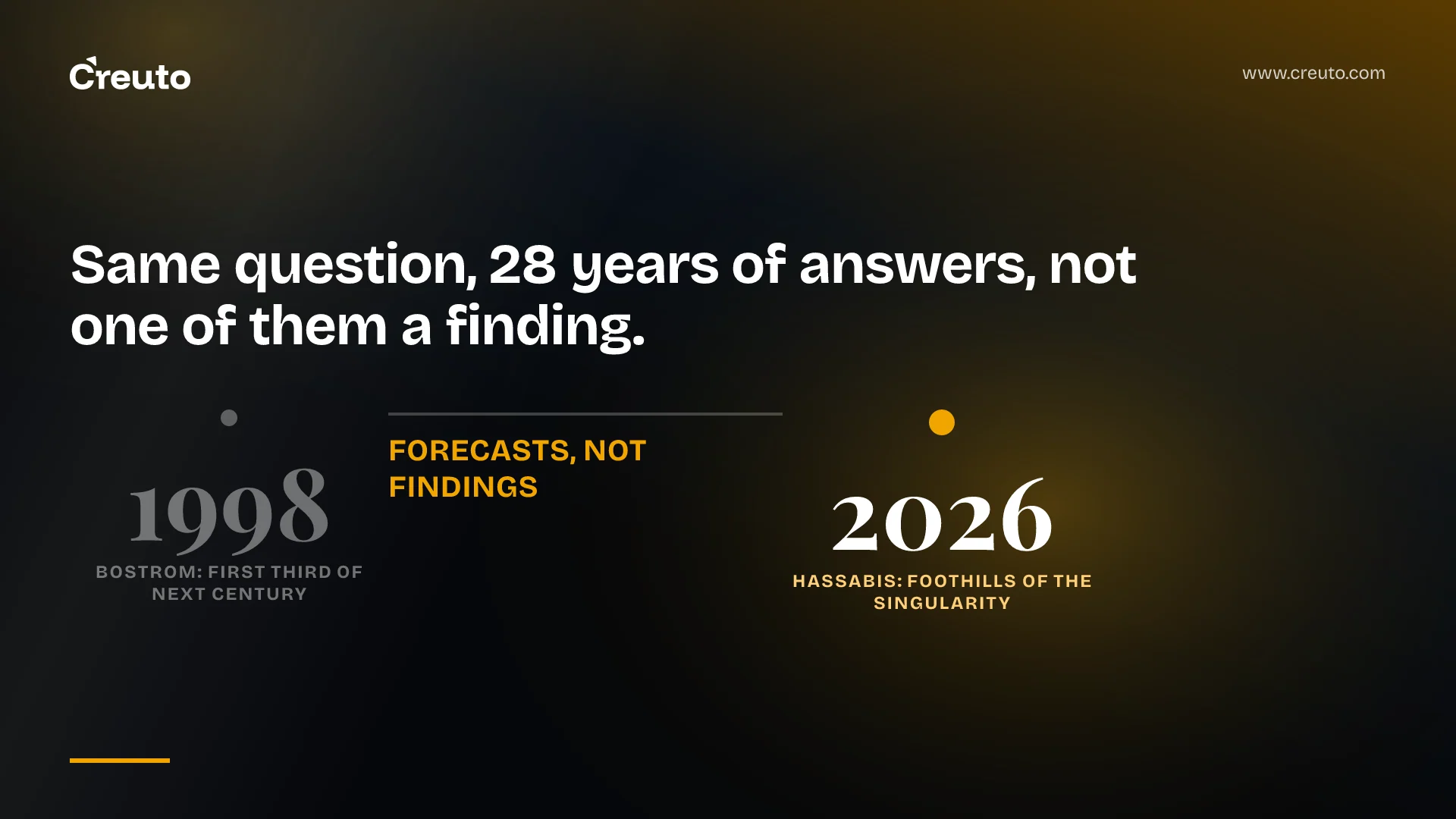
Every superintelligence timeline in public circulation is a quote from a named person on a dated day, and most of the coverage strips all three of those things out. Below is the record with them left back in: the exact words, who said them, when, and a link to the primary document. Where we could not source a sentence to a primary document, it is not in this post.
Settle one thing before the list. A forecast is not a finding. A benchmark score is a measurement of something that happened; a sentence about 2030 is a person's expectation. We do not forecast a date for superintelligence, and the last section says what we plan against instead.
The superintelligence timeline claims, quoted and dated
Eight dated public statements, every one of them a forecast rather than a result. Each is sourced in full below.
| Who | Date | What they said |
|---|---|---|
| Nick Bostrom | 1998 | "superhuman artificial intelligence within the first third of the next century" |
| Nick Bostrom | 12 March 2008 | "less than a 50% probability to superintelligence being developed by 2033" |
| OpenAI | 5 July 2023 | "we believe it could arrive this decade" |
| Sam Altman | 23 September 2024 | "superintelligence in a few thousand days (!)" |
| Dario Amodei | October 2024 | "it could come as early as 2026" |
| Sam Altman | 10 June 2025 | "2026 will likely see the arrival of systems that can figure out novel insights" |
| Mark Zuckerberg | 30 July 2025 | "Developing superintelligence is now in sight" |
| Demis Hassabis | 18 June 2026 | "standing in the foothills of the singularity now" |
Notice what is missing. Not one of these is a research result, and not one of them is unhedged in its original wording. The hedges are the first casualty of secondary coverage, which is why reading the primary document matters more here than on almost any other subject. If you want the terms themselves pinned down first, we have separate pieces on what superintelligence actually means and on the difference between AGI and ASI.
The oldest forecast on record, and its author's own downgrade
The earliest citable version of the question is Nick Bostrom's paper How Long Before Superintelligence?, originally published in the International Journal of Futures Studies in 1998 and still on his own site with its revision history intact. The abstract:
This paper outlines the case for believing that we will have superhuman artificial intelligence within the first third of the next century.
What makes this the most instructive entry in the whole record is the four postscripts underneath it. The fourth, dated 12 March 2008, revises the author's confidence down rather than up:
In fact, I would all-things-considered assign less than a 50% probability to superintelligence being developed by 2033. I do think there is great uncertainty about whether and when it might happen.
He adds in the same paragraph that there is more interest in artificial general intelligence research than there was a few years earlier, "however, it appears that as yet no major breakthrough has occurred". Ten years after making the case, the person who made it put it below even odds and said so on the same page. That is what an honestly maintained forecast looks like, and it is rarer than it should be.
What the lab leaders have said on the record since 2023
OpenAI, 5 July 2023
The Introducing Superalignment post is the clearest institutional statement anyone has made, because it attaches a deadline to itself:
While superintelligence seems far off now, we believe it could arrive this decade.
The subheading carries the commitment: "To solve this problem within four years, we're starting a new team, co-led by Ilya Sutskever and Jan Leike, and dedicating 20% of the compute we've secured to date to this effort." Four years from July 2023 is July 2027. Hold that date.
Sam Altman, 23 September 2024 and 10 June 2025
In The Intelligence Age, published at ia.samaltman.com on 23 September 2024, OpenAI's chief executive wrote:
It is possible that we will have superintelligence in a few thousand days (!); it may take longer, but I'm confident we'll get there.
The hedge sits inside the sentence, and the exclamation mark is his. Both usually vanish by the time the line reaches a slide deck. Nine months later, in The Gentle Singularity, published 10 June 2025, he swapped the single horizon for year-by-year expectations: "2026 will likely see the arrival of systems that can figure out novel insights" and "2027 may see the arrival of robots that can do tasks in the real world."
Dario Amodei, October 2024
Anthropic's chief executive mostly avoids the word superintelligence and defines his own term instead. In Machines of Loving Grace, published in October 2024, "powerful AI" is a model that is "smarter than a Nobel Prize winner across most relevant fields", that "can be given tasks that take hours, days, or weeks to complete, and then goes off and does those tasks autonomously", that can "control existing physical tools, robots, or laboratory equipment through a computer", and that runs as millions of instances at "roughly 10x-100x human speed". On timing:
I think it could come as early as 2026, though there are also ways it could take much longer.
Amodei's definition is the most useful thing in the whole record, because it is the only one specific enough to be scored. Keep it; we use it below.
Mark Zuckerberg, 30 July 2025
Meta's letter on personal superintelligence, signed "Mark" and dated 30 July 2025, makes the shortest claim and the least falsifiable one: "Developing superintelligence is now in sight." There is no date in it at all. It is a product positioning statement, and it is worth recognising as one when a vendor quotes it at you.
Demis Hassabis, 18 June 2026
The most recent dated statement we could source to a published transcript is Google DeepMind's chief executive in conversation with Stanford's president and Jennifer Aaker, published by Stanford Graduate School of Business on 18 June 2026:
Ten years from now, I think we'll realize that we were standing in the foothills of the singularity now.
Asked what he meant, he separates the technology from the era: "there's the technology which is AGI... I believe that we're only a few years away from that, maybe like 20, 30 plus or minus a year". The published transcript renders the year that way; in context he is naming 2030, give or take a year, for AGI rather than for superintelligence.
The same interview contains the single most useful line any lab leader has said about this genre, and it is about his peers: "I think they're being way too certain, I would say, with some of their pronouncements. Where I think actually there's just huge uncertainty."
Where the predictions have already slipped
This is the section most timeline articles leave out, and it is the only one with any predictive value at all. A forecaster's track record is checkable; their confidence is not.
Bostrom, 1998 to 2008. The 1998 paper reasoned that the hardware threshold would be crossed "sometime between 2004 and 2008, depending on whether we assume a doubling time of 12 or 18 months". The hardware arrived; the 2005 postscript records Blue Gene/L passing the Moravec estimate of the brain's processing power. The software did not follow, and the 2008 postscript recorded that no major breakthrough had occurred. A correct hardware prediction and a wrong capability prediction, from the same author, ten years apart.
OpenAI's four-year deadline. The July 2023 commitment was to solve superintelligence alignment "within four years" with 20% of secured compute. On 17 May 2024, ten months in, WIRED reported under the headline OpenAI's Long-Term AI Risk Team Has Disbanded that "the entire OpenAI team focused on the existential dangers of AI has either resigned or been absorbed into other research groups". The July 2027 deadline still stands on the original page. The team that owned it did not last a year. That is not a capability forecast failing — it is an institutional commitment failing, which for a buyer is the more relevant kind, and the reason we wrote separately about what the labs have actually shipped as against what they have announced.
Amodei's "as early as 2026". As of 1 October 2026 the year is three-quarters gone. Score it against his own definition rather than against vibes, because the definition requires autonomous work over days or weeks and control of physical tools. The International AI Safety Report 2026, submitted on 24 February 2026 and written with guidance from over 100 independent experts nominated by more than 30 countries and intergovernmental organisations, assessed that AI systems "cannot yet integrate with robotic components to perform basic physical tasks such as housework". The original sentence was hedged — "there are also ways it could take much longer" — and the hedge is now the operative half.
Altman's 2026 and 2027 claims are not yet due. "Systems that can figure out novel insights" has no agreed test behind it, so it will be argued rather than settled. We are not scoring it in either direction, and neither should anyone selling you software on the strength of it.
What the expert assessment offers instead of a date
The safety report declines to give a date. It presents four scenarios for 2030 developed by the OECD and concludes that "by 2030, AI progress could plausibly range from stagnation to rapid improvement to levels that exceed human cognitive performance". Its contributors, it says plainly, differ on how quickly capabilities will improve. Our builder's summary of that report goes through the rest of it.
It does carry one measured trend worth more than all eight quotes above. Citing Kwa et al. (2025), it states that AI systems complete well-specified software engineering tasks that take human experts 30 minutes around 80% of the time, and that this task length has been doubling roughly every seven months. The report then extrapolates — explicitly as an if-this-continues, not as a finding — to tasks lasting several hours by 2027 and several days by 2030.
That number is usable in a way an exam score is not, because it is denominated in the same unit your work is denominated in: how long a competent person would take. It is also falsifiable on a schedule. You can check it against your own backlog this quarter.
The strongest case for taking the lab forecasts seriously
Here is the counter-argument at full strength, because it deserves one. The people making these statements have more information than anyone outside their companies: they see the next training run, the internal evaluations and the compute curve months before the rest of us do. Bostrom in 1998 was extrapolating Moore's law from outside the field. Amodei in 2024 was describing a system his own organisation was building. Treating both as the same kind of claim is lazy.
Two things answer it. First, private information cuts both ways — it also gives a reason to talk the number up while raising capital, and none of these statements were made in a context where being wrong carried a cost. Second, and more decisively, the insiders disagree with each other by years while looking at comparable evidence, and one of them says so out loud. When Hassabis says his peers are "being way too certain", he is describing a group that has the information advantage and still cannot converge. An information advantage that does not produce agreement is not a reason to trust any single member of the group.
Why we do not forecast a superintelligence timeline, and what we plan against
We do not give a date for superintelligence or AGI. Not a decade, not a range, not a hedged range. It is not modesty; it is that a date would change nothing we would build.
What we plan against is measured task length and measured failure behaviour. In practice that means three habits in the AI engineering work we do. Bound every model call to a task duration where published reliability actually holds, and re-check that bound when a model changes. Treat a model's confidence as a routing signal rather than a truth claim, which is the argument in confidence versus probability thresholds. And keep a deterministic path alive for anything that touches money, safety or a regulator.
This is the wrong approach if you are an investor rather than a builder. Someone allocating capital across a decade has to take a position on the trend line, and refusing to is itself a position. The argument here is narrower: an architecture decision you make this quarter should not depend on a sentence someone said in a blog post.
So when a roadmap only works if a forecast lands, the forecast is the product. Ask which of the eight quotes above the plan depends on, and ask what the system does in every year where it has not happened yet.
Frequently asked questions
No dated answer is supportable from the public record. Demis Hassabis said on 18 June 2026 that AGI is only a few years away, naming roughly 2030 give or take a year, while the International AI Safety Report 2026 presents four OECD scenarios for 2030 ranging from stagnation to performance exceeding human cognition.
Nobody knows, and every public claim is a forecast rather than a finding. Sam Altman wrote in September 2024 that superintelligence in a few thousand days was possible, while Nick Bostrom assigned it under 50% probability by 2033 in a postscript dated March 2008. Both authors hedged explicitly in the original sentence.
The track record argues against relying on them. Nick Bostrom lowered his own 1998 forecast in 2008, and OpenAI's July 2023 commitment to solve superintelligence alignment within four years lost the team that owned it by May 2024, ten months later, according to WIRED's reporting at the time.
Of the dated statements we could source to primary documents, Dario Amodei's October 2024 essay names the earliest year, saying his definition of powerful AI could come as early as 2026 though it could also take much longer. Demis Hassabis names roughly 2030 for AGI, and Bostrom's 2008 postscript names 2033 at under 50%.
Some have slipped and some are not yet due. Bostrom's 1998 hardware milestones arrived without the software breakthroughs he expected, and Amodei's 2026 date for powerful AI requires autonomous multi-week work and physical tool control that the February 2026 safety report says systems still lack.
No. Creuto does not forecast a date for superintelligence or AGI in any form, including a hedged range. We plan against measured task length and measured failure behaviour instead, because a date would not change any architecture decision we would make for a client this quarter.
Watch task duration. The International AI Safety Report 2026 cites a study finding that AI systems complete 30-minute software engineering tasks around 80% of the time, with that task length doubling roughly every seven months. It is denominated in the same unit as your own backlog, unlike an exam score.