Software development company checklist: 10 checks to verify
A software development company checklist you can verify: company records, live portfolios, verified reviews, named teams, pricing and code ownership.
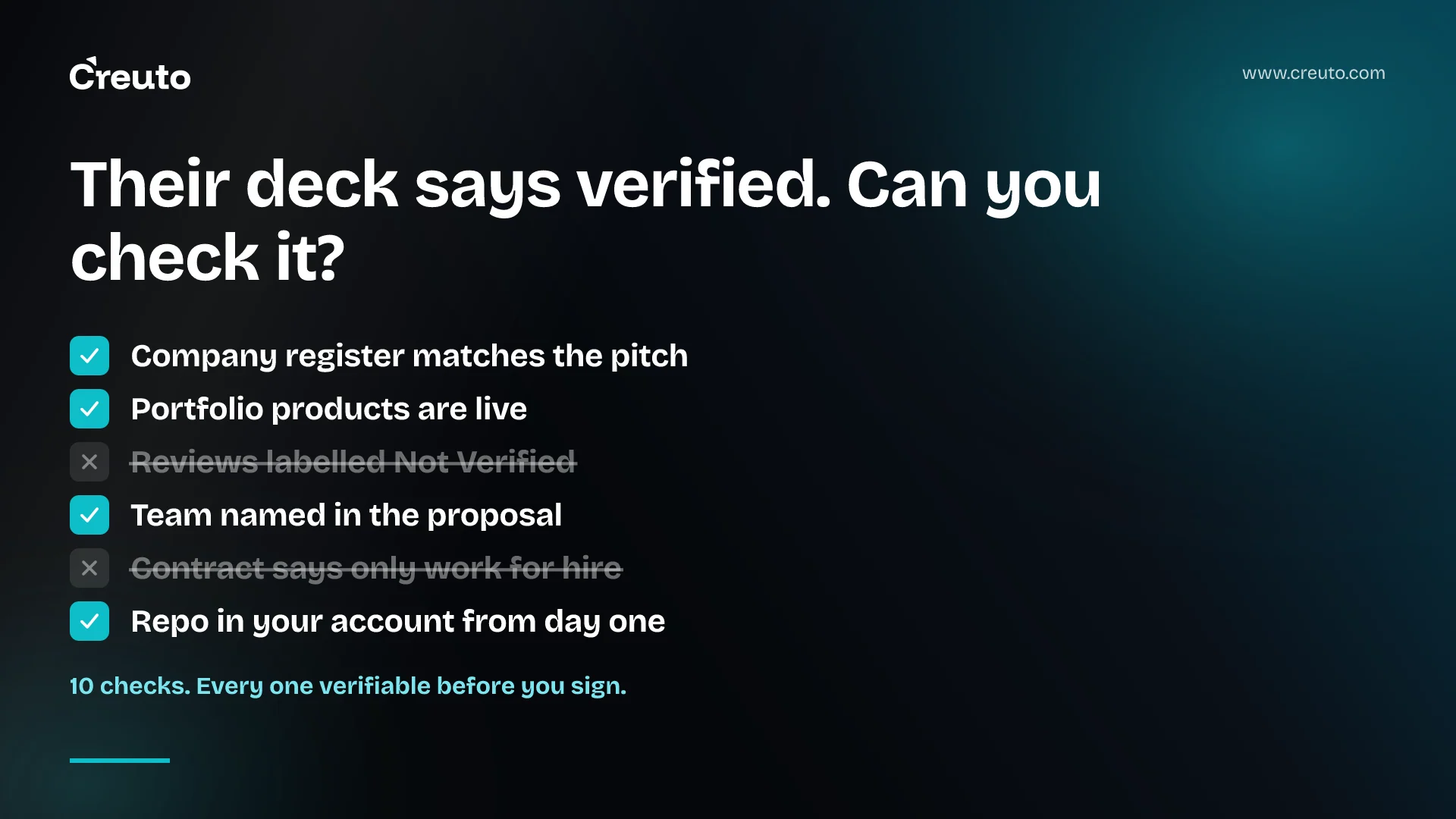
A software development company checklist only helps if you can actually check it. Most ask you to judge "communication" and "culture" from a sales call. The ten checks below are different: each can be confirmed outside the vendor's pitch, in public company registers, live products, review platforms and the contract itself.
By the end you will have a scorecard to run against every company on your shortlist, the questions that expose a weak answer, and the contract clause that decides who owns your code. Where a check depends on a law or a platform's rules, we link the primary source.
The software development company checklist at a glance
| # | Check | How you verify it |
|---|---|---|
| 1 | The legal entity exists and is as old as its claims | Company register lookup |
| 2 | Portfolio products are live and published by them | Open the product; read the store listing |
| 3 | Case studies name a client you can contact | Ask for an introduction, then make the call |
| 4 | Reviews are verified, not just numerous | Read the verification label on each review |
| 5 | The picture holds across more than one platform | Compare two independent review sites |
| 6 | The proposal names the team | Names, roles and profiles in writing |
| 7 | An engineer, not only sales, has talked to you | A technical session before signing |
| 8 | The pricing model fits how settled your scope is | Match the model to your requirements |
| 9 | Communication is visible before you sign | Sample reports, cadence, tool access |
| 10 | You own the source code | An explicit IP assignment clause |
Run the same ten against every vendor. A company that passes eight with clear evidence is a safer bet than one that dazzles on three and goes vague on the rest.
Checks 1-3: prove the company and its work exist
1. The legal entity is real and its age matches the pitch
Every serious vendor is a registered company, and most countries let you look one up for free. In the UK that is Companies House; in India it is the Ministry of Corporate Affairs master data. Compare the incorporation date with the "15 years of experience" on the website. Team experience can predate the company, but the gap should be explainable, and the contracting entity on your proposal should be the one you looked up.
2. How to check a software company portfolio
Open every product in the portfolio and use it. A mobile app's store listing shows the developer account that published it and when it was last updated. If the developer is the client, ask what part the vendor built. If the app has not been updated in two years, ask who maintains it now. Screenshots prove nothing; a live product with recent releases proves a lot.
3. Case studies name a client you can talk to
A case study that says "a leading fintech" cannot be checked. Ask for two references from projects similar to yours in size and type, and make the calls. Ask the reference what went wrong and how the vendor handled it. Every project has a bad week, and the answer to that question tells you more than the praise does.
Checks 4-5: how to verify software development company reviews
4. Reviews are verified, not just numerous
A review count tells you little until you know how the reviews were checked. Before you trust an average, find out what the platform confirmed about each reviewer: that the person exists, that they were a client of the company, and which project they worked on. Read the label on each review, not just the score.
Do not confuse a verified review with a verified company. A badge that says a vendor is a legitimate business tells you nothing about whether any single review came from a real client. On Edverise the two are kept apart: a company earns its Verified label by proving it controls its domain or email, while only reviews confirmed to come from a real client on a real project count towards its ranking.
The law has moved too. On 14 August 2024 the US Federal Trade Commission announced a final rule that prohibits creating or selling reviews from people who do not exist, including AI-generated ones, and lets the agency seek civil penalties against knowing violators. A rule is not a filter, though. Fake reviews are now riskier to buy, not impossible to find, so the label still matters.
5. Compare software development companies' reviews on more than one platform
One platform can be gamed or simply thin. When a company's reviews say the same things on two independent sites, about the same strengths and the same weaknesses, you can start to trust the pattern. A company that has hundreds of reviews in one place and none anywhere else deserves a closer look.
Compare verified software companies and read client reviews on Edverise. A disclosure first: Edverise is our sister company. We built it, and Creuto's three co-founders co-founded it, so weigh this recommendation with that in mind. We point you to it because it is built around the two checks above. Reviews on Edverise are not anonymous: each reviewer names the project they worked on, and a company cannot review itself. Its published ranking methodology states that paying Edverise does not raise a company's rank.
Edverise launched in the third quarter of 2026, so many profiles do not have client reviews yet. Read the reviews that are there, treat an empty profile as neutral rather than negative, and start from its ranked list of software development companies or its guide for buyers vetting a vendor. We describe the engineering behind its ownership verification in our Edverise case study.
Checks 6-7: the team you will actually get
6. The proposal names the people
The senior architect on the sales call is often not the person who writes your code. Ask for the delivery team by name and role in the proposal: engineering lead, developers, QA, designer. Look them up. Then ask for a clause that says the vendor will not replace named key people without telling you and agreeing a handover. A vendor that will not name the team before signing is telling you the team is not decided yet.
7. An engineer has talked to you, not only sales
Book a 45-minute technical session with the proposed engineering lead. Ask them to walk through an architecture decision from a past project, what they chose, what they rejected and what they would change. Then give them a real constraint from your project and listen to the questions they ask. Good engineers ask about your data, your integrations and your users before they talk about frameworks.
Check 8: fixed price vs time and materials in software development
The best pricing model for outsourced software development is the one that matches how settled your scope is. Neither model is cheaper by default. Each moves risk to a different side of the table.
| Model | Fits when | Risk you carry |
|---|---|---|
| Fixed price | Scope is written down and unlikely to change | Every change becomes a change request; the vendor pads the quote for uncertainty |
| Time and materials | Requirements will evolve as users react | The budget is open unless you cap it and watch the burn |
| Dedicated team | Long-running product work with a steady backlog | You manage priorities; idle capacity still costs money |
The strongest case for fixed price is budget certainty, and finance teams need it. The answer is not to refuse fixed price but to earn it: run a short paid discovery phase first, fix the price on the scope that discovery produces, and keep the rest on time and materials. If you have not yet decided whether to build at all, settle which parts of your stack to build and which to buy before you compare quotes.
Use timelines as a sanity check too. On our own projects, a focused MVP typically takes 6-10 weeks and a larger enterprise platform 3-6 months, depending on complexity, integrations and scope. A quote far outside those ranges is not necessarily wrong, but the vendor should be able to explain it line by line.
Check 9: communication you can see before you sign
You cannot verify "great communication" from a sales call, but you can ask for evidence of it. Ask for a redacted sprint report and a recorded demo from a current project. Ask how many hours of working overlap you will get, and who answers when something breaks on a Friday evening. Ask whether you will have direct access to the code repository and the issue tracker from day one, not a weekly PDF summary. Then notice how the vendor behaves during the proposal itself. Response times and clear answers now are the best preview you will get.
Check 10: who owns the code when you outsource software development
Do not assume that paying for the code means you own it. Under US copyright law, a commissioned work by an outside party counts as "work made for hire" only if it falls into one of nine categories, such as a contribution to a collective work, a translation or an atlas, and both sides sign a written agreement saying so. That is according to the US Copyright Office's Circular 30. Software built by a vendor is not on that list. So a contract that only calls the code "work for hire" may not transfer ownership under US law.
What you want instead is an explicit assignment of intellectual property to you, effective on payment, covering source code, designs and documentation. Add three practical terms: the repository lives in your organisation's account from the first commit, third-party and open-source components are listed, and the vendor's reusable libraries come with a perpetual licence. Contracts under Indian, UK or UAE law work differently, so have counsel review the clause. If you are hiring in the Gulf, we cover the contract questions in what to ask a software development company in Dubai before you sign.
Software development company red flags
- The contracting entity on the proposal is not the company you researched.
- Portfolio products are offline, or published by an account with no link to the vendor.
- References are offered only in writing, never on a call.
- Most reviews are unverified, or all of them appeared within a few weeks.
- The team is "to be assigned after signing".
- A fixed price arrives before anyone has asked about your data or integrations.
- The vendor wants to keep the repository in its own account.
Run this software development company checklist on us
Apply every check here to Creuto as well. Our case studies name the products we built, and the people who built them will join the technical session in check 7. If you are shortlisting vendors for a custom build, our custom software development team will walk through scope, pricing model and the IP assignment terms from check 10 before you sign anything. And if you have already hired a software company, reviewing it on Edverise gives the next buyer one more check they can trust.
Frequently asked questions
Before hiring a software development company, check that its legal entity is registered, its portfolio products are live, its references will talk to you, its reviews are verified, its proposal names the team, its pricing model fits your scope, and its contract assigns the source code and IP to you.
Software company reviews are more trustworthy when the platform confirms the reviewer's identity and project and labels reviews it could not verify. Read the verification label on each review, check that the same strengths and weaknesses appear on two independent platforms, and be wary of many reviews posted in a short burst.
The best pricing model for outsourced software development depends on how settled the scope is. Fixed price suits a written, stable scope; time and materials suits requirements that will change; a dedicated team suits long product work. A common middle path is paid discovery first, then fixed price on the scope it produces.
Ownership of outsourced code depends on the contract and its governing law. Under US law, vendor-built software is not one of the nine work-made-for-hire categories, so a work-for-hire label alone may not transfer it. Ask for an explicit IP assignment on payment, and have counsel review it.
Edverise lets buyers compare software development companies, with profiles marked Verified once a company proves control of its domain or email, and rankings built only on reviews from named clients on real projects. Edverise is Creuto's sister company, so it is worth checking a second platform too.
