Salesforce Core pricing: $195 a user, and when a custom CRM wins
Salesforce Core pricing is $195 per user a month after Enterprise was retired on 3 September. What Core includes, five-year costs, and when a custom CRM wins.
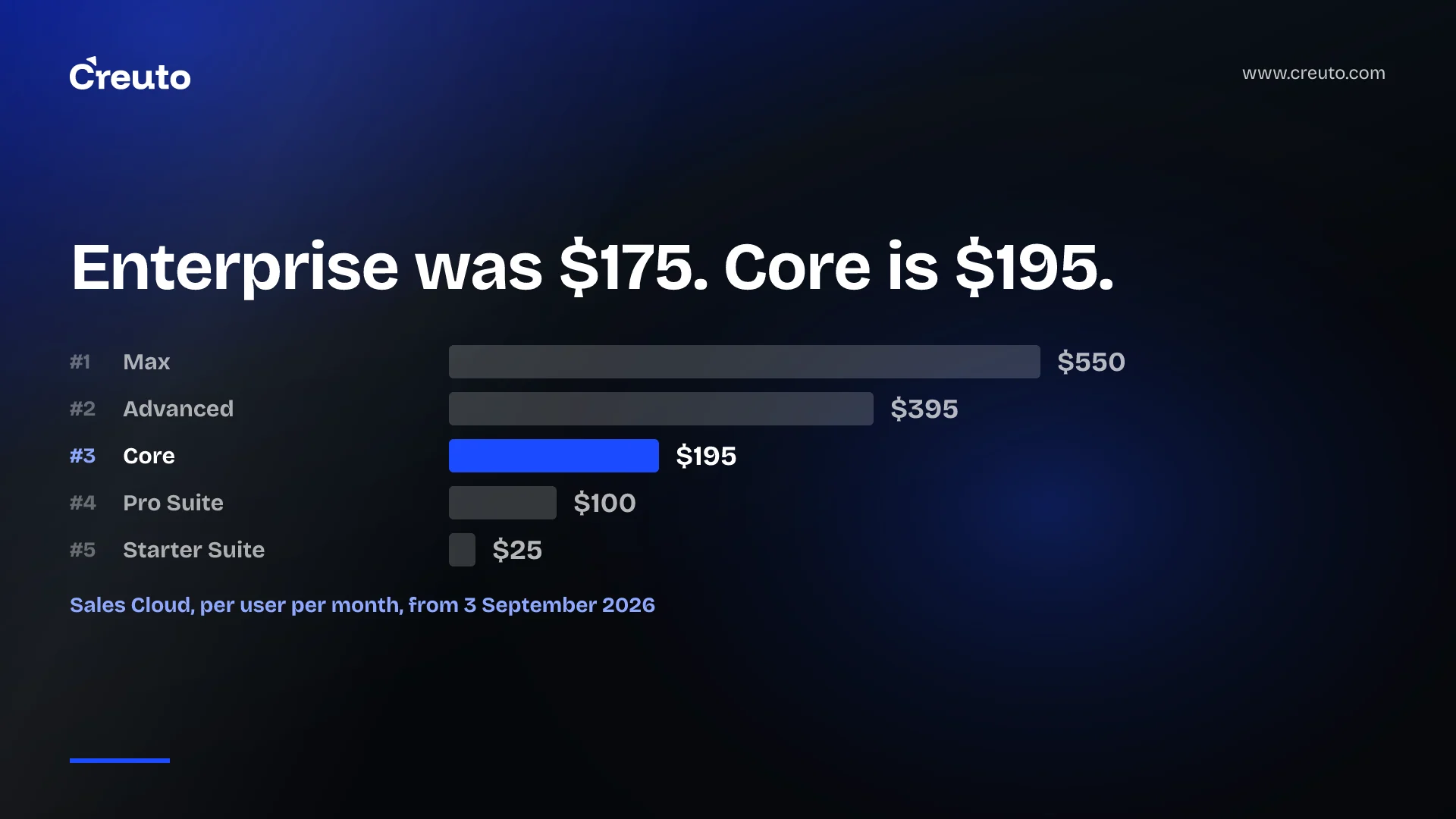
On 3 September Salesforce rebuilt its price list. Enterprise and Unlimited are gone; in their place are Core, Advanced and Max. Salesforce Core pricing starts at $195 per user per month, billed annually — up from $175 for the Enterprise edition it replaces. Salesforce says the new editions deliver far more value, and for some customers they do. For others, the repricing is a good moment to check what they are actually using, and whether a CRM built around their own sales process would cost less over five years.
We build custom CRMs, so read this with that in mind. We also think Salesforce is the right answer for many companies, and say where below.
Salesforce Core pricing and the new editions
Salesforce's Sales Cloud pricing page now lists, per user per month:
| Edition | Price | Billing |
|---|---|---|
| Starter Suite | $25 | Monthly or annual |
| Pro Suite | $100 | Annual |
| Core | $195 | Annual |
| Advanced | $395 | Annual |
| Max | $550 | Annual |
According to Salesforce Dictionary's analysis of the change, Core replaces Enterprise, which had listed at $175 since an August 2025 increase — $20 more per user per month, or 11%. Advanced replaces Unlimited at $350, a 13% increase. Max matches the old Agentforce 1 edition at $550, and existing Agentforce 1 customers can move across at no additional cost.
What is included in Salesforce Core?
The price rise comes with bundling. Every new edition includes Agentforce capabilities, Slack, embedded analytics through Tableau Next, enhanced data security and the Premier Success Plan; Core and Advanced include Slack Business+. Each edition also carries a fixed annual allocation of Flex Credits for agent actions: 500,000 for Core, 1 million for Advanced and 2.75 million for Max. Salesforce Dictionary points out that the allocation is per organisation per year, not per user, and works out at about 25,000 standard agent actions a year on Core at the published credit rate.
Salesforce's own framing is that Core offers 70% more value than Enterprise. As SalesforceDevops.net observes, the new packaging moves the conversation from "how much AI do you want to buy?" to what environment a sales organisation needs — with data readiness, governance and cost versus value as the real barriers to adoption.
Who the repricing helps, and who it does not
Salesforce Dictionary's test is the right one. If your organisation was already paying separately for Slack, Tableau and Premier Success, the bundle is cheaper than the parts and you should take it. If you run on Microsoft Teams, have never opened Tableau, and chose standard support, you are being asked to pay 11% more for products you decided against.
The Flex Credits deserve the same scrutiny. Because the allocation does not grow with seats, a large sales team that adopts agent features seriously will run through it and buy more. A team that never uses agents gets no value from it at all.
What Salesforce costs over five years
Licence arithmetic at list price, Core edition, before implementation, integration, add-ons and any discount:
- 25 users: $195 × 25 × 12 = $58,500 a year, about $292,500 over five years.
- 50 users: $117,000 a year, about $585,000 over five years.
- 100 users: $234,000 a year, about $1.17 million over five years.
Negotiated discounts change these numbers, and many customers never pay list. But the shape holds: the cost grows linearly with headcount and continues for as long as you use the product. Implementation partners, data migration and administration are on top.
Is a custom CRM cheaper than Salesforce?
Sometimes. A custom CRM has the opposite cost shape: most of the money is spent up front on discovery, design and build, followed by hosting, support and enhancement. There is no per-user fee, so adding salespeople costs almost nothing. Whether that wins depends on four things.
1. How standard your sales process is
If you sell like most B2B companies — leads, opportunities, stages, quotes, forecasts — Salesforce or a lighter product fits well and building one is hard to justify. If your process has unusual steps — site surveys before quotes, multi-party approvals, dealer networks, complex configure-price-quote rules — you will pay to customise Salesforce, and keep paying to maintain those customisations.
2. How many users you will have in year five
Per-user licensing is cheap at ten seats and expensive at two hundred. Plan against headcount you expect, not headcount you have.
3. Which bundled features you will really use
Agents, analytics and collaboration tools are valuable when adopted. If your honest usage estimate is low, a CRM that does exactly what your team needs, and integrates with the tools you already use, may serve better.
4. What else the CRM must talk to
ERP, billing, WhatsApp, field apps, dealer portals. Salesforce integrates with almost anything, at a cost; a custom system can be designed around those integrations from the start. Platform API changes are a real maintenance line either way, as HubSpot's API deprecation shows.
When Salesforce is the right choice
- Your sales process is close to standard and you want to be live quickly.
- You will genuinely use the bundle — Slack, analytics, agents — or already pay for it.
- You need an ecosystem of apps, admins and partners you can hire from the market.
- Your user count is modest, or the business value per seller clearly outweighs the licence.
Starter Suite at $25 and Pro Suite at $100 also deserve a look before assuming Core is the entry point. Many smaller teams do not need an enterprise edition at all.
When to build a custom CRM instead of Salesforce
- Your sales process is your competitive advantage and does not fit a standard pipeline.
- You have, or will have, a large number of users with simple needs, such as field reps or channel partners.
- You would otherwise customise Salesforce heavily and carry that customisation through every release.
- You want your customer data and workflow in systems you own, integrated tightly with your ERP.
We built our own sales CRM on that reasoning, and our earlier guide to custom versus ready-made CRM covers the general trade-offs. The same five-year view we applied to Odoo versus a custom ERP applies here: compare licences times users times years against build plus run.
What to do before your renewal
- Pull actual usage: active users, features used, and whether Slack, Tableau and Premier support are needed.
- Price the edition you would really need at renewal, including any move from Enterprise to Core.
- List the customisations you maintain today and what they cost each year.
- Get a scoped estimate for the alternative — a lighter edition, another CRM, or a custom build — over five years.
If you want that comparison done without a vendor's thumb on the scale — including when the answer is to stay on Salesforce — our CRM development team will lay out the numbers.
Frequently asked questions
Salesforce Core costs $195 per user per month, billed annually, according to Salesforce's Sales Cloud pricing page. It replaced the Enterprise edition, which listed at $175, on 3 September 2026. Advanced costs $395 and Max $550.
Salesforce Core replaced Enterprise Edition on 3 September 2026, and Advanced replaced Unlimited Edition. Max took over from Agentforce 1 at the same $550 price, with existing Agentforce 1 customers able to move at no additional cost.
Salesforce Core includes Agentforce capabilities, Slack Business+, Tableau Next analytics, enhanced data security, the Premier Success Plan, and 500,000 Flex Credits per organisation per year for agent actions, according to analysis of the September 2026 repricing.
A custom CRM can be cheaper than Salesforce over five years when user numbers are large, the sales process is non-standard, or Salesforce would need heavy customisation. For standard processes and smaller teams, Salesforce or a lighter CRM edition is usually more economical.