Safe superintelligence: what four labs have actually shipped
Safe superintelligence, Meta Superintelligence Labs, Microsoft MAI and OpenAI use one word for four things. What each has shipped, with dates.
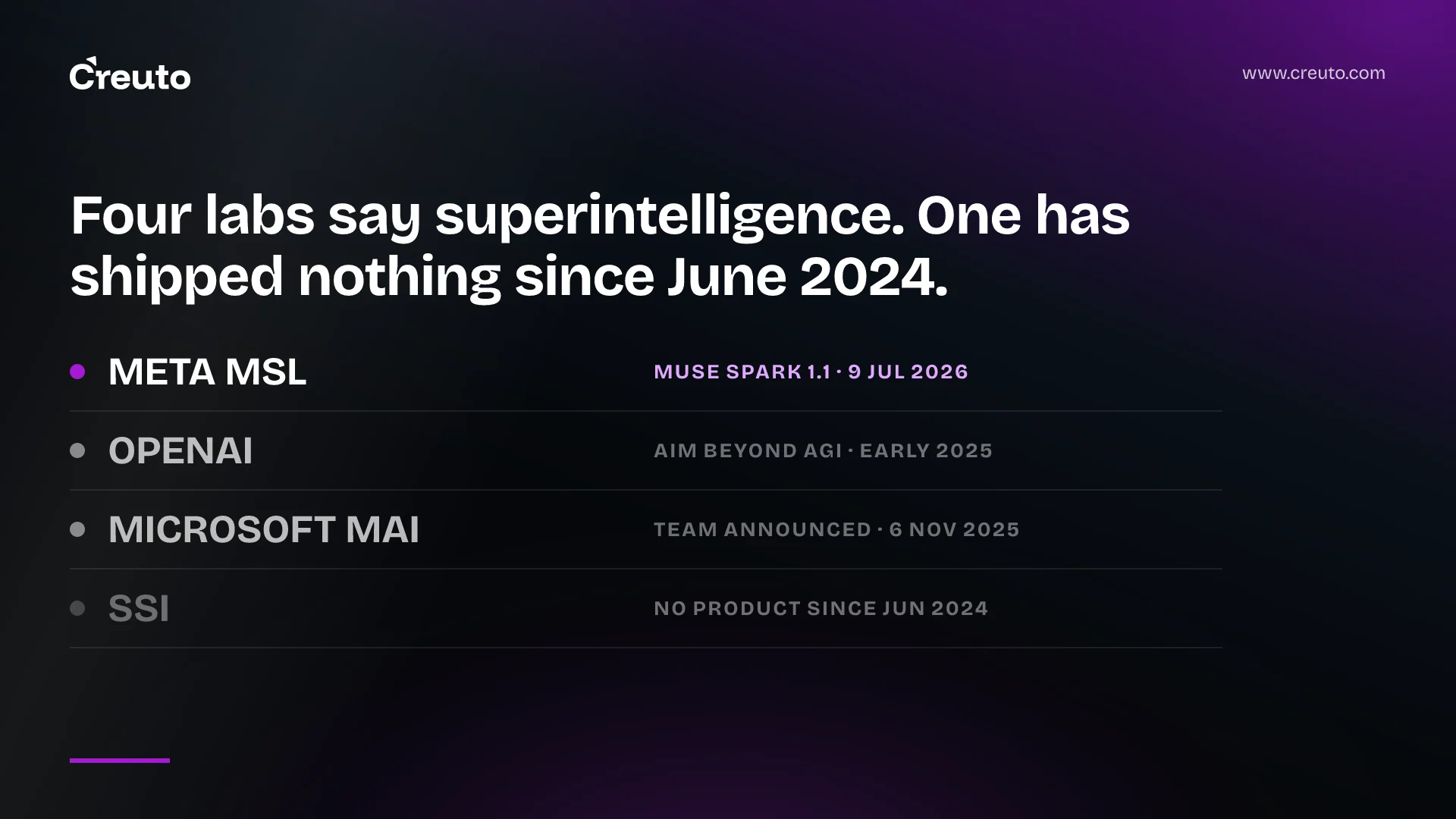
Safe Superintelligence Inc. has never shipped a product. Its own site says the company has "one goal and one product: a safe superintelligence", and as of 1 October 2026 that page is a statement of intent and a hiring invitation, with no product listed. In the same period, Nvidia agreed to raise SSI's compute tenfold, Meta shipped a model from a division named after the same word, and Microsoft announced a team to build a deliberately limited version of it. Four labs, one vocabulary, four very different amounts of shipped software.
This post sets out what each organisation has said, on the record and with dates, and separates what has shipped from what has been announced. Where popular coverage and the primary source disagree — and on the Nvidia deal they do — the disagreement is flagged.
| Lab | What it says it is building | What has shipped or been published |
|---|---|---|
| Safe Superintelligence Inc. | "A safe superintelligence", as the single product | No announced product or model as of 1 October 2026 |
| Meta Superintelligence Labs | Meta's frontier models and AI products | Muse Spark 1.1, public preview via the Meta Model API, 9 July 2026 |
| Microsoft MAI Superintelligence Team | "Humanist superintelligence" — bounded, domain-specific | Team and intent announced 6 November 2025 |
| OpenAI | "Superintelligence in the true sense of the word", stated as an aim beyond AGI | Shipping models continuously; no product carries the label |
What safe superintelligence means at SSI, and what it has published
SSI describes itself on its own site as "the world's first straight-shot SSI lab", says it approaches "safety and capabilities in tandem", and states that its business model keeps "safety, security, and progress" insulated from short-term commercial pressures. That is the whole public position. There is no model card, no API and no benchmark result to read.
The company was founded on 19 June 2024 by Ilya Sutskever, Daniel Gross and Daniel Levy, according to the timeline compiled from Reuters, Bloomberg and Wall Street Journal reporting. Gross left in July 2025 to join Meta's new superintelligence unit, and Sutskever took over as chief executive — a change reported on 3 July 2025.
The valuation is where reporting diverges, and it is worth noticing. TechCrunch puts a $32bn mark in February 2025; the Wikipedia timeline, citing the Wall Street Journal, puts a $30bn valuation in March 2025 against a $5bn mark from September 2024. Treat any single figure as a reported number with a contested date, not a fact.
The Nvidia partnership: what the press release says, and what it does not
On 27 July 2026, Nvidia and SSI announced a long-term strategic partnership. Nvidia's own release says that "access to the next-generation, best-in-class NVIDIA Vera Rubin platform will allow SSI to increase its compute by an order of magnitude", and carries quotes from Jensen Huang and Sutskever. It states no dollar figure at all.
The $5bn number that headlines most coverage is not in the press release. TechCrunch reported on the same day that the investment "stretches into multiple billions" per a source familiar with the deal, and attributed the $5bn figure to Bloomberg. So: the tenfold compute increase is a company statement; the $5bn is reported, single-sourced and unconfirmed by either party. If you are quoting this deal in a board paper, quote it that way.
Meta Superintelligence Labs has shipped a model; SSI has shipped a thesis
Meta Superintelligence Labs was formed on 30 June 2025. On 9 July 2026 it published Muse Spark 1.1, described in Meta's own words as "the latest model from Meta Superintelligence Labs", with the note that "for the first time, developers can begin building with Muse Spark 1.1 via the new Meta Model API, now in public preview". The post is signed by the lab itself. That is the clearest case in this group of a superintelligence-branded division producing something a developer can call.
The same timeline records a harder year around it: a restructure into four subgroups in August 2025, roughly 600 roles cut at the lab in October 2025, and Yann LeCun's departure on 20 November 2025 to found his own lab — each sourced in that compilation to the New York Times, Bloomberg or Reuters rather than to Meta. Read those as reported, not announced.
Microsoft and OpenAI use the word to mean nearly opposite things
Microsoft's position is the narrowest. On 6 November 2025, Mustafa Suleyman announced the MAI Superintelligence Team and defined "humanist superintelligence" as systems that are "problem-oriented and tend towards the domain specific. Not an unbounded and unlimited entity with high degrees of autonomy – but AI that is carefully calibrated, contextualized, within limits". He calls it "a subordinate, controllable AI". His stated targets — expert-level medical diagnosis "in the next few years", abundant renewable generation "before 2040" — are forecasts by Suleyman, not results.
OpenAI uses the word as a direction of travel. In his "Reflections" post, written in early 2025, Sam Altman wrote that "we are now confident we know how to build AGI as we have traditionally understood it" and that "we are beginning to turn our aim beyond that, to superintelligence in the true sense of the word". That is a stated aim with no attached product, and Altman is explicit elsewhere in the same post that the capability ceiling is unknown.
Anthropic's chief executive refuses the word, and that is the useful data point
Dario Amodei went the other way. In an October 2024 essay he wrote, in a footnote: "I find AGI to be an imprecise term that has gathered a lot of sci-fi baggage and hype. I prefer 'powerful AI' or 'Expert-Level Science and Engineering' which get at what I mean without the hype." Two labs with comparable resources therefore describe overlapping research programmes in incompatible vocabulary. The word is a positioning choice. It carries no information about capability.
The strongest argument for taking the term seriously
The fair counter-argument is that measured capability really is moving quickly, so dismissing the vocabulary risks dismissing the trend. The International AI Safety Report 2026, published in February 2026 by over 100 experts chaired by Yoshua Bengio, records a measured finding: the maximum duration of software engineering tasks a model completes with an 80% success rate has doubled roughly every seven months for six years, and now sits at around 30 minutes of expert human work (Kwa et al., 2025).
The same report is careful about what that does and does not imply. Its projection — hours-long projects by 2027–2028, days-long by the end of the decade — is explicitly conditional on the trend continuing and on an 80% success rate that the report says is lower than many deployments need. On loss of control it is blunter: "Current systems lack the capabilities to pose such risks, but they are improving in relevant areas." A doubling trend in task length is a measurement. An arrival date for superintelligence is not, and no lab in this list has published one we could cite.
How to read "superintelligence" in a vendor's deck
Three questions get you through most of these conversations. What shipped, under what product name, on what date? Is the capability claim a benchmark result or a forecast, and by whom? And what does the vendor's use of the word commit them to — Microsoft's bounded definition and SSI's unbounded one carry very different implications for whether you can buy anything this year.
In the systems we build, none of this changes the engineering. Our AI engineering work assumes the model behind a feature will be replaced, so the model boundary is an interface with its own tests. The same discipline applies to generative AI features: we measure what the current model does on your data, not what a roadmap promises. That measurement habit is why we published our own read of AI coding agent success rates on private code, where the best result was 38.8%, and why we score agents on the trajectory rather than the final answer.
If a supplier's superintelligence claim cannot be turned into a dated benchmark on a named model, it is a positioning statement, and the correct response is to ask for the current version's evaluation numbers instead.
Frequently asked questions
Safe Superintelligence Inc. is an AI lab founded on 19 June 2024 by Ilya Sutskever, Daniel Gross and Daniel Levy. Its site states it has one goal and one product, a safe superintelligence, and it approaches safety and capabilities together rather than shipping commercial products along the way.
SSI has announced no model, API or product as of 1 October 2026. Its public output is a mission statement, a recruiting page and partnership announcements, including a compute agreement with Nvidia dated 27 July 2026. There is no published benchmark result or model card to evaluate.
Nvidia's press release of 27 July 2026 states no figure. It says the Vera Rubin platform will let SSI increase its compute by an order of magnitude. TechCrunch described the investment as multiple billions and attributed a $5bn figure to Bloomberg, so treat $5bn as reported rather than confirmed.
Meta Superintelligence Labs is the Meta division formed on 30 June 2025 that now produces the company's frontier models. It published Muse Spark 1.1 on 9 July 2026, available to developers in public preview through the new Meta Model API, making it the group in this cluster with shipped software.
Safe Superintelligence Inc., Meta Superintelligence Labs and Microsoft's MAI Superintelligence Team use the term in their names, and OpenAI states superintelligence as an aim beyond AGI. Anthropic's chief executive rejects the vocabulary, preferring powerful AI, so the label does not map neatly onto research programmes.
No. The term carries no agreed capability definition, and the labs using it mean different things, from Microsoft's deliberately bounded humanist superintelligence to SSI's unbounded goal. Ask instead for a named model, a dated benchmark result on your own task type, and whether the claim is measured or forecast.