RHEL alternatives in 2026: leverage, not a migration
RHEL alternatives are mature and binary compatible. For most mid-market estates the honest move is renewal leverage, not migration. The cost is revalidation.
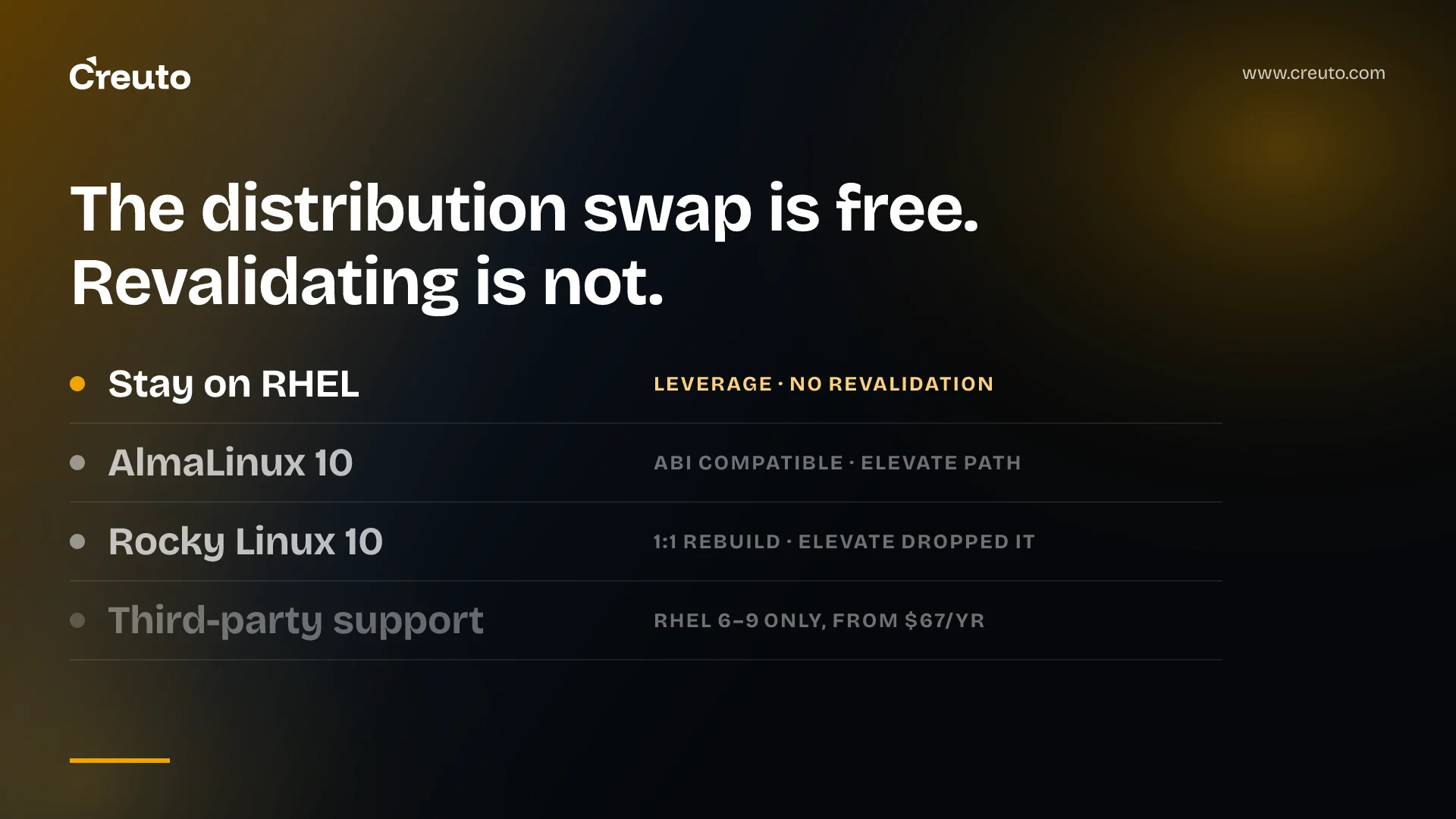
The cheapest RHEL alternative is a quote you never sign. Rocky Linux and AlmaLinux are free, mature and binary compatible, and for most mid-market estates in 2026 the right use of them is still the renewal conversation rather than the migration project — because the distribution is the part that swaps cleanly, and the certified stack running on it is the part that does not.
That is an unfashionable position and we will put the opposing case first, properly, before answering it.
The strongest case for RHEL alternatives, made properly
It goes like this. You are paying a recurring per-system subscription for an operating system whose binaries you can obtain, patched and supported, for nothing. Rocky Linux describes itself on its own front page as "100% bug-for-bug compatible with Red Hat Enterprise Linux", rebuilt directly from RHEL sources. AlmaLinux is governed by a 501(c)(6) non-profit foundation with no controlling shareholder, publishes its board minutes, and commits that anything which works on RHEL works on AlmaLinux — "and if they don't we would consider that a bug".
The lifecycles match too, which is the part people assume they are giving up. Rocky Linux publishes end-of-life dates of 31 May 2029 for Rocky 8, 31 May 2032 for Rocky 9 and 31 May 2035 for Rocky 10. AlmaLinux's FAQ gives 2029 for AlmaLinux 8 and 2032 for AlmaLinux 9. Those are the same ten-year windows Red Hat sells, ending in the same months.
One detail inside those windows is worth planning around, because it is where the free option is genuinely thinner. Rocky splits its ten years into active support and security support: active support for Rocky 9 ends on 31 May 2027 and for Rocky 10 on 31 May 2030, with security-only maintenance running to 2032 and 2035 respectively. Red Hat's own lifecycle has the same shape — five years of Full Support, then five of Maintenance Support — so the comparison is fair, but "supported until 2035" and "receiving new hardware enablement until 2035" are different sentences in both columns, and procurement routinely reads them as the same one.
And the CentOS lesson is real. A large number of estates were rebuilt once already, under deadline, because an upstream changed a product strategy. Paying a vendor does not insulate you from that; it only changes who makes the decision.
If your estate is a few hundred application servers running your own code, a web tier and some open-source databases, this argument wins outright. Migrate. There is nothing to revalidate and the saving is real.
What each distribution actually guarantees
The guarantees are not identical, and the difference is the one thing in this comparison that will show up in an incident.
| Distribution | Stated compatibility | What that means in practice |
|---|---|---|
| Rocky Linux | 100% bug-for-bug compatible, rebuilt from RHEL sources | Closest to a drop-in; inherits RHEL's bugs as well as its behaviour |
| AlmaLinux | ABI compatible with RHEL, not 1:1 | RHEL binaries and kernel modules run; the package set can diverge |
| RHEL | The reference itself | The thing every vendor support matrix is written against |
AlmaLinux changed its own goal deliberately and said so in public. In a July 2023 post, the foundation dropped the aim of a 1:1 copy and committed instead to being "aligned and binary compatible with RHEL … such that software that runs on RHEL will run the same on AlmaLinux". For most workloads that distinction is invisible. For anything that pins exact package versions, parses release files, or is certified against a specific minor release, it is not invisible at all, and it is the question to ask your vendor rather than your sysadmin.
Where the cost actually sits: the certified stack
Here is the answer to the case above. The expensive part of leaving RHEL is almost never the operating system. It is everything whose support contract names the operating system.
Take the clearest published example. Oracle's installation guide for Oracle AI Database 26ai on x86-64 names its supported distributions explicitly: Oracle Linux, Red Hat Enterprise Linux and SUSE Linux Enterprise Server. Rocky Linux, AlmaLinux and CentOS are not on that list. The database will install and run — binary compatibility is real — but you have moved from a configuration your vendor certifies to one it does not, and you will discover which of those two things you were actually paying for the first time you open a severity-one ticket.
SAP publishes its supported HANA operating systems in SAP Note 2235581, behind a customer login, which is itself the point: check your own entitlement document rather than a blog post, ours included. The same applies to your hardware vendor's firmware matrix, your backup agent, your HSM driver, your EDR agent and whichever auditor signs off your change control.
That is the revalidation bill, and it is paid in engineering weeks rather than licence fees: a test environment per certified product, a regression pass, a rollback plan, and a renegotiated support position with every vendor whose matrix you just left. We do this work as part of legacy application modernisation, and the pattern is consistent — the platform change is a sprint, the revalidation is a quarter. It is the same arithmetic we described when SAP ECC reached end of maintenance and when .NET 8 support ended: the runtime is rarely the hard part.
Migration tooling: ELevate, and what it quietly dropped
In-place major-version upgrades across RHEL-family distributions are handled by ELevate, AlmaLinux's project combining the LEAPP tool with a leapp-data library. It supports CentOS 7 to AlmaLinux 8, and 8.x to 9.x and 9.x to 10.x within a distribution. AlmaLinux says it has been used to migrate production environments worldwide, and still advises testing in a virtual machine first; migrations require two reboots.
Read the project page carefully, though, because one line changes the comparison: ELevate's Rocky Linux migration support was discontinued as of 3 November 2025. If your plan was an in-place conversion to Rocky, confirm your tooling before you cost the project. This is a statement about migration readiness in October 2026, not a verdict on Rocky Linux, which remains the closer rebuild of the two.
Third-party support without changing the OS
There is a third option that gets skipped because it is unglamorous: keep RHEL installed and buy the patches elsewhere. SUSE Multi-Linux Support sells exactly that — "keep your operating system; get your patches from SUSE" — covering RHEL 6 to 9 and CentOS 7 onward, from $67 per year per unit at its Lite tier as listed in October 2026. Note the ceiling: RHEL 10 is not in that coverage list, so it is a strategy for the estate you have, not the one you are building.
On Red Hat's own situation we will say only what is on the record: Red Hat has operated as a distinct unit within IBM since the acquisition closed on 9 July 2019. Anything beyond that about its commercial direction is speculation we cannot source, and the decision below does not need it.
Use the alternatives as leverage, and be specific about it
For a mid-market estate with certified middleware, this is the move. You are not bluffing — the alternatives are genuinely viable, which is what makes the conversation work — but you are buying a better renewal rather than a migration programme.
- Segment the estate before you negotiate. Split it into systems with a vendor certification attached and systems without. The second group is your genuine migration candidate and your evidence; the first group is what you are renewing.
- Migrate the uncertified group first, for real. A dev, build and test tier on AlmaLinux is a working proof, not a threat, and it removes those subscriptions permanently.
- Price the revalidation per certified product. One line per vendor: test environment, regression window, support position. That number is your negotiating position, because it is the number the alternative actually costs you.
- Ask for the extended life terms in writing. Red Hat's Extended Life Cycle Premium add-on, announced in April 2026, extends a major version to a fourteen-year lifecycle. If your real problem is an application you cannot move, that add-on may be cheaper than any migration and should be priced alongside one.
This is the wrong advice in two cases. If your estate carries no vendor certifications at all, migrate — the leverage argument is just an excuse to keep paying. And if you are standing up something new, start it on Rocky or Alma and never acquire the dependency; the cost of leaving only exists because someone once joined.
The decision is not Rocky versus Alma. It is whether your certified stack is an asset you are maintaining or a constraint you have stopped questioning. When we unified four departments into a single platform for an industrial client's custom ERP, the operating system was the least contested choice in the project. Everything above it was the work. Count that stack first, then decide — and if the count comes back short, you were never locked in to begin with.
Frequently asked questions
The two mainstream RHEL alternatives are Rocky Linux, which states it is 100% bug-for-bug compatible and rebuilt from RHEL sources, and AlmaLinux, which commits to ABI compatibility rather than a 1:1 copy. A third option is third-party support that leaves RHEL installed.
Rocky Linux publishes a ten-year lifecycle per major release, with Rocky 10 supported until 31 May 2035, and describes itself as a direct rebuild of RHEL sources. The practical caveat in 2026 is tooling: ELevate discontinued Rocky Linux migration support on 3 November 2025.
Rocky Linux aims for bug-for-bug compatibility with RHEL by rebuilding its sources directly. AlmaLinux publicly dropped that goal in July 2023 and now targets ABI compatibility instead, so RHEL software and kernel modules still run, but the package set itself can diverge from RHEL's.
Often not. Oracle's installation guide for Oracle AI Database 26ai on x86-64 names Oracle Linux, RHEL and SUSE Linux Enterprise Server, and does not list Rocky Linux or AlmaLinux. Binary compatibility means the software runs; it does not mean your vendor supports it.
The distribution swap is the cheap part. The cost of migrating off RHEL sits in revalidating the certified stack above it: a test environment and regression pass per certified database, middleware and agent, plus a renegotiated support position with each vendor whose matrix you leave.
Yes, and for most mid-market estates that is the better outcome. Segment the estate by vendor certification, migrate the uncertified tier for real, price the revalidation per certified product, and take that number into the renewal as your actual cost of leaving.