Reverse Engineer Anything: what REA does and does not do
Reverse Engineer Anything is an MCP orchestration layer, not a decompiler. What REA reads, what it inherits from Ghidra, and when not to run it.
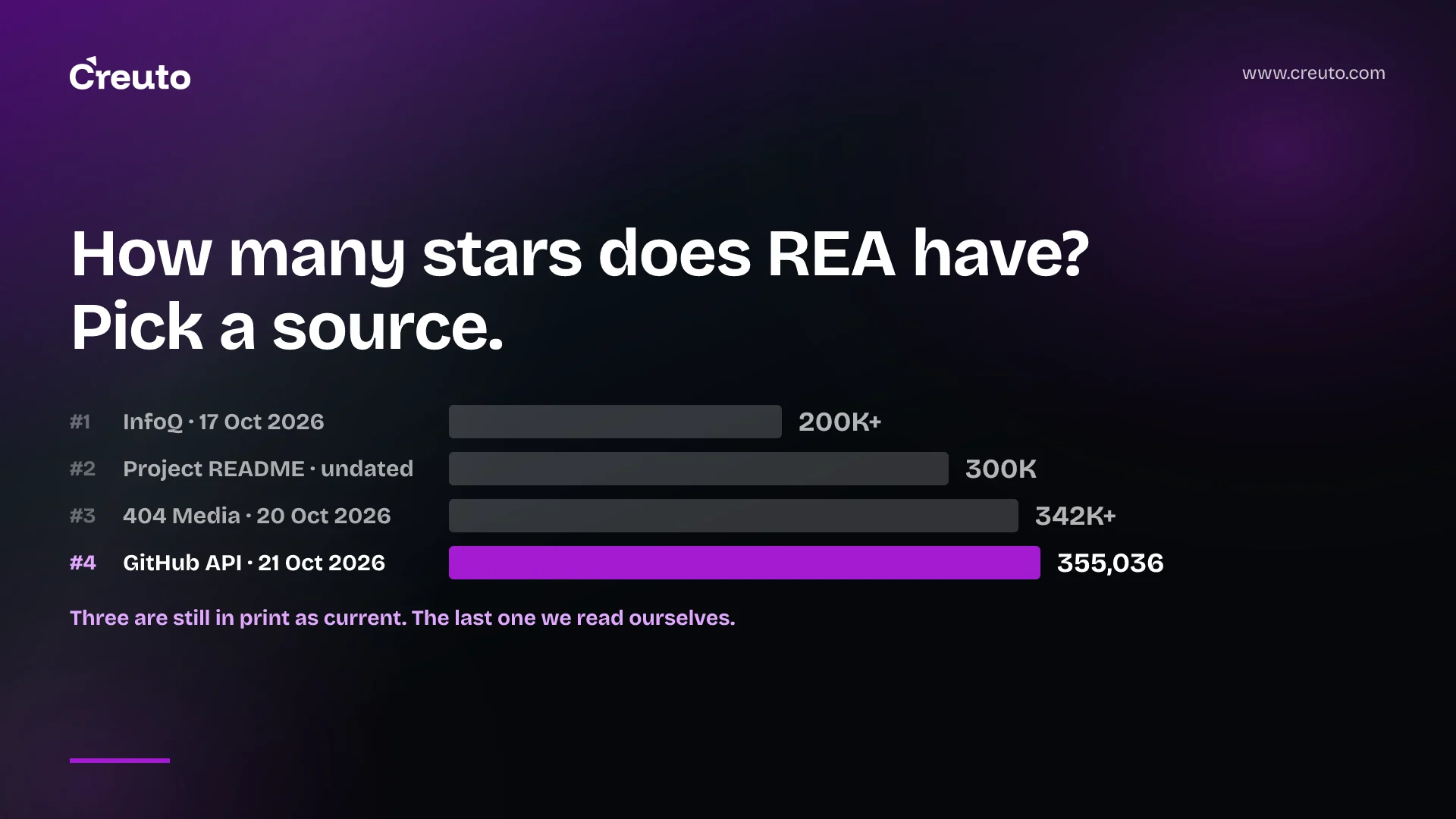
Reverse Engineer Anything (REA) carried four different star counts in four days. InfoQ reported over 200,000 stars on 17 October 2026, 404 Media reported more than 342,000 on 20 October, the repository's own README still celebrates 300,000, and the GitHub API returned 355,036 when we read it at 15:38 UTC on 21 October 2026.
That spread is the first useful fact about REA: it is moving faster than anything written about it. The second is that REA is not a decompiler. It is an MCP server and CLI that drives decompilers you install yourself. Read it that way and both its speed and its ceiling make sense — and so does the question an engineering leader actually has to answer, which is whether an anonymous dependency belongs anywhere near your build.
Here is what REA is, in one paragraph
REA is a TypeScript project on GitHub published under the MIT licence, distributed as the npm package rea-agents, and registered with a coding agent by running npx rea-agents setup. Its own subtitle is "One MCP for reverse engineering across binaries, applications, and runtime behavior." It gives an agent such as Claude Code or Codex a catalogue of tools for inspecting compiled software without its source, and the same tools are available from a terminal. As of 21 October 2026 the GitHub API reports 89,175 forks, 1,687 open issues and a repository created on 14 April 2026 — 190 days before we read it. The npm registry puts rea-agents at version 6.7.0, published 2026-10-18, with 415,576 downloads in the week to 18 October 2026.
Setup is the interesting part architecturally. REA registers itself as a local MCP server and installs matching workflow instructions into the agent's configuration, so the agent gains the tools rather than being told how to use a program. That is the same shape as any other local MCP integration, and it inherits the protocol's current direction of travel, including the move away from sticky sessions.
Reverse engineer anything is a claim about orchestration, not about decompilation
The README's own support table is the clearest evidence for this reading. Almost every capability it advertises names a third-party engine in the requirements column, and the README states plainly that for offline native inspection REA "does not install or update either provider". Where the work is genuinely REA's own, the table says so: ".NET assemblies — None (static only)".
| Target | What does the actual reading | What you supply |
|---|---|---|
| Native binaries (pseudocode, assembly, symbols, calls) | Hopper, Ghidra or IDA | A licensed or installed provider |
| Android APKs (manifest, classes, decompiled methods) | Headless JADX | JADX and a full JDK |
| Android resources (manifest, string tables, locales) | Apktool | A caller-supplied Apktool launcher |
| WebAssembly (sections, import/export WAT forms) | WABT 1.0.42 | Caller-supplied WABT |
| Firmware (regions, extraction, native handoffs) | Binwalk or Unblob | The extraction tool, on Linux |
| Recorded packets (fields, filters, decode-as rules) | TShark 4.x | TShark and prlimit, on Linux |
| JavaScript and Electron (modules, imports, IPC, source maps) | REA itself | Node.js and npm |
| .NET assemblies (metadata, CIL instructions) | REA itself, static only | Nothing |
Three consequences follow, and they are the ones nobody in the coverage mentions. REA's support matrix is really Ghidra's, JADX's and WABT's support matrix. REA's accuracy on a native binary is Ghidra's accuracy on that binary, including Ghidra's mistakes. And REA's speed comes from removing the part a human was slowest at — knowing which of forty tools to reach for and how to drive it — not from a new analysis technique. On Hacker News, where the project drew 814 points and 339 comments on 10 October 2026, InfoQ reports that some practitioners asked exactly this: what does REA add beyond telling an agent to install and use Ghidra?
The honest answer is that orchestration is worth real money and is not the same as capability. If you have ever watched an agent attempt a large refactor of unfamiliar code, you know the failure mode is rarely raw reasoning; it is the agent not knowing what evidence to go and get. REA is a map of what evidence exists.
What REA does not do
It does not recover original source code. InfoQ states that REA "runs locally and does not claim to recover the original source code", and the project's own disclaimer is blunter: "Decompilation, reconstruction, heuristics, and AI-assisted analysis may be incomplete or incorrect. Results do not guarantee accuracy, completeness, security, compatibility, or legal compliance."
It does not install your decompiler. Ghidra and IDA must already be present; setup can install Hopper only after you approve it. It does not grant you a tool licence — the README is explicit that "You must legally obtain and be authorized to use commercial tools", naming IDA Pro, Hopper and JEB, and that "REA grants no tool license, key, or activation entitlement."
It does not sandbox anything. The project's security policy says so in terms most vendors would soften: "This is not a sandbox and does not protect against malicious processes already running as the same operating-system user. Opening an untrusted binary delegates parsing and analysis to the selected local provider with that user's permissions."
And it does not give you a stable interface. REA's own README warns that "REA changes quickly, and new releases include frequent bug fixes." The npm registry bears that out: 33 published versions since the package first appeared on 2026-07-12, and three major versions between 4.0.1 on 5 October and 6.7.0 on 18 October 2026 — thirteen days. Anything you automate against REA should pin a version and record the date, because the capability you tested may not be the capability you get.
The case against REA, in its strongest form
The critical case is not that reverse engineering is new. It is that the cost of doing it well collapsed, and the README markets that collapse at the top of the page: "See a feature in an app that you want in your own product? Ask your agent to investigate it with REA. It can inspect the app without its source code, explain how the feature works, show the evidence, and build a version for your project."
404 Media's Jason Koebler quoted that exact line and read it as a promise: "What this promises is a way to easily clone and modify other people's products." His piece describes the wider pattern as "some mix of 'decompiling,' 'reverse-engineering,' 'hacking,' vibe coding, AI slop, and stealing", and calls it "the plagiarism machine being used for plagiarism".
The sharpest single data point is a Hacker News comment from a small pro-audio manufacturer, posted on 15 October 2026, which 404 Media also quoted: "In the past 72 hours I have ONE-SHOT decompiled 3 of my main competitors products, including the Strymon Big Sky. I just... have their award winning algorithms now. Like, I could in theory just stick them in a box and resell them." Read that as the person who could be on the receiving end next quarter, because that is who wrote it.
Two things make the case stronger still. First, the quality problem does not cancel the harm. Koebler's argument is that cloned software "often has bugs that the person using the AI doesn't understand or know how to fix, and people are doing it anyway" — so the damage arrives as unvettable software in circulation, not as good competition. Second, Mike Nolan, who studies the politics of open source software, told 404 Media that "it's becoming so easy to recreate the functionality that you want", while adding the caveat that cuts the other way: "there's a lot of work associated with maintaining software so there may be a lot of instances where the software may not be reliable enough to use."
The project itself does not endorse any of this. Its disclaimer lists what it "does not support, and will not help with", including "copying proprietary software or reproducing its protected code and assets", circumventing DRM or licence checks, and developing game cheats, and says such requests "will be closed without response". That is a real position, and it sits in visible tension with the sentence at the top of the README. Both are primary sources. Both are quoted above. Make of the gap what you will, but do not pretend it is not there.
The legitimate column is just as real and gets less attention: malware and incident analysis, vulnerability research with coordinated disclosure, interoperability, software preservation, CTFs and teaching, and auditing software you own. Koebler's own examples include people reviving bricked devices and stripping advertising from hardware they bought.
Nobody's name is on it
REA is published by a single GitHub account, morluto, whose API record lists no company and no contact address. InfoQ reports that the author "uses the handle morluto and whose real name has not been publicly identified". No funding, no vendor, no legal entity. The security policy refers to "the maintainer" in the singular, while the repository has drawn contributions from 271 accounts as of 21 October 2026.
For a weekend experiment, none of that matters. For a dependency in a regulated environment, it is the whole question. Anonymity means no counterparty to a security commitment, no entity to sign a data-processing agreement, no vendor security review to complete, and no succession plan if the account goes quiet. It also means the usual supply-chain checks have nothing to check against, which is why the README itself has to warn that "A similar repository name or copied README does not establish that a download is official."
We have not used REA on client work, and we are not recommending it. We have not run it against a binary, we have not evaluated its output quality, and nothing above is first-hand. Every figure here comes from the GitHub API, the npm registry, the Hacker News API or a named publication, read on 21 October 2026.
When you should not run this
There are four situations where the answer is no, and three of them come from the project's own documentation.
- On an untrusted binary, on a machine that matters. The security policy states REA is not a sandbox and that opening an untrusted binary hands parsing to a local provider with your user's permissions. Malware analysis is a listed legitimate use, but it belongs on disposable infrastructure, not an engineer's laptop with production credentials on it.
- Against software whose licence forbids it. The disclaimer puts the burden on you: "Public availability of software, possession of a file, or access to a debugging endpoint does not by itself establish permission for every operation." Reverse engineering is restricted in some jurisdictions and by many end-user licences, and an analysis report "does not grant rights to the original program".
- As a standing dependency in a regulated build. An anonymous MIT project shipping three major versions in thirteen days is not a supplier. If you need it, run it as a one-off investigation on an isolated host, pin the version, record the date, and keep it out of CI.
- Where the output will be shipped without a human reading the evidence. This is a general agent problem and REA does not escape it. We have written before about how agents route around the controls you put in front of them; a tool whose stated purpose is extracting behaviour from software you did not write is the last place to relax review.
Worth noting on the credit side: REA analyses locally, and its FAQ answers the obvious follow-up directly — "REA analyzes targets locally. Your agent receives the tool results, and its model provider has its own data policy." Your binary does not leave the machine. Whatever your agent sends to its model provider is governed by that provider's terms, not REA's.
What to decide this week
The useful question is not whether REA is good. It is whether your product is now cheap to read. If you ship a desktop application, an Electron app, an APK or firmware, assume someone can get a credible account of how your differentiating feature works in an afternoon, and that the floor for doing so is a Node.js install and a Ghidra licence file. That changes where your moat lives: in data, distribution, integrations and operations rather than in a compiled algorithm.
If you want that assessed against your own stack rather than in the abstract, it is the kind of question our AI engineering practice gets asked most often at the moment. Start with the inventory, not the tool: list what you ship as a compiled artefact, what secret each one contains, and what happens to your business if that secret is readable by Friday.
Frequently asked questions
Reverse Engineer Anything is an MIT-licensed MCP server and CLI, distributed as the npm package rea-agents, that gives a coding agent tools for inspecting compiled software without its source. It covers native binaries, JavaScript and Electron apps, .NET assemblies, Android packages, firmware and live runtime behaviour.
REA is published by a single GitHub account using the handle morluto. InfoQ reported on 17 October 2026 that the author's real name has not been publicly identified, and the GitHub API record lists no company. There is no vendor, funding or legal entity behind the project.
Very little. REA orchestrates other tools: native binaries need Hopper, Ghidra or IDA, Android packages need headless JADX, and WebAssembly needs WABT. Its own static analysis covers .NET assemblies, JavaScript and Electron applications, Go and Rust metadata, and several container formats.
It depends entirely on the target and your jurisdiction. REA's disclaimer places the burden on the user, states that possessing a file does not establish permission for every operation, and lists uses the project refuses to help with, including copying proprietary software. Get legal advice before analysing anything you do not own.
Not on a machine you care about. REA's own security policy states that it is not a sandbox and that opening an untrusted binary delegates parsing and analysis to the local provider with your user account's permissions. Malware analysis belongs on disposable, isolated infrastructure.
No. REA's FAQ states that it analyses targets locally and that your agent receives the tool results. The caveat is the agent itself: whatever your coding agent sends to its model provider is governed by that provider's data policy, not by REA's local-only analysis.
Pin whichever version you tested, and record the date. The npm registry showed 33 published versions of rea-agents between 12 July and 18 October 2026, including three major versions in the thirteen days to 18 October 2026, so behaviour you verified can change inside a minor release.