Recover from Google core update losses: what Google says
How to recover from Google core update drops using Google's own guidance: small vs large drops, no quick fixes, and why it can take until the next update.
Google's own core updates guide says that after a big ranking drop, some fixes show up in days but others can take months to register, and the result may not show until the next core update. If you need to recover from Google core update losses, that's the planning reality: a months-long product decision about content and site quality, not a week of SEO tweaks. This guide sets out what Google actually recommends, what the one measured 2026 dataset shows, and how to brief your board on timing.
Everything below comes from Google Search Central documentation, the Google Search Status Dashboard and one third-party study we could check line by line. It's current as of 27 November 2026, three days after the November 2026 core update finished rolling out.
| 2026 core update | Started | Rollout length |
|---|---|---|
| March 2026 core update | 27 March | 12 days 4 hours |
| May 2026 core update | 21 May | 11 days 21 hours |
| November 2026 core update | 10 November | 13 days 20 hours |
| December 2026 core update | Preannounced 24 November, no start date given | Not started |
A core update is not a penalty, but check that nothing else broke
A core update isn't a penalty in Google's sense of the word. Google's core updates documentation says the updates "don't target specific sites or individual web pages", and that pages which move down "aren't necessarily "bad"". Penalties in the formal sense are manual actions: Google's spam policies say violations can be found by automated systems and by human review "that can result in a manual action". Those show up in the Manual Actions report in Search Console. Core update losses don't.
That distinction matters because the November drop may not be the update at all. Google's guide to debugging Search traffic drops lists six causes: algorithmic updates, technical issues such as crawling, indexing, server errors or robots.txt, security issues, spam and manual actions, seasonality and changing interest, and site moves or migrations. Only the first one is the core update. Before anyone rewrites content, someone should open the Crawl stats, Page indexing, Security Issues and Manual Actions reports and rule the others out.
The timing this month makes that check worth doing properly. On 11 November 2026, the day after the November rollout began, Google published a post on moving a site to a CDN. It warned that a new CDN starts with a cold cache, so misses hit your origin, and that "leaving blanket bot protection enabled without exempting verified crawlers" leaves Google's crawlers on error pages. If your team changed hosting, caching or bot protection in October or November, the drop you're blaming on Google may be one you shipped. Our earlier piece on caching personalised pages without leaks covers one of the cache settings that tends to change in exactly those migrations.
Wait a full week, then measure which kind of drop you have
Google recommends "waiting at least a full week after a core update completes before analyzing your site in Search Console", according to the core updates guide. The November update completed on 24 November 2026 per its Search Status Dashboard entry, so the earliest sensible read is 1 December. The guide then suggests comparing that week with the week before the rollout started.
The measurement itself is mechanical. The debugging guide walks through it in the Search Console Performance report:
- Set the date range to "Last 16 months" so you can see seasonality and earlier updates.
- Compare the period after the update with the period before it.
- Check each Search type separately, because web, image and news can move differently.
- Look at Average position, not only clicks.
- Sort the Pages tab by "Clicks Difference" to find the pages that lost most.
- Use URL Inspection on the worst pages, and Google Trends to see whether the whole industry dropped.
Core update small drop vs large drop
Google splits the response into two cases. A small drop, its example being "dropping from position 2 to 4", gets this advice: "There's no need to take drastic action." A large drop, its example being "dropping from position 4 to 29", gets a different instruction: "Do a deeper assessment." Both quotes are from the core updates guide.
This is the first decision for the board, and it's often skipped. If your lost leads come from a handful of pages that slipped two or three places, a recovery programme is the wrong response. You'd be spending months reworking a site that Google itself says doesn't need drastic action. The plan below is for the second case: large drops that persist across many pages.
How to recover from Google core update losses: what Google recommends
Google's recommended recovery is a site-wide quality review, not page-level fixes. The core updates guide tells you to "take a close look at your site as a whole, and try to be objective", and then to "evaluate the pages that were most impacted". The work it points to is the self-assessment in Google's helpful content documentation.
Google's helpful content self-assessment questions
Google's self-assessment questions read like an editorial review, not a technical audit. Among them:
- "Does the content provide original information, reporting, research, or analysis?"
- "Is this content written or reviewed by an expert or enthusiast who demonstrably knows the topic well?"
- "Does the content have any easily-verified factual errors?"
- "Is this the sort of page you'd want to bookmark, share with a friend, or recommend?"
The same page sets out a Who, How and Why test: who created the content, how it was produced, including where automation or AI was used, and why it exists. Google writes that "Why" is perhaps the most important question to answer about your content. On E-E-A-T, the page says E-E-A-T "itself isn't a specific ranking factor", and that "trust is most important". Vendors who sell "E-E-A-T fixes" as a ranking lever are selling something Google's own page doesn't describe.
What Google tells you not to do
The section of the core updates guide titled "Things to keep in mind when making changes" is short and blunt. It says to avoid "quick fix" changes, such as removing page elements because of perceived SEO problems. It says to "consider how you can improve your content in meaningful ways". And it says "deleting content is a last resort". Set against the advice that circulates after every update, the gap is wide:
| Common post-update advice | What Google's core updates guide says |
|---|---|
| Rewrite titles and meta tags across the site this week | Avoid "quick fix" changes |
| Prune or noindex the pages that dropped | Deleting content is a last resort |
| Expect a rebound within a month | Some changes take days, but it could take several months |
| Act on day one of the drop | Wait at least a full week after the update completes |
How long does it take to recover from a Google core update?
Recovery from a Google core update can take anywhere from a few days to several months, and Google says it may not come until the next core update. The exact wording in the core updates guide is that "some changes can take effect in a few days, but it could take several months" for Google's systems to confirm that a site is improving, and that "if it's been a few months and you still haven't seen any effect, that could mean waiting until the next core update". The same page adds that "there's no guarantee" your changes will have a noticeable effect.
The 2026 calendar shows what "the next core update" has meant in practice. The ranking update history lists core updates starting on 27 March, 21 May and 10 November 2026. The gap between May and November was more than five months. On 24 November Google preannounced a December 2026 core update, saying in its status feed that it "is scheduled to be released in December 2026". A Google spokesperson told Search Engine Roundtable: "We don't have a date yet" and "It's not imminent." Changes you start in December are unlikely to be fully reflected by then, so don't promise the board a December rebound.
Can you recover from a Google core update?
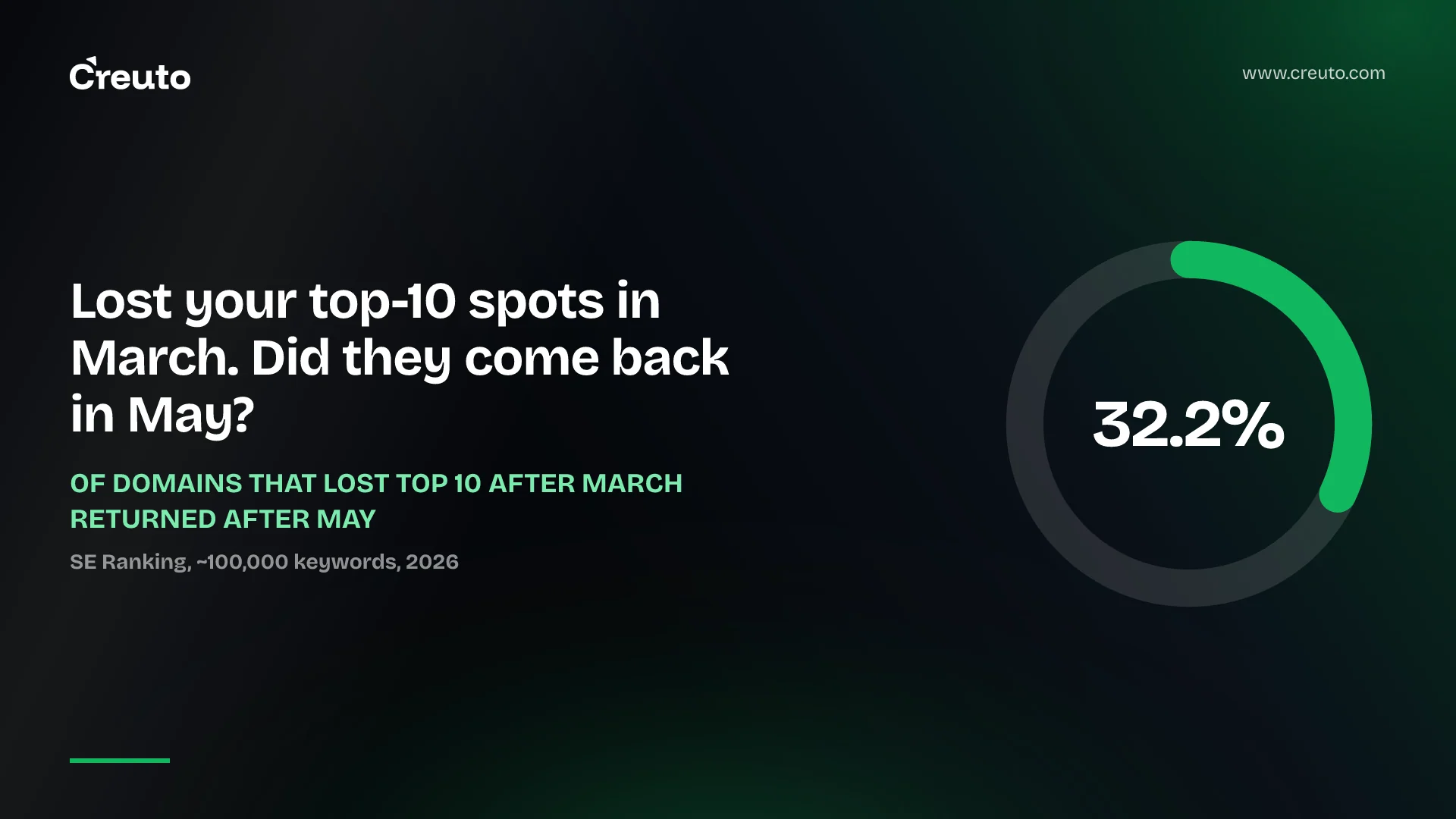
Some sites do recover from a Google core update, and the best 2026 measurement puts that at roughly a third. SE Ranking's analysis of the May 2026 core update tracked about 100,000 keywords across 20 niches from a New York location, comparing snapshots from 15 April and 2 June 2026. It found that "32.20% of the domains that lost their TOP 10 spots after March climbed back into the TOP 10 after May". It also found that 19.87% of pages in the top 10 before the update were gone from the top 100 afterwards.
The strongest reading of that number is the pessimistic one. If about 32% of losers came back in the next update, about two-thirds didn't, at least within that window. The study also has limits you should state when you quote it. It's one location, one keyword set, and its "March" baseline combines the March 2026 spam update and core update, which the dashboard lists as starting three days apart. It doesn't say whether the domains that came back had changed anything. Figures you'll find elsewhere, such as claims that 72% of sites recover, didn't come with a dataset we could check, so we've left them out.
Should you delete pages after a core update?
Deleting pages after a core update is, in Google's words, "a last resort", for content that can't be salvaged. The stronger argument for deleting is real: if a site has published hundreds of thin pages, pruning them feels like a quick way to raise the average. Google's spam policies explain why that instinct sometimes points at a real problem. "Scaled content abuse is when many pages are generated for the primary purpose of manipulating search rankings and not helping users," per the spam policies.
Pages built that way are a spam problem, not a core update problem, and the fix is a decision about whether they should exist at all. Pages that serve readers but rank lower now are different. The core updates guide points you towards improving them. The helpful content page also lists warning signs that a site is writing for search engines, such as "producing lots of content on many different topics in hopes that some of it might perform well", or writing to a particular word count. If those describe your content operation, the change you need is to the process, not to individual URLs.
A core update recovery plan the board can sign off
A credible core update recovery plan follows Google's own sequence and states the uncertainty up front. Built only from the guidance above, it has four parts:
- Diagnosis, from one week after rollout. Confirm the drop is the update and not a crawl, indexing, security or migration problem. Classify it as small or large using Search Console.
- A site-wide review. Run the self-assessment questions and the Who, How and Why test against the most affected page types, with someone who knows the subject doing the reading.
- Meaningful changes, not quick fixes. Improve or merge content that serves readers. Remove only what can't be salvaged, and fix any engineering faults found in step one.
- A review date tied to the next core update, not to a calendar month. Google says the effect may not show until then, and gives no guarantee it will.
This plan is the wrong choice if your drop is small, seasonal or industry-wide. Google Trends and the 16-month view will tell you that in an afternoon. In those cases the honest board update is that nothing needs rebuilding, and the money is better spent elsewhere.
Where outside engineering help fits in a core update recovery
Creuto doesn't sell SEO, and we haven't run ranking recoveries for anyone. What we do is the engineering half of step one and step three: tracing a traffic drop to a deploy, a CDN or bot-protection change, a rendering fault or a template that turned hundreds of pages thin, and then fixing the application so the content team's work can be crawled and served properly. If your diagnosis points at the site rather than the writing, or the recovery plan calls for rebuilding the templates behind your most affected pages, our web app development team can take that work on and scope it against the next core update. Where the fault turns out to be hosting or caching, our DevOps and cloud engineering practice covers the infrastructure side.
Frequently asked questions
Recovery from a Google core update can take anywhere from a few days to several months, according to Google's core updates guide. Google adds that if a few months pass with no effect, the improvement may only show at the next core update, and that there is no guarantee changes will have a noticeable impact.
A Google core update is not a penalty. Google's documentation says core updates do not target specific sites or individual pages, and that pages which move down are not necessarily bad. Formal penalties are manual actions under Google's spam policies, and those appear in the Manual Actions report in Search Console.
Deleting pages after a core update is a last resort, according to Google's core updates guide, reserved for content that cannot be salvaged. Google recommends improving content in meaningful ways and avoiding quick fixes. Pages mass-produced mainly to manipulate rankings are a separate problem covered by Google's scaled content abuse spam policy.
Google recommends waiting at least a full week after a core update completes before analysing a site in Search Console, then comparing that week with a week before the rollout started. The November 2026 core update completed on 24 November 2026, so the earliest sensible comparison starts on 1 December.
SE Ranking's study of the May 2026 core update found that 32.20% of domains that lost top-10 positions after March 2026 returned to the top 10 after May. The study covered about 100,000 keywords in 20 niches from a New York location, so it is one measured sample, not a universal recovery rate.