Real estate tokenisation platform development under DLD/VARA
Real estate tokenisation platform development in Dubai: what the DLD pilot and VARA's April 2026 guidance actually require of your build.
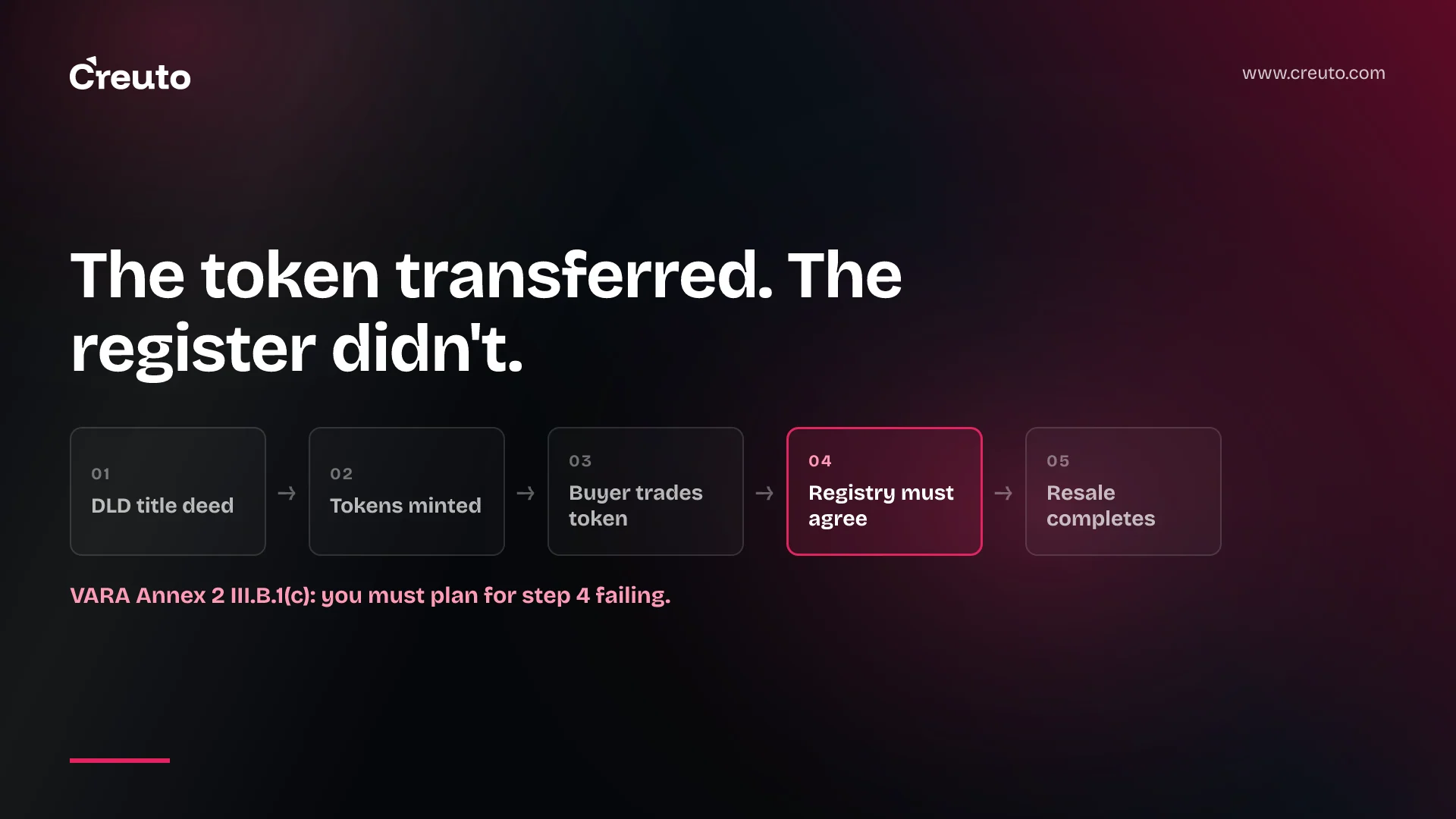
VARA's 76-page Guidance on the Virtual Asset Issuance Rulebook, published 9 April 2026, does not contain the phrase "smart contract" once. It does require, in writing, that you plan for a token trade that fails to produce a legally settled transfer of the underlying asset. Real estate tokenisation platform development in Dubai is governed by that second sentence, not the first.
That is the whole engineering argument. Dubai did not build fractional property ownership alongside the land registry — it wired tokens into it. So the hard parts of your build are reconciliation and ordering against a register you do not control, and the regulator has written that obligation down as a licensing condition rather than leaving it to your architecture review.
What the DLD pilot actually is, as of October 2026
Before the design discussion, the facts, because most of what is written about this comes from firms selling the product. Every figure below is from a Dubai Land Department or Ctrl Alt release.
| What | When | Detail |
|---|---|---|
| Pilot platform live | 25 May 2025 | PRYPCO Mint, with Ctrl Alt, VARA, the Central Bank of the UAE and the Dubai Future Foundation's Real Estate Sandbox |
| Minimum investment | Pilot terms | From AED 2,000, dirhams only, no cryptocurrency used during the pilot |
| Phase One result | To Feb 2026 | Ten properties tokenised, more than USD 5m (AED 18.5m) in property value |
| Phase Two announced | 9 Feb 2026 | DLD statement; a "controlled pilot framework" |
| Secondary resale opens | 20 Feb 2026 | Approximately 7.8 million tokens become resaleable |
| Chain and custody | Phase Two | XRP Ledger, secured by Ripple Custody |
| DLD target | By 2033 | Up to 7% of Dubai's real estate market, about AED 60bn (USD 16bn) |
The DLD's own Phase II announcement dates the resale start to 20 February and describes the phase as a controlled pilot for assessing market efficiency and testing operational readiness. Ctrl Alt's release of 20 February 2026 adds the Phase One numbers, the XRPL and Ripple Custody arrangement, and the fact that it will issue Asset-Referenced Virtual Asset management tokens to effect regulated secondary transfers.
Three corrections to the version of this story circulating in property marketing. First, entry is from AED 2,000, not tens of thousands: that figure is on DLD's May 2025 launch release, alongside the restriction to UAE ID holders and Zand Digital Bank as pilot banking partner. Second, the AED 60bn figure is DLD's projection of up to 7% of Dubai's real estate market by 2033, not a share of transaction counts. Third, the widely repeated claim that the framework imposes "mandatory escrow and audited smart contracts" appears in brokerage and advisory blogs, not in any DLD, Ctrl Alt or VARA text we could read. Treat it as commentary.
And the status, date-stamped: as of 8 October 2026 we found no DLD or VARA announcement of a Phase Three, a general-availability launch, or an opening to non-resident investors. Phase Two is still the latest phase, and DLD's own wording is that it continues to work with VARA on "regulatory and technical standards for upcoming phases" and is studying wider participation and additional platforms. Ctrl Alt's own press cadence since February has been FCA, MiFID and Guernsey authorisations and a Solana structured product — not further Dubai phases. If you are building, you are building for a gated pilot.
Who is regulated for what: VARA for the token, DLD for the register
This is the distinction that collapses in most coverage. VARA regulates the virtual asset activity — issuing the token, distributing it, broking it, holding it in custody. The Dubai Land Department owns the property register, and registration is what makes ownership good against the world. Neither regulator takes over the other's job because tokens are involved.
Concretely: under VARA's issuance regime, a token referencing real estate is an Asset-Referenced Virtual Asset, because real estate is a real-world asset in VARA's definition as a "physical and/or tangible asset". Issuing one is a Category 1 VA Issuance and needs a Category 1 licence plus VARA approval of the whitepaper for each token before issuance. Ctrl Alt states it holds VASP, Broker-Dealer and Issuer authorisations from VARA under licence reference VL/25/05/002, granted 24 May 2025. A companion post in this series goes through the VARA rulebooks in general; here we only care where they touch the registry. Dubai's habit of binding the private sector through emirate-level instruments rather than federal law is worth understanding on its own — we covered the same pattern in the Dubai agentic AI mandate, where the question of what actually binds a company was equally badly reported.
The important consequence is that your licence does not give you title. If the token conveys direct ownership, the registry transfer is still the operative legal act, and your platform is a system that must cause that act to happen reliably.
Why real estate tokenisation platform development is a reconciliation problem
VARA has written the failure mode into the rulebook. Annex 2 of the Virtual Asset Issuance Rulebook, Rule III.B.1, requires an issuer of a direct-ownership ARVA to ensure three things: that the right of ownership is legally and validly established and transfers when the token transfers; that any legal or regulatory requirements for settlement, completion or transfer of title are satisfied so as to give effect to that transfer; and — the clause that should shape your architecture — that the issuer "will respond to transactions in the ARVA not resulting in a corresponding transaction in the Reference Asset being legally settled, completed and/or transferred", with mitigating measures in place.
Rule II.A.1.e puts the same obligation in the whitepaper: a detailed description of how you will respond to that divergence and what mitigation you employ. The April 2026 guidance adds that you must "plan, and have mitigating measures in place, for all scenarios where a transaction in the ARVA does not result in the transaction being legally settled or completed as described."
Read that as a spec and the design follows. You cannot run a two-phase commit across a public ledger and a government register, because you do not hold the second participant and it will not accept a prepare-and-wait. So you choose which side is authoritative, and the law has already chosen for you: the register is. The ledger is a replica with better settlement properties, and your platform is the reconciliation process between them.
What that means for the trade path
- Order the registry act first where you can. If registration is the operative event, a token movement that precedes it is a promise, not a settlement. Model the intermediate state explicitly instead of letting the ledger imply a transfer that has not happened.
- Make divergence a first-class state, not an exception log. Ledger-says-A, register-says-B needs a status, an owner, a time budget and a documented remedy — which is exactly what III.B.1(c) asks you to describe.
- Reconcile continuously against the register, not at month end. The register can change without your system being told: a transfer restriction, an attachment, a mortgage registration, a court order. Polling cadence and the authority of what you poll are design decisions with legal consequences.
- Decide what a holder can do while a divergence is open. Blocking further trades in an unreconciled token is the conservative answer, and it is a product decision with a disclosure obligation attached.
This pattern is not novel in itself; it is the registry-of-record problem. When we unified HR, CRM, inventory and finance for an industrial client into one browser-based platform — a build delivered in India, described on its custom ERP case study — the win was naming a single source of truth and making every other store a derived view that could be rebuilt. A tokenised property platform is the same discipline with a regulator reading your reconciliation report. If you want the integration layer discussed on its own terms, that is the territory of API development and integrations.
Transfer restrictions, court orders and the propagation problem
An encumbrance on a property is not an event your ledger will observe. A freezing order, a creditor's attachment, an inheritance claim or a regulatory restriction lands at the registry and binds the asset. If the token is fractionalised across many holders, you now need to propagate a restriction on one asset to an arbitrary set of token holders who did not transact and may not be contactable.
Two things follow. You need an authority boundary in the token itself — a mechanism by which the issuer can halt transfer of a specific asset's tokens on instruction, without being able to reassign them. And you need to be honest in the whitepaper about who can trigger it, because VARA's Rule II.A.1.d requires an explicit statement of whether the token represents direct ownership or title, or merely beneficial ownership or a contractual claim, and the guidance treats a vague clause here as non-compliant.
That distinction also decides what an investor owns in an insolvency, and it is the single most consequential line in the structure. A token that is title is an entry the register will honour. A token that is a claim against a vehicle is a claim, and ranks accordingly.
What "audited smart contract" has to mean for a legal title
Since the phrase is not in VARA's issuance guidance, you have to derive the requirement from what the rules do demand. The ARVA rules in Annex 2 require an independent audit every six months of the number and value of tokens in circulation and of reserve composition and value, an annual financial statement audit, senior management attestation, and at least monthly public disclosure of tokens in circulation.
Note what that audits: the correspondence between the token supply and the asset position. Not the bytecode. So a code audit worth commissioning on this kind of platform has to answer registry questions, not only ledger ones — can anyone mint a token that no registered interest backs, can an admin key move a token without a corresponding registry act, can an upgrade change the ownership semantics after issuance, and is every privileged action attributable to a named role and recoverable in evidence.
There is one more point here that most summaries get backwards. The April 2026 guidance states that reserve-asset requirements do not apply where the ARVA provides a direct right of ownership of the reference asset which transfers with the token. If your token is title, there is no reserve pool protecting the holder. The protection is the registry link. That is precisely why the reconciliation design is the investor protection, and why it cannot be a phase-two concern in your plan.
The strongest case for not building this yet
Here is the argument against, at full strength. Phase One tokenised ten properties worth AED 18.5m — a rounding error against Dubai's transaction volume. Phase Two made 7.8 million existing tokens resaleable rather than opening issuance to new entrants. Distribution has run through a single platform with a single tokenisation engine. DLD still calls it a controlled pilot, has published no Phase Three, and says expansion is subject to evaluation and regulatory approval. You would be spending engineering budget on a market you cannot be licensed into on a schedule you do not set, and the AED 60bn number is a 2033 projection, not demand you can sell against today.
That case is largely right, and it is the reason to be careful about the build's scope rather than its existence. The part of the system with the longest lead time is not the token contract — it is the registry integration, the divergence handling and the whitepaper-grade description of both, and VARA requires all three before a licence, not after. A firm that treats reconciliation as the product has something to put in front of a regulator. A firm that treats it as plumbing has a demo.
This is the wrong project for you if your thesis is liquidity. Nothing in the primary record supports a liquid market yet: resale is confined to a regulated pilot venue, aligned with land registry processes, and the pilot has been dirham-only and restricted to UAE ID holders since May 2025, with no primary announcement we could find changing that as of October 2026. It is the right project if you are a property or asset-management firm that will need a licensed, registry-integrated platform when the gate opens, and you would rather spend the pilot period getting the reconciliation model right than template an offshore security-token stack that was never designed to answer to a land registry.
Our reading of this regime comes from the published DLD releases and the VARA rulebooks and guidance, not from a vendor deck. If you want to talk through where a build like this would sit against your own licensing path, that conversation starts on our custom software development practice page, and you can see the shape of the work we do from Dubai on the Dubai software development page.
The first decision is not which chain. It is whether your product can state, in a document a regulator will approve, what happens on the day the token moves and the register does not.
Frequently asked questions
Dubai real estate tokenisation issues tokens that reference a property registered with the Dubai Land Department, with ownership records integrated into DLD systems. Phase One tokenised ten properties worth over AED 18.5 million through PRYPCO Mint, and Phase Two opened resale of about 7.8 million tokens on 20 February 2026.
Tokenised property is legal in Dubai within a controlled pilot run by the Dubai Land Department with VARA, the Central Bank of the UAE and the Dubai Future Foundation. It is not a generally available market: DLD still describes Phase Two as a controlled pilot framework and expansion remains subject to evaluation and regulatory approval.
Two bodies regulate different things. VARA licenses and supervises the virtual asset activity, including issuance, distribution, broking and custody. The Dubai Land Department owns the property register, and registration remains the operative legal act that makes ownership effective, whatever the token records.
VARA treats a property token as an Asset-Referenced Virtual Asset, so issuance needs a Category 1 licence and whitepaper approval. Annex 2 Rule III.B.1 also requires the issuer to ensure title transfers with the token and to have mitigating measures for trades that fail to settle at the registry.
The Dubai Land Department's launch release for PRYPCO Mint put the minimum at AED 2,000, with transactions in dirhams only and no cryptocurrency used during the pilot. Higher entry figures circulating in property marketing do not match DLD's own published pilot terms.
The hardest part of building a property tokenisation platform is reconciliation, not the token contract. Because the land registry is the source of truth and will not join a two-phase commit, your platform has to detect, state and remediate divergence between ledger and register as a documented, regulator-approved process.