React Native vs Flutter: Which Should Your Business App Use in 2026?
React Native vs Flutter in 2026: performance after React Native's New Architecture, UI approach, hiring, cost and which to choose for your business app.
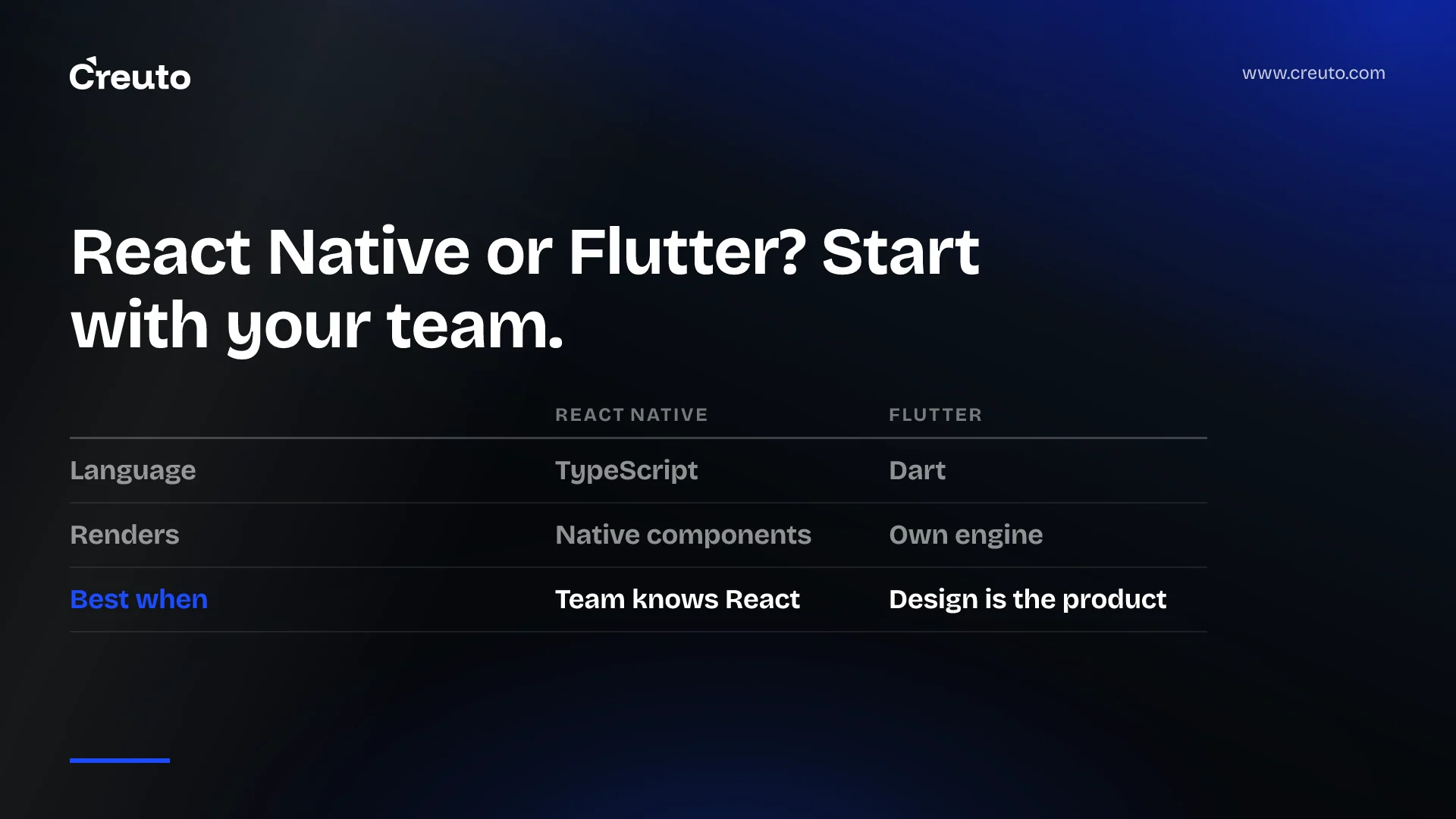
If you are commissioning a mobile app for iOS and Android, the framework question usually comes down to React Native vs Flutter. Both let one team ship to both platforms from a single codebase, both are used in serious production apps, and both are well supported. The right choice depends less on benchmarks and more on your team, your design ambitions and what you already run.
React Native vs Flutter: the core difference
- React Native uses JavaScript or TypeScript and React. It renders real platform UI components, so apps look and behave like native iOS and Android apps by default.
- Flutter uses Dart and draws its own interface with its own rendering engine, so an app looks identical on every platform unless you deliberately adapt it.
That single design decision explains most of the trade-offs that follow.
React Native vs Flutter performance comparison
Older comparisons often say React Native is held back by a "bridge" between JavaScript and native code. That is out of date. React Native's New Architecture became the default in version 0.76 in October 2024, replacing the old asynchronous bridge with direct interfaces between JavaScript and native code.
Flutter compiles Dart to native machine code and controls every pixel, which makes it very consistent for animation-heavy, custom-designed interfaces. In practice, for most business apps — forms, lists, dashboards, commerce, bookings — both frameworks perform well, and the quality of the code matters more than the framework. Performance differences show up at the edges: very complex animations, large lists on low-end Android devices, or heavy native integrations. Test those specific cases rather than relying on general claims.
Flutter vs React Native for business apps
Choose React Native when
- your team or partner already works in React and TypeScript, including a React web app you want to share logic with;
- you want the app to feel native on each platform with minimal effort;
- you rely on a large ecosystem of JavaScript libraries and native modules;
- you need over-the-air update options for JavaScript changes, covered in our guide to React Native OTA updates after CodePush.
Choose Flutter when
- your brand calls for a highly custom, pixel-consistent design across platforms;
- animation and motion are central to the experience;
- you want one toolkit that also targets web and desktop from the same UI code;
- your team is happy to work in Dart.
React Native vs Flutter pros and cons
| React Native | Flutter | |
|---|---|---|
| Language | JavaScript / TypeScript | Dart |
| UI | Native platform components | Own rendering engine |
| Strengths | Huge JS ecosystem, React skills reuse, native look | Consistent custom UI, strong animation, multi-platform UI |
| Watch-outs | Native module quality varies; upgrades need care | Smaller hiring pool; platform look must be built deliberately |
Which is better for startups: Flutter or React Native?
For an MVP, pick the framework your team knows best — speed of iteration matters more than anything else at that stage. If you are hiring from scratch, React Native's use of JavaScript and TypeScript typically gives a larger pool of developers; Flutter teams are very productive once in place. Our MVP guide covers how to keep the first version focused whichever you choose.
React Native vs Flutter app development cost
Neither framework is inherently cheaper. Cost is driven by features, design complexity, integrations, testing and maintenance, as we explain in how much a mobile app costs. Both are usually cheaper than building two fully separate native apps, because most of the code is shared.
What about native development?
Cross-platform is not always the answer. Apps that live on the newest platform features, need maximum performance, or are central to a large company's business sometimes justify native Swift and Kotlin. Shopify's decision to move some work back to native is a good example of the trade-offs, discussed in React Native vs native in 2026.
Final verdict
Choose React Native if your team knows React, you want a native feel with little effort, and ecosystem breadth matters. Choose Flutter if a distinctive, consistent design and rich motion are central and your team is comfortable with Dart. Either way, a prototype of your hardest screen will tell you more than any comparison article.
We build apps in both. Our React Native and Flutter teams can help you choose based on your product, not on framework loyalty.
Frequently asked questions
For most business apps, Flutter and React Native both perform well and code quality matters more than the framework. Flutter is very consistent for custom, animation-heavy UIs, while React Native's New Architecture, default since version 0.76, removed the old bridge bottleneck.
For a startup, the better framework is usually the one your team already knows, because iteration speed matters most at the MVP stage. React Native often has a larger hiring pool through JavaScript and TypeScript; Flutter suits design-led products.
React Native's New Architecture, enabled by default from version 0.76 in October 2024, replaced the old asynchronous bridge with direct interfaces between JavaScript and native code. Comparisons citing the bridge as a bottleneck are out of date.
Neither Flutter nor React Native is inherently cheaper. Development cost depends on features, design complexity, integrations, testing and maintenance. Both are typically cheaper than building separate native iOS and Android apps because most code is shared.