RBI AI guidelines: what the draft wants built
The RBI AI guidelines are still a draft: June 2026 model risk guidance. What it asks banks and NBFCs to build, from model inventory to a kill switch.
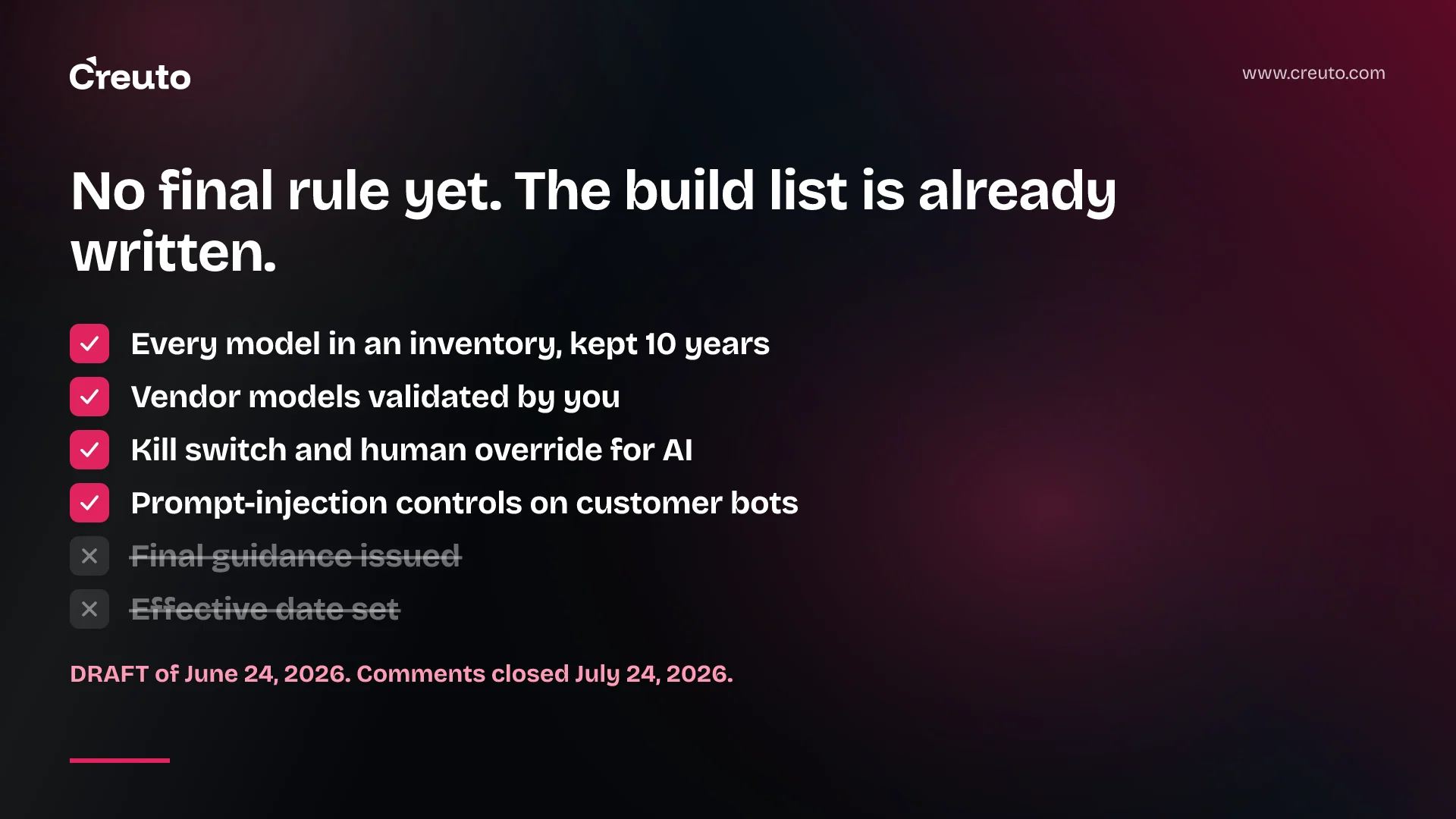
The RBI AI guidelines that matter for your tech stack today are a draft: the Reserve Bank of India's draft Guidance on Regulatory Principles for Model Risk Management, released on June 24, 2026. It covers every model a bank or NBFC uses, AI or not, and it would count a spreadsheet loan-pricing calculator as a model.
That last point is in the draft's own definitions, and it sets the scale of the work. By the end of this post you will know what the draft asks a lender to build, paragraph by paragraph, which parts bite hardest on vendor and generative AI models, and what a UAE or EU book adds. All status checks are as of November 20, 2026.
| Item | What the record shows |
|---|---|
| Document | Draft Guidance on Regulatory Principles for Model Risk Management, 2026 |
| Released | June 24, 2026, by Press Release 2026-2027/528 |
| Status | Draft for public comment. Comments closed July 24, 2026. No final version found on rbi.org.in as of November 20, 2026 |
| Effective date | None stated. The draft's circular number and date are still placeholders ("DoR.ORG.REC.XXXX" and "June xx, 2026") |
| Who it covers | Commercial, small finance, payments, local area, regional rural and co-operative banks; NBFCs in all four layers; all-India financial institutions; asset reconstruction and credit information companies |
The RBI AI guidelines are still a draft, and the AI-specific rules may come later
The RBI has not issued a final AI rulebook. What exists is a committee report and a draft. The FREE-AI committee report, published on August 13, 2025, set out 7 Sutras and 26 recommendations under six pillars. It is a framework to guide the sector, not a direction a supervisor enforces.
The June 2026 draft is the first text that turns that thinking into expected controls. The press release traces its lineage: an August 5, 2024 draft on model risk in credit, then the FREE-AI report, then this broader draft that applies "to all models used by regulated entities, including third party models and models employing AI / ML." Once final, it would supersede Chapter 3, on credit risk models, of the RBI's Guidance Note on Credit Risk Management of October 12, 2002.
Read paragraph 2 of the draft before you assume it is the last word on AI. It says "further requirements, if any, applicable to AI models may be issued later." So the draft is a floor for AI governance, and possibly not the whole of it.
Popular coverage has run ahead of the text. One news site headlined its story "RBI mandates kill switch for bank AI models", though its own body calls the document a draft. The draft says lenders "should" put human oversight mitigants in place, and lists kill switches as one of them. Until the RBI issues a final version, these are proposals, not obligations.
Who the draft covers: every NBFC layer, and anything that acts like a model
The draft applies to NBFCs in the Base, Middle, Upper and Top layers, so a small digital lender is in scope alongside the large banks. The definition of a model is what widens the work. It includes "algorithms, analytics, interfaces, applications, decision-based rules, and other computational tools" that have a material impact on decisions, "irrespective of whether such tools are recognised as models by the RE."
The illustration in paragraph 7(3) is the one to show your risk committee. A spreadsheet loan-pricing calculator that takes borrower type, tenor, credit score and collateral value and produces a lending rate "should be considered as a model." If your pricing grid, your collections prioritization rules or your fraud thresholds live in a spreadsheet or a rules engine, they belong in scope too.
Paragraph 8 settles accountability: the lender "is accountable for the outcomes of all models used by it," whether built in-house or bought.
Seven systems the RBI draft asks a lender to build
Read as an engineering spec, the draft resolves into seven systems. The paragraph numbers below are from the draft text.
| System | Draft paragraphs | What it has to do |
|---|---|---|
| Model inventory | 21-24 | Hold every active, inactive and decommissioned model; nothing runs unless it is listed |
| Risk tiering and approvals | 12, 17-20, 34-35 | Tier every model, review tiers at least annually, route high-tier models to the board risk committee |
| Independent validation | 29-33, 46 | Validate before and after deployment, after changes and on triggers, including vendor models |
| Monitoring and change control | 37-42, 54(7), 56 | Watch performance and drift, log every change and version, re-validate on material change |
| Generative AI guardrails | 54(2), 55, 59 | Contain hallucinations, red-team customer-facing models, block prompt injection |
| Human oversight and kill switch | 60-63 | Human-in-command, override and deactivation, review of overrides and near misses |
| Fallback and continuity | 43-44 | Manual or backup paths when a model is unavailable, degraded or switched off |
Model inventory requirement in the RBI draft
Paragraph 21 says a lender "should ensure that no model is used, relied upon, or deployed unless it is part of inventory." Paragraph 22 sets the minimum fields: owners, developers, validators and approvers, risk tier, intended use, upstream and downstream dependencies, and key observations from validation, monitoring and audit.
Retention is the detail that changes the design. Decommissioned models stay in the inventory for at least ten years from decommissioning, or from when they stop serving as a backup or benchmark, whichever is later. Paragraph 24 ties documentation retention to the same period. A shared spreadsheet can hold the first list. It cannot reliably hold ten years of lineage, so this is where most lenders will need a proper registry with immutable history.
Risk tiering, approval and the three-month reporting clock
Every model gets a tier, reviewed at least annually (paragraph 17). Tiers must reflect materiality, complexity and other factors, and the draft warns that "a low complexity should not result in a disproportionate reduction" of a highly material model's tier. For AI models, paragraph 52 adds the level of autonomy and reliance placed on outputs.
High-tier models need approval from the Risk Management Committee of the Board (RMCB). Validation reports go to the RMCB or its delegate within three months of the validation finishing (paragraph 33). That is a workflow with deadlines, not a document, and it needs tracking.
Data drift and concept drift monitoring
Paragraph 54(7) says "data drift and concept drift, should be monitored and addressed on an ongoing basis." Paragraph 54(6) asks that outputs under similar inputs do not show "excessive or unexplained variation," managed through measures such as confidence scores. For an ML credit model, that means population stability and performance tracking against a baseline. For a generative model, it means running a fixed evaluation set on a schedule and comparing results, which we discuss in why models behave differently when they know they are tested.
Change control (paragraphs 38-42) needs a log of changes, versions and approvals, and a defined threshold for "material change" that re-triggers validation. Paragraph 56 adds tighter controls for models that update themselves automatically.
Do third-party AI models need independent validation under RBI rules?
Yes, under the draft. Paragraph 46 applies the full framework to third-party models and adds two things: independent validation by the lender "notwithstanding any validation, certification, or assurance provided by the third-party provider," and enhanced RMCB oversight "irrespective of their risk tier." A vendor's model card or audit letter is an input to your validation, not a substitute for it.
Paragraph 48 moves the requirement into your contracts. Vendor agreements should give you technical documentation sufficient to validate the model, audit rights for you and the RBI, and continuity and exit arrangements. If you are signing or renewing a vendor fraud or bureau-scoring contract this year, those three clauses are the cheapest part of compliance to secure now.
Large language model APIs are the hard case. Paragraph 51 says that where a provider "does not disclose adequate information," you identify the resulting risks and mitigate them, "such as limiting the usage." Paragraph 53 names "changes in model behaviour or capabilities resulting from provider-driven updates" as a risk to plan for. In engineering terms: pin a specific model version rather than a moving alias, record which version served each decision, and re-run your evaluation set before you move to a new one.
What the RBI AI kill switch requirement actually says
Paragraph 60 asks for human oversight of AI models, including "override, suspension, or deactivation mechanisms, including kill-switch arrangements." It sits beside human-in-the-loop or human-on-the-loop arrangements and periodic human review of model decisions. Paragraph 63 asks that decisions, interventions, overrides, incidents and near misses be reviewed periodically.
A kill switch with no fallback stops your business rather than the model. Paragraph 43 asks continuity plans to cover model unavailability, degradation or failure, with fallbacks such as "manual interventions, substitution, or back-up arrangements." Design the two together: a feature flag that routes credit decisions to a rules-based scorecard or a manual queue, an audit record each time it is used, and a tested drill.
Customer-facing models carry three extra controls in paragraph 59: defenses against prompt injection and adversarial inputs, with limits on session and context persistence; disclosure that the customer is talking to an AI system, with its limitations; and an option to switch to a human on request. Paragraph 55 adds red-teaming "particularly for models involving customer interaction or generative capabilities."
Why waiting for the final text is tempting, and where it goes wrong
The case for waiting is a serious one. The comment window closed in July, the RBI has said AI-specific requirements may follow separately, and building to a draft can mean rework. A lender that builds a heavy model-risk platform to today's paragraph numbers may find thresholds, tiers or approval routes changed in the final text.
The answer is to separate records from workflow. Inventory entries, version and change logs, validation evidence and override logs are records you cannot backfill: if they were not captured when a model was changed or switched off, they do not exist. Approval routes, report formats and committee cadences are workflow, and they can wait for the final text. Capture the records now and keep the workflow configurable.
Building a dedicated platform is the wrong choice if you run a handful of models. A lender with three models and a support bot can hold its inventory in a well-structured table with change history and spend the effort on validation and the fallback path. A platform earns its cost when you have dozens of models, several vendors and an RMCB asking for portfolio-level reporting.
For lenders with a UAE or EU book: what CBUAE and the EU AI Act add
The Central Bank of the UAE announced a guidance note on AI and machine learning for licensed financial institutions on February 23, 2026. The press release lists its principles as governance and accountability, fairness and non-discrimination, transparency and explainability, effective human oversight, and data management and privacy, and says it applies to all licensed financial institutions. We have read only the press release, not the guidance note itself, so we cannot map its paragraphs the way we have for the RBI draft. If you operate in the DIFC, the separate data protection regime in DIFC Regulation 10 may also apply.
In the EU, AI systems used to evaluate creditworthiness or establish a credit score are high-risk under Annex III, point 5(b) of the AI Act, with an exception for fraud detection. Regulation (EU) 2026/1744 of July 8, 2026 set the application date for Annex III high-risk obligations at December 2, 2027. The overlap with the RBI draft is large: inventory, documentation, human oversight and monitoring are common to both, so one set of records can serve two regulators.
Where to start on the RBI AI guidelines build
Start with the inventory, because paragraph 21 makes it the gate for everything else, and include the spreadsheets and rules engines that the draft's definition pulls in. Next, add version pinning and decision-level logging to every vendor and generative AI model, then design the kill switch and its fallback path together. Leave committee reporting formats until the final text is out.
If you are scoping the inventory, evaluation pipeline and guardrails for a credit model or a customer-facing bot, our AI engineering team can map your current models against the draft's paragraphs and size the build, so your risk committee gets an answer in engineering terms before the final guidance lands.
Frequently asked questions
The RBI AI guidelines are not final. The Guidance on Regulatory Principles for Model Risk Management was released as a draft on June 24, 2026, comments closed on July 24, 2026, and no final version was on the RBI website as of November 20, 2026. The draft also states no effective date.
The RBI draft model risk guidance applies to NBFCs in the Base, Middle, Upper and Top layers, alongside commercial, small finance, payments and co-operative banks, all-India financial institutions, asset reconstruction companies and credit information companies. It covers every model they use, including third-party and AI or machine learning models.
Vendor AI models need independent validation by the lender under paragraph 46 of the RBI draft, notwithstanding any validation, certification or assurance from the provider. Third-party models also get enhanced oversight by the board risk committee regardless of risk tier, and contracts should grant documentation, audit rights and exit arrangements.
The RBI AI kill switch appears in paragraph 60 of the draft model risk guidance, which says lenders should have override, suspension or deactivation mechanisms, including kill-switch arrangements, as part of human oversight of AI models. Paragraph 43 separately asks for fallback arrangements such as manual intervention when a model fails.
EU AI Act high-risk obligations for credit scoring apply from December 2, 2027. Creditworthiness and credit-score systems are listed in Annex III, point 5(b), and Regulation (EU) 2026/1744 of July 8, 2026 set December 2, 2027 as the application date for Annex III high-risk systems.