RAG implementation cost: the managed floors, line by line
RAG implementation cost, line by line: Bedrock, Azure AI Search, OpenSearch and OpenAI price floors as of November 2026, and where spend goes after launch.
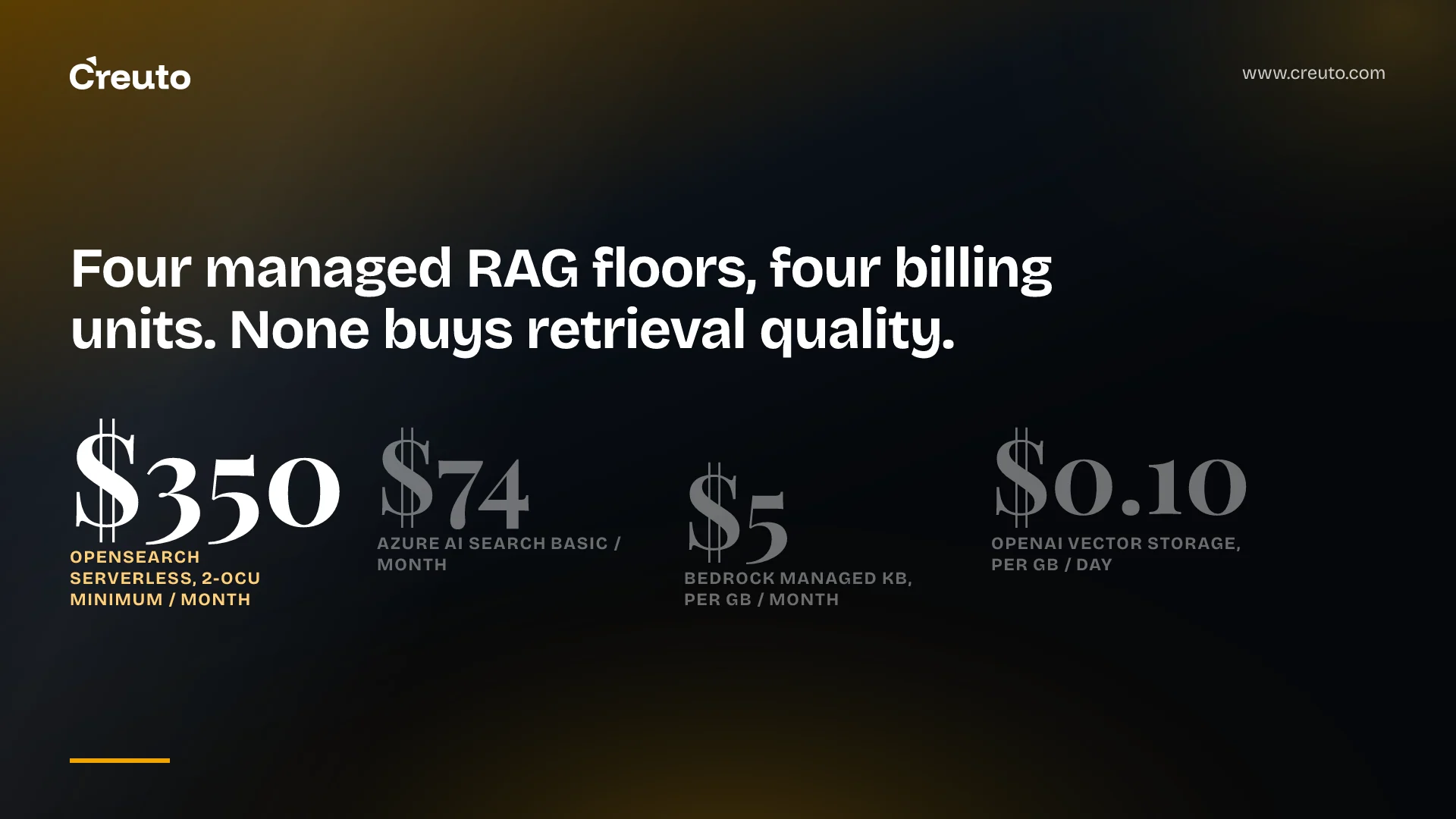
Your RAG implementation cost has a floor you can check, and it is lower than most agency quotes suggest. As of November 2026, a managed retrieval service starts at about $74 a month on Azure AI Search Basic, about $350 a month for a classic OpenSearch Serverless collection, and pay-per-use on Bedrock's new Managed Knowledge Base. After launch, the spend moves to ingestion, evaluation and re-indexing.
The first page of results for this query is mostly agency pages quoting five- and six-figure ranges with no sources behind them. This post goes the other way: every managed floor below is linked to the vendor's own pricing page, the monthly figures show their arithmetic, and the final sections cover the part no price list carries, which is the engineering time that decides whether the assistant answers correctly.
The key figures, as of November 2026:
| Service | Billing unit | Published price | Floor |
|---|---|---|---|
| Amazon OpenSearch Serverless (classic) | OCU-hour | $0.24 per OCU-hour | 2 OCUs billed minimum |
| Amazon Bedrock Managed Knowledge Base | GB of raw data, retrieval calls | $5.00 per GB-month; $1.00 per 1,000 retrievals | None published |
| Azure AI Search Basic / S1 | Search unit hour | $0.101 / $0.336 per hour | One unit, always on |
| OpenAI file search | GB-day of vector storage, tool calls | $0.10 per GB per day (1 GB free); $2.50 per 1,000 calls | None |
| Pinecone Standard | GB-month, read units | $0.33 per GB-month; $16-18 per million read units | $50 a month minimum |
| Google Agent Search (Standard) | Queries, GiB of indexed raw data | $1.50 per 1,000 queries; about $5 per GiB-month | 10 GiB storage free |
What the managed floors say about rag implementation cost
A managed floor is the smallest monthly bill a service will send you once a retrieval index exists, before your users ask a single question. It matters because an internal-docs assistant at a 100-400 person company rarely produces enough traffic to rise far above it. For that workload, the floor is most of the cloud bill.
The floors also change faster than the articles that quote them. Bedrock's managed knowledge base, Azure's Serverless SKU and Google's rename of Vertex AI Search all landed in 2026, so any figure older than a few months deserves a second look before it goes into a budget.
OpenSearch Serverless OCU minimum cost
Classic OpenSearch Serverless collections are billed for a minimum of 2 OCUs, one for indexing and one for search, at the $0.24 per OCU-hour rate the page's US East examples use. Our calculation: 2 OCUs × $0.24 × 730 hours = $350.40 a month before storage. The dev/test mode drops the redundant standby and halves that to 0.5 OCU for indexing and 0.5 for search, which works out at 1 × $0.24 × 730 = $175.20 a month (our calculation).
The figure you will still see in older posts, a $700 monthly floor, is out of date twice over. The same AWS pricing page now says NextGen collections have "no minimum OCU requirement", with indexing and search capacity scaling to zero after 10 minutes of inactivity. If your assistant is quiet overnight and at weekends, that is the line that changes the comparison.
Bedrock knowledge base minimum monthly cost
Amazon Bedrock Managed Knowledge Base, generally available since 17 June 2026, publishes no minimum. The Bedrock pricing page charges $5.00 per GB of raw data per month for the index and $1.00 per 1,000 Retrieve API calls, which include hybrid search. Parsing, embeddings and reranking cost $0 when you use the managed models; bring your own and that provider's fees apply.
Two details matter for a budget. Storage is billed on raw source data, not on the size of the vectors, so a scanned-PDF archive costs what its files weigh. And agentic retrieval, the multi-step mode, costs $4.00 per 1,000 calls plus $1.00 per 1,000 underlying retrievals, on the same page. The launch post also lists six native connectors: S3, SharePoint, Confluence, Google Drive, OneDrive and a web crawler.
Azure AI Search Basic vs S1 for RAG
Azure AI Search bills per search unit hour, whether you query or not. The Azure Retail Prices API lists East US at $0.101 an hour for Basic and $0.336 for S1. Our calculation at 730 hours: $73.73 a month for Basic, $245.28 for S1, $981.12 for S2 and $1,962.24 for S3. The semantic ranker, Azure's reranking step, has a free monthly allowance and then costs $1 per 1,000 queries on the same price list.
The same price list carries a Serverless SKU effective 1 September 2026: $0.24 per compute unit-hour and $0.20 per GB-month of storage. We could not find a launch announcement for it, so treat those two numbers as a price-list entry and confirm the billing model with Microsoft before you design around it.
OpenAI file search vector store pricing
OpenAI's hosted file search charges $0.10 per GB of vector storage per day, with 1 GB free, plus $2.50 per 1,000 file search tool calls in the Responses API. The daily unit catches people out: 10 GB of vector storage is (10 − 1) × $0.10 × 30 days = $27 a month by our calculation, and storage that nobody queries keeps billing.
Pinecone, S3 Vectors and Agent Search
Three other options set the shape of the market. Pinecone has a $20 Builder plan, a $50 monthly minimum on Standard and $500 on Enterprise, with storage at $0.33 per GB-month. Amazon S3 Vectors has no floor at all: $0.06 per GB-month of vector storage, $0.20 per GB uploaded and $2.50 per million queries, plus a small processed-data charge. AWS's own documentation describes S3 Vectors as best suited for infrequent query workloads.
Google renamed Vertex AI Search to Agent Search on 22 April 2026, though the console and API endpoints keep the old names. Its pricing page lists Standard Edition search at $1.50 per 1,000 queries, Enterprise at $4.00, a free allowance of 10,000 queries per account each month, and index storage at $0.006849315 per GiB-hour with 10 GiB free. That hourly rate is $5.00 per GiB-month at 730 hours, our calculation.
How much does a RAG system cost per month on one workload?
A RAG system over 10 GB of documents answering 50,000 retrievals a month costs roughly $60 to $350 in retrieval infrastructure, depending on the service. The table below applies the published prices above to that single workload; every total is our calculation, and generation, the LLM call that writes the answer, is excluded.
| Service | Arithmetic | Monthly retrieval cost |
|---|---|---|
| Google Agent Search Standard | (50,000 − 10,000 free) ÷ 1,000 × $1.50; 10 GB fits inside the 10 GiB free storage | $60 |
| Azure AI Search Basic + semantic ranker | $73.73 + up to 50 × $1 before the free allowance | $74-124 |
| Bedrock Managed Knowledge Base | 10 × $5 + 50 × $1 | $100 |
| OpenAI file search | $27 storage (if the vector store is 10 GB) + 50 × $2.50 | $152 |
| OpenSearch Serverless classic | 2 × $0.24 × 730, storage extra | $350 |
Read this table with the units in mind. Bedrock and Agent Search bill on raw source data, OpenAI on the size of the vector store, and Azure on capacity regardless of size. The ranking flips at different volumes: per-call pricing wins at low traffic, while fixed capacity wins once queries climb, so run your own numbers at two or three times your expected load.
The generation side is a separate bill, and usually a bigger one. We broke that down per model call in our AI agent development cost post; the same token arithmetic applies to the answer step of a RAG assistant.
Is Bedrock Knowledge Base cheaper than building on pgvector?
On the cloud bill alone, building on pgvector in a PostgreSQL database you already run is cheaper: the marginal cost of a few gigabytes of vectors is close to zero, and Bedrock's own self-managed knowledge bases accept Aurora PostgreSQL as a vector store. That is the strongest case for the custom build, and for a team with Postgres skills and a single document source it often wins.
The managed service is selling the parts around the index. Six connectors with automatic sync, hybrid search, reranking and agentic retrieval come bundled in Bedrock's $5 per GB and $1 per 1,000 calls. On pgvector you write the SharePoint and Confluence sync, the keyword half of hybrid search, the reranker call and the document-level access control yourself, and you maintain them. Connector work deserves its own estimate, for the same reasons we covered in what API integration cost ranges leave out.
The custom build is the wrong choice if your documents live in four SaaS tools and permissions differ per folder. The managed service is the wrong choice if you need a retrieval behavior it does not expose, or your corpus is large enough that $5 per GB of raw data outgrows the price of a database. If pgvector is on your list, read our note on the pg_vectorsearch benchmark before you assume a newer extension will fix recall.
Where most RAG cost goes after launch
After launch, most RAG cost goes into engineering time on ingestion, evaluation and re-indexing, not into the index bill. Compute for the ingestion pipeline itself is cheap. Embedding 100 million tokens with text-embedding-3-small at $0.02 per million tokens costs $2, or $13 with text-embedding-3-large at $0.13, both our calculations.
What moves retrieval quality is how chunks are prepared. Anthropic's Contextual Retrieval study, published in September 2024, cut the top-20 retrieval failure rate by 49% by prepending generated context to each chunk and combining embeddings with BM25 keyword search, and by 67% once a reranker was added. The one-time cost of generating that context was $1.02 per million document tokens, so about $102 for a 100-million-token corpus by our calculation.
None of those gains are visible without an evaluation set: a few hundred real questions, each with the document that should answer it, scored with a metric such as recall@k. Anthropic measured 1 minus recall@20. We have found no credible published figure for what building and maintaining that set costs in staff time, and we would not trust a quote that claims one. It is a recurring line item, owned by someone who knows the documents.
How often do you need to re-index a RAG system?
You need to re-index a RAG system whenever the thing that produced the vectors changes, not on a calendar. Changing embedding model, chunk size or chunk-context strategy means re-embedding the whole corpus, because vectors from different models do not compare. Source changes are handled by incremental sync, which Bedrock's Managed Knowledge Base runs automatically for its connectors.
The compute for a full re-index is small, as the embedding arithmetic above shows. The cost is the evaluation run before and after, and the time spent working out why recall dropped on one document type. Budget for re-indexing as a planned event, each one tied to an evaluation result, rather than something that happens when someone notices bad answers.
What to budget before you choose a RAG platform
Budget the cloud floor from the tables above, then budget separately for the three things no price list covers: connectors to the systems your documents live in, an evaluation set with an owner, and the re-indexing cycles that the evaluation will ask for. When the first number is a few hundred dollars a month and the second is a standing share of an engineer's time, the platform choice matters less than whether you fund the second.
We build LLM applications with the OpenAI and Anthropic APIs on PostgreSQL and AWS, and we scope these decisions before anyone commits to a platform. If you are choosing between a managed knowledge base and a custom build over your own documents, our AI engineering services team can price both against your corpus, your traffic and your connector list, so the comparison is your numbers rather than ours.
Frequently asked questions
The minimum monthly cost of a managed RAG service ranges from nothing to about $350 as of November 2026. Bedrock Managed Knowledge Base, OpenAI file search and S3 Vectors publish no floor, Pinecone Standard has a $50 minimum, Azure AI Search Basic runs about $74, and a classic OpenSearch Serverless collection about $350.
A RAG system over 10 GB of internal documents with 50,000 retrievals a month costs roughly $60 to $350 in retrieval infrastructure on managed services, based on published November 2026 prices. That excludes the LLM calls that generate answers and the engineering time spent on connectors, evaluation and re-indexing.
Building on pgvector in a PostgreSQL database you already run is usually cheaper on the cloud bill alone. Bedrock Managed Knowledge Base costs more per gigabyte but bundles six connectors, hybrid search, reranking and sync, which a pgvector build has to implement and maintain with your own engineers.
Most RAG cost after launch goes into engineering time for ingestion, evaluation and re-indexing rather than the index bill. Embedding 100 million tokens costs about $2 with text-embedding-3-small, while building an evaluation set and diagnosing recall drops takes recurring time from someone who knows the documents.
A RAG system needs a full re-index whenever you change the embedding model, chunk size or chunk-context strategy, because vectors from different models cannot be compared. Day-to-day document changes are handled by incremental sync, which Bedrock Managed Knowledge Base runs automatically for its connectors.