Python on Vercel is GA, but its Next.js glue is still Beta
Python on Vercel is GA, but Services is still Beta. The limits, the billing detail and when to keep your FastAPI backend on AWS instead.
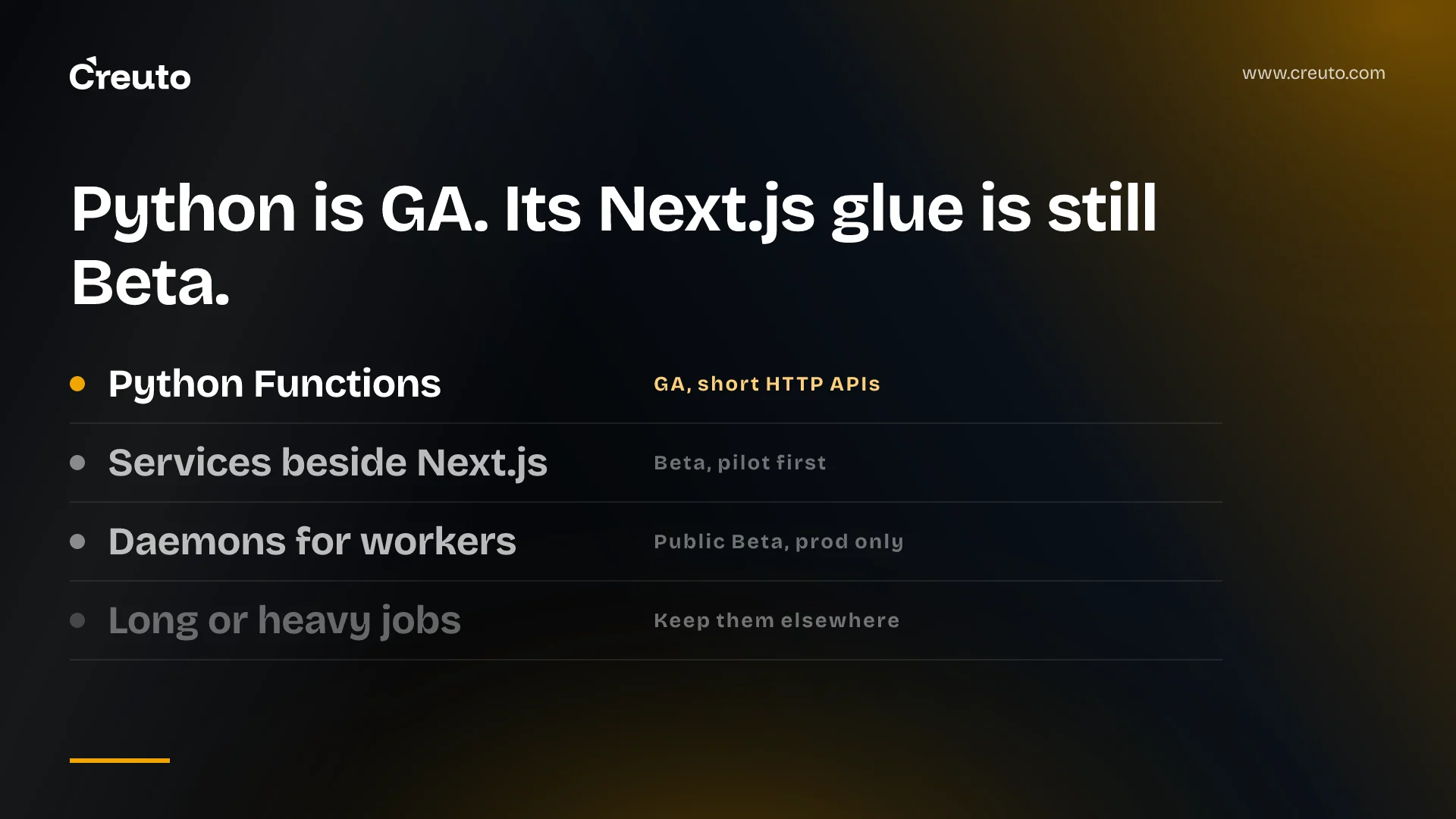
Python on Vercel was announced as generally available on October 15, 2026, but the feature that puts a FastAPI backend beside a Next.js frontend, Vercel Services, is still labelled Beta in its docs. This guide covers what the GA includes, which limits decide whether your API fits, and when you should keep it elsewhere.
We should say where we stand. Creuto has not deployed a production Python workload on Vercel. We build Next.js frontends and Python AI/ML services, and we run AWS, Docker, Kubernetes and serverless setups for clients, so this is a reading of Vercel's documentation, checked against what we know of those stacks. Vercel sells the platform, and almost every source below is Vercel's own. Limits are stated as read on 2026-10-20.
Python on Vercel is GA, but Services, Daemons and large functions are not
The GA announcement covers the Python runtime itself. Vercel says it reads your dependency files, including those managed by uv, and detects FastAPI, Flask, Django and FastHTML, then runs the app on Fluid compute. The Python runtime docs describe ASGI and WSGI applications run as Vercel Functions, with Python 3.12 as the default and 3.13 and 3.14 available.
The pieces around that runtime are labelled differently. The Services page carries an availability note reading "Services (Beta) are available on all plans". The Daemons page says "Daemons (Public Beta)", and the limits page marks large functions and the 30-minute extended duration as Beta.
That matters because the GA post's pitch for full-stack projects leans on Services: running vercel dev starts both parts together, and shared previews let you test backend changes with the frontend that uses them. The runtime is GA. The colocation workflow is, by Vercel's own labels, not yet. A beta label is not a reason to avoid it, but it is a reason to pilot before you move a revenue-bearing API.
What the 150,000 teams figure does and does not tell you
In a companion post, Vercel states that 150,000 teams run Python backends on Vercel, including engineers at OpenAI, Polymarket and Exa. It is Vercel's count and the post does not define "run" or give a time window, so read it as evidence of adoption, not of fit for your workload.
One trap: the same post also says that 5,000 teams have shipped 150,000 container deployments. The two figures share a number and measure different things. If you quote either, quote it with its subject.
The limits that decide whether your Python API fits
Most migration surprises come from limits, not features. These are the figures from Vercel's Functions limits page (last updated 2026-08-24 on the page, read 2026-10-20) and the Python runtime page.
| Limit | Value on Vercel Functions | What it means for a FastAPI backend |
|---|---|---|
| Maximum duration | Hobby 300s. Pro and Enterprise 300s default, 800s maximum, 1,800s extended maximum in Beta | A request that runs past the limit returns a 504; longer work needs Workflows, Queues or a Daemon |
| Memory | Hobby 2 GB and 1 vCPU. Pro and Enterprise up to 4 GB and 2 vCPU | Loading a large model or dataset per instance can hit this first |
| Bundle size | 500 MB uncompressed for Python; up to 5 GB with large functions (Beta) | Python has no automatic tree-shaking, so trim dependencies yourself |
| Request and response body | 4.5 MB maximum | File uploads and large exports need object storage, not the function body |
| File descriptors | 1,024 shared across concurrent executions, including the runtime's own | Pool database connections and close sockets |
| Default region | A single region, iad1, unless you change it; multiple regions on Pro and Enterprise | Place the function near your database |
Cold starts are the other question teams ask, and here we have nothing to quote. Vercel says Fluid compute applies automatic bytecode optimization and function pre-warming on production deployments, and the Python runtime page says Vercel compiles Python source into bytecode and includes the .pyc files in the bundle when space allows. None of the pages we read gave a Python cold-start figure, so we are not publishing one and we are not comparing against Lambda or any other host. Measure your own endpoint with your own dependencies.
How colocating a FastAPI backend with Next.js works in Services
Per the Services docs, a service is an independently built unit within your project, and all services share one deployment. A Next.js frontend at the root and a FastAPI backend under its own directory is the example the docs use. The configuration is a vercel.json with a services block and rewrites:
{
  "services": {
    "my_frontend": { "root": "frontend/" },
    "my_backend": { "root": "backend/", "entrypoint": "main:app" }
  },
  "rewrites": [
    { "source": "/api/(.*)", "destination": { "service": "my_backend" } },
    { "source": "/(.*)", "destination": { "service": "my_frontend" } }
  ]
}
Three behaviours are worth knowing before you adopt it. A service is internal by default and not routable from the internet unless a top-level rewrite exposes it, and one service can call another over a binding. Services also remain, in the words of Vercel's own hosting guide, separate applications communicating across a service boundary, with no implied shared process or memory. And the preview is only as isolated as its data: Vercel's Python starter guide warns that deploying both apps together does not isolate their database, so previews that share a database let a schema change affect older deployments.
On the bill, CPU stops during I/O but memory does not
Services are billed the same as Vercel Functions: Active CPU, provisioned memory and invocations, plus a charge for service-to-service requests over bindings, with the first 1,000,000 included on Hobby. The pricing page says Active CPU is billed only while your code is running, and pauses while it waits on I/O.
The same page adds the half that blog summaries leave out: provisioned memory keeps billing while requests wait on I/O, until the last in-flight request completes. An API that spends most of its time waiting on a database or a model call pays less CPU than a busy-loop would, but it is not free while it waits. We have not priced a workload against AWS, so we make no cost comparison. What you can do is take your current peak memory and request time and run them through the published regional rates.
Delphi's move saved onboarding time, not compute
Vercel's lead case study is Delphi, which moved its Python backend from AWS ECS to Vercel; with ten engineers and no dedicated infrastructure role, it reports more than 100 production deploys a day behind feature flags. That is a vendor-published customer story, so weigh it accordingly.
The detail that is useful to you is the reason. Delphi's backend ran on ECS, Docker Desktop and local databases, and getting a new engineer to their first deploy took a full day of environment setup. The story says Delphi could have fixed that without leaving AWS, but that would have meant designing and owning the infrastructure, which the team did not want. It also says the move depended on Vercel Workflows and Queues for its long-running work and background jobs.
Our reading, and it is ours: Delphi bought less infrastructure ownership, and paid for it with a deeper dependence on Vercel's own primitives. That trade suits a ten-person team with no platform engineer. It may not suit a company that already runs a platform team and a compliance regime on AWS.
When keeping your Python service separate is the right call
The strongest argument for staying put comes from Vercel's own hosting guide: adding a new frontend is often insufficient reason to relocate an otherwise suitable Python API, and independent deployments suit a backend that serves several clients or has its own release process. We agree with it, and it points to the cases below.
- More than one client. If a mobile app, partners or webhooks call the API directly, it needs its own public surface and release cadence. Services can expose a backend, but then you are running an independent API that happens to sit in a frontend repository.
- Long or stateful work. Past 800 seconds you are in Beta territory, and Vercel points unlimited-duration work to Workflows. Daemons, the worker option, run only in production during the beta, with no preview-deployment support. The Daemons docs give a 30-second default shutdown grace after SIGTERM while Vercel's Functions, containers and Daemons guide says 10 seconds. Test the figure you rely on.
- Heavy dependencies. A 500 MB bundle ceiling, 4 GB of memory and no tree-shaking rule out many ML-heavy services unless you accept large functions in Beta or put the heavy step in a separate worker.
- Data location. The regional pricing table lists 19 regions, from Cape Town to Tokyo and including Mumbai, and none in the Gulf. If your data must stay in the UAE, check the service availability gap in the UAE cloud region and Vercel's region list before you plan around either.
- Realtime. Vercel says its Functions can serve WebSockets, currently in beta, and that a reconnect can reach a different instance, so session state must live outside process memory.
If edge Python is what you are weighing, we covered Cloudflare Python Workers and FastAPI separately. If the alternative to ECS is Lambda, our note on the AWS Lambda 90 minute timeout is the place to start, and its advice is to read the conditions first.
A decision framework we would use, untested on Vercel by us
This table is our reasoning from the sources above, not a benchmark. It assumes you are choosing for a Next.js product with a Python API behind it.
| Your situation | Our lean | Why |
|---|---|---|
| Python API used only by this Next.js app, requests well under a minute, payloads under 4.5 MB | Pilot colocating on Vercel | Fits the limits, and one preview covers both halves |
| API also serves mobile apps, partners or webhooks | Keep a separate service | Its release cycle should not follow the frontend's |
| Jobs that run for minutes or hours, or poll queues | Keep workers where they are, or pilot Workflows or Daemons knowing both are young | Beta limits, and Daemons have no preview support |
| Large ML dependencies, GPU, or models loaded into memory | Keep on AWS or a dedicated compute service | 500 MB bundle and 4 GB ceilings |
| Data pinned to a region or cloud Vercel does not list | Keep the API next to the data | Latency and residency come before deployment convenience |
| Small team, no platform engineer, an environment that takes a day to set up | Colocating is worth a serious pilot | This is the profile of Delphi's reported gain |
Treat any row that depends on a Beta feature as a pilot, not a migration. The decision that costs least to get wrong is the next one: pick the single endpoint with your largest realistic input, deploy it to a Vercel preview, and record peak memory, duration and first-request latency against the limits table. If it clears them, the web app development question becomes how to stage the rest, and the serverless architecture and DevOps and cloud engineering work is deciding what stays on AWS.
Frequently asked questions
The Python runtime is generally available as of Vercel's October 15, 2026 announcement. The surrounding pieces differ: Vercel's docs label Services as Beta, Daemons as Public Beta, and large functions as Beta. Run one real endpoint on a preview before moving a production API.
Vercel detects FastAPI from your pyproject.toml or requirements.txt and loads an entrypoint such as app.py or main.py that defines a top-level app variable. To deploy it beside a Next.js frontend, declare both as services in vercel.json and add rewrites that route /api paths to the backend.
As read on 2026-10-20, Python Functions on Vercel default to 300 seconds. Hobby tops out at 300 seconds, while Pro and Enterprise reach 800 seconds generally and 1,800 seconds in Beta. Work that needs more time belongs in Vercel Workflows, which Vercel describes as having no duration limit.
Vercel says Fluid compute applies bytecode optimization and pre-warming on production deployments, and the Python runtime ships precompiled bytecode when space allows. The pages we read give no Python cold-start figure, so measure your own endpoint with its real dependencies before relying on any number.
Only if the API mostly serves your Next.js app and fits Vercel's limits. Vercel's own hosting guide says adding a new frontend is often insufficient reason to move an otherwise suitable API. Keep it separate when mobile apps, partners, long jobs, large dependencies or data location are involved.
Yes, in three ways, with caveats. Queue-triggered Functions and Workflows handle jobs inside Vercel's duration limits, and Vercel Daemons run continuous workers from container images. Daemons are Public Beta, run only in production deployments during the beta, and do not support preview deployments.
