Python 3.10 end of life: why Lambda's dates keep moving
Python 3.10 end of life hit on 1 October. Lambda deprecates python3.10 on 31 October but blocks deploys only in 2027. The dates, the CLI check, the target.
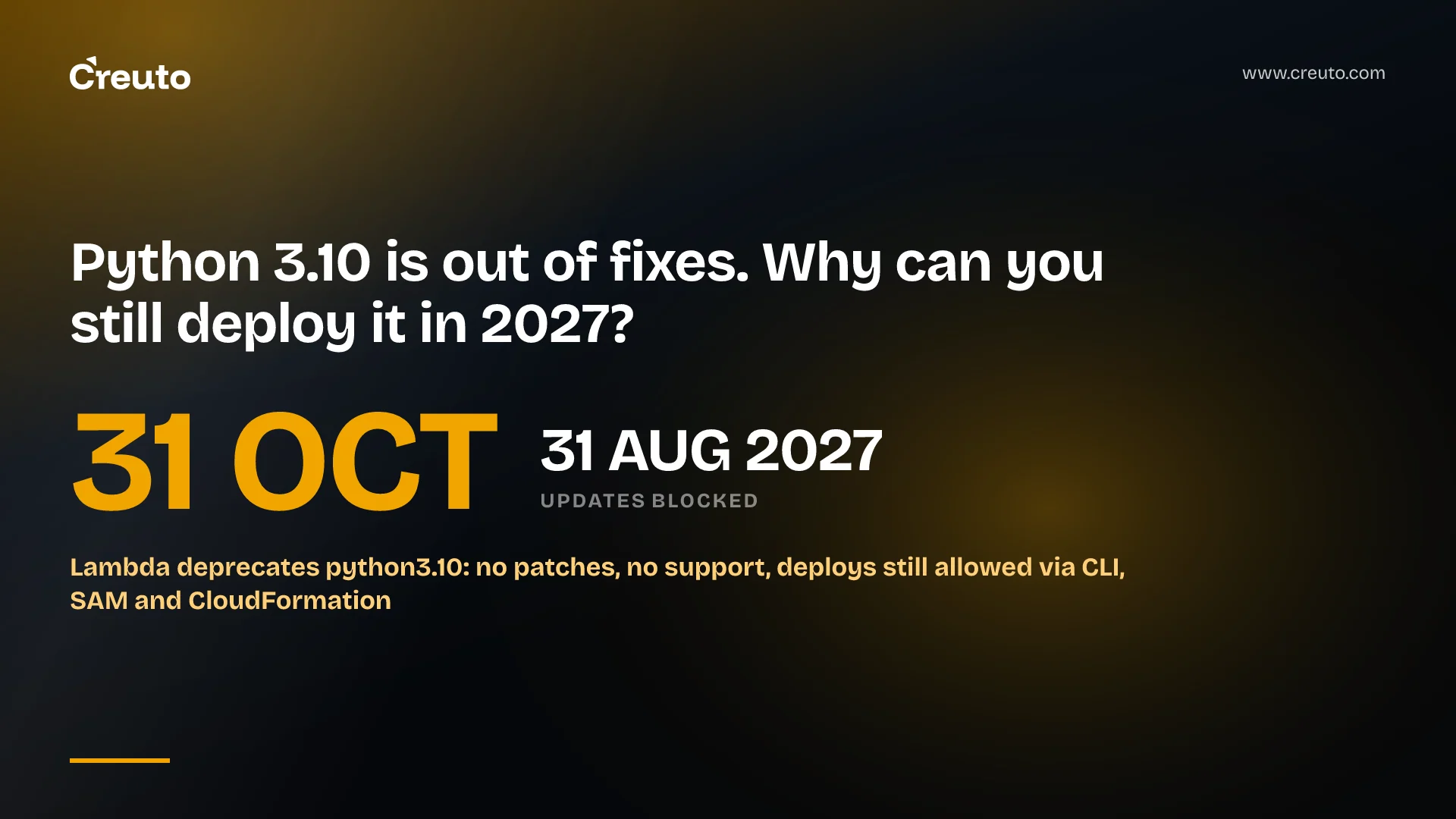
Python 3.10 end of life arrived on 1 October 2026, when PEP 619 recorded that 3.10.22 "was the final security release". AWS Lambda deprecates the python3.10 runtime on 31 October, yet still lets you create functions on it until 29 July 2027. By the end of this post you will know which dates are real, why the pages you find disagree, and which version to move to.
The surprising part is not the deadline. It is that AWS has rewritten the python3.10 schedule at least three times in ten months, and the gap between "unsupported" and "blocked" is now almost a year. That gap is where unpatched code lives.
Python 3.10 end of life: the dates that actually apply
Two bodies set dates here, and they set different things. The Python Software Foundation decides when CPython stops getting fixes. AWS decides when its managed runtime stops getting patches and when it stops accepting deployments. As of 26 October 2026, the primary sources say this:
| Event | Date | Source |
|---|---|---|
| Final CPython 3.10 release (3.10.22) | 1 October 2026 | PEP 619 |
| CPython 3.10 end of life | 1 October 2026 | Python devguide |
| Lambda python3.10 deprecated | 31 October 2026 | Lambda runtimes |
| Lambda blocks new python3.10 functions | 29 July 2027 | Lambda runtimes |
| Lambda blocks python3.10 code and config updates | 31 August 2027 | Lambda runtimes |
PEP 619 is blunt about what end of life means upstream: the 3.10 codebase "is now frozen and no further updates will be provided nor issues of any kind will be accepted on the bug tracker." Security releases since 3.10.12 in June 2023 were source-only, so if you have been running 3.10 from a vendor build, your patch stream already depended on that vendor.
Why the python3.10 Lambda dates you find disagree
If a blog or tracker gives you different block dates, it may not be wrong so much as stale. Archived copies of the AWS runtimes page show the python3.10 row changing repeatedly:
| AWS page as captured | Deprecation | Block create | Block update |
|---|---|---|---|
| 26 December 2025 | 30 Jun 2026 | 31 Jul 2026 | 31 Aug 2026 |
| 15 April 2026 | 31 Oct 2026 | 30 Nov 2026 | 15 Jan 2027 |
| 17 September 2026 | 31 Oct 2026 | 1 Feb 2027 | 3 Mar 2027 |
| 26 October 2026 (live) | 31 Oct 2026 | 29 Jul 2027 | 31 Aug 2027 |
So a forum post quoting a February and March 2027 cut-off was accurate when written. AWS explains the pattern in its own policy: for some runtimes it is "delaying the block-function-create and block-function-update dates beyond the usual 30 and 60 days after deprecation" in response to customer feedback, and it "will not start blocking function creates or updates before the dates given in these tables" (AWS). Note what that promise does not say: the dates can move later, and in every archived version we checked, they did. Plan against the live table, not a screenshot of it.
Watch for one more mislabel. Some trackers present 31 August 2027 as the end of support. It is not. Support, meaning patches and technical support, ends at deprecation on 31 October 2026. The August date is only when deployments stop.
What happens to Lambda functions on python3.10 after 31 October
On the deprecation date, AWS says it "may no longer apply security updates or other updates," functions "are no longer eligible for technical support," and you "can no longer create or update functions using the deprecated runtime in the Lambda console." You can still create and update them "through the AWS CLI, AWS SAM, or CloudFormation" (Lambda runtime deprecation policy). Invocation never stops: "you can continue to invoke your functions indefinitely."
That is why this deadline is easy to miss. Pipelines keep deploying, nothing fails, and the only visible change is in the console. Two things make the quiet period worse than it sounds:
- The base OS is already past its own end. AWS states that Amazon Linux 2 was scheduled for end of life on 30 June 2026, and that the python3.10 and python3.11 runtimes get only "critical and selected important" Amazon Linux 2 patches until their deprecation dates.
- Rollback disappears on 31 August 2027. After updates are blocked you can still move a function to a supported runtime, but "rolling back to the deprecated runtime may be blocked" (AWS). AWS recommends function versions and aliases so a bad upgrade can be reverted without the old runtime.
Container-image functions get no warning at all: "Deprecation notifications are not available for functions using container images" (AWS). If you deploy python3.10 as a container image, you are responsible for noticing.
How to find every Lambda function on a deprecated runtime
AWS sends an email and a Health Dashboard notice at least 180 days before deprecation, and lists affected functions in the Trusted Advisor deprecated runtimes check. Those notices cover only $LATEST versions (AWS). To catch published versions too, AWS documents this command, which you repeat per region and per account (AWS docs):
aws lambda list-functions --function-version ALL --region us-east-1 --output text --query "Functions[?Runtime=='python3.10'].FunctionArn"The same page notes this "doesn't return Lambda Web Functions", and that AWS Config advanced queries can aggregate across regions and accounts but return only $LATEST. If you have adopted the newer function type we covered in AWS Lambda Web Functions, inventory those separately. Then rank what you find by recent invocations, using the CloudWatch log stream and Invocations metric approach AWS describes on the same page.
Which Python version should you upgrade to?
Skip python3.11. It runs on Amazon Linux 2 as well, and Lambda deprecates it on 30 June 2027, so you would repeat this exercise within a year. The real choice is among the Amazon Linux 2023 runtimes:
| Runtime | OS | Lambda deprecation | CPython end of life |
|---|---|---|---|
| python3.11 | Amazon Linux 2 | 30 Jun 2027 | 2027-10 |
| python3.12 | Amazon Linux 2023 | 31 Oct 2028 | 2028-10 |
| python3.13 | Amazon Linux 2023 | 30 Jun 2029 | 2029-10 |
| python3.14 | Amazon Linux 2023 | 30 Jun 2029 | 2030-10 |
Lambda dates come from the runtimes table; CPython dates from the devguide, which already lists both 3.12 and 3.13 as security-only. On Lambda, python3.13 buys eight months over python3.12 for the same migration work. Python 3.14 gets no extra Lambda time today but a longer upstream tail. Choose python3.12 only if a dependency you cannot replace has not shipped wheels for 3.13. Lambda disables the 3.13 JIT compiler and free-threading in its builds (AWS), so neither is a reason to pick a version.
Python 3.10 to 3.12 migration: the breaking changes that bite
The jump crosses three CPython releases of removals. From the official "What's New" pages:
- 3.11 removed the
@asyncio.coroutinedecorator and thebinhexmodule (What's New in 3.11). - 3.12 removed
distutils,asynchat,asyncoreandimp, dropped unittest aliases such asassertEqualsandfailUnless, and stopped installing setuptools in new virtual environments (What's New in 3.12). Code that importspkg_resourcesat runtime now needs setuptools declared as a dependency. - 3.13 removed 19 "dead batteries" including
cgi,cryptandtelnetlib, pluslib2to3and the 2to3 tool (What's New in 3.13).
Lambda adds one change that tests rarely catch. From python3.12, functions return Unicode characters in JSON responses instead of escaped sequences, so a caller expecting こ-style output may break (AWS). The upside is real, though: Python 3.11 is between 10-60% faster than Python 3.10 on CPython's benchmark suite. Whether your handler sees any of that depends on how much time it spends in Python rather than waiting on I/O.
Where the deadline actually falls for you
The strongest argument for waiting is that AWS keeps extending the block dates, and invocation never stops. Both are true. But every extension has shifted when deployments stop, not when patches stop, and the patch stream for both the language and the OS has already ended or narrowed. Waiting is the wrong call if any python3.10 function touches the internet or untrusted input.
Work it in this order: inventory with the command above, upgrade the most-invoked functions first to python3.13, and keep the old version behind an alias until after 31 August 2027. If the inventory reveals a broader legacy application modernization problem, such as abandoned dependencies pinned to 3.10, treat it as one. We have written about the same pattern with Node 20 end of life, and our serverless architecture team can help when the runtime upgrade turns into a redesign.
Frequently asked questions
Python 3.10 reached end of life on 1 October 2026. PEP 619 records that 3.10.22, released that day, was the final security release, and the CPython 3.10 codebase is now frozen with no further fixes or bug reports accepted.
After 31 October 2026, Lambda python3.10 functions keep running and can be invoked indefinitely, but AWS may stop applying security updates and they lose technical support. The console blocks creates and updates, while the AWS CLI, AWS SAM and CloudFormation still work until the 2027 block dates.
As of 26 October 2026, the AWS Lambda runtimes table blocks new python3.10 functions from 29 July 2027 and blocks code and configuration updates from 31 August 2027. AWS has moved these dates several times, so check the live table before planning around them.
Python 3.11 is still supported upstream, receiving security fixes until October 2027 according to the Python devguide. On AWS Lambda, the python3.11 runtime runs on Amazon Linux 2 and is scheduled for deprecation on 30 June 2027, so it is a short-lived upgrade target.
For most Lambda functions leaving python3.10, python3.13 is the practical target. It runs on Amazon Linux 2023 and Lambda supports it until 30 June 2029, eight months longer than python3.12. Choose python3.12 only if a required dependency lacks Python 3.13 support.
The AWS-documented way to find Lambda functions on a deprecated runtime is the list-functions command with --function-version ALL and a query filtering on the runtime identifier, repeated for each region and account. Trusted Advisor and the Health Dashboard also list affected functions, but only their $LATEST versions.
