Product-First Engineering: Why Technology Projects Need Product Thinking to Succeed
Product-first engineering puts product thinking into software delivery: outcomes before features, architecture as a product decision, and data-led roadmaps.
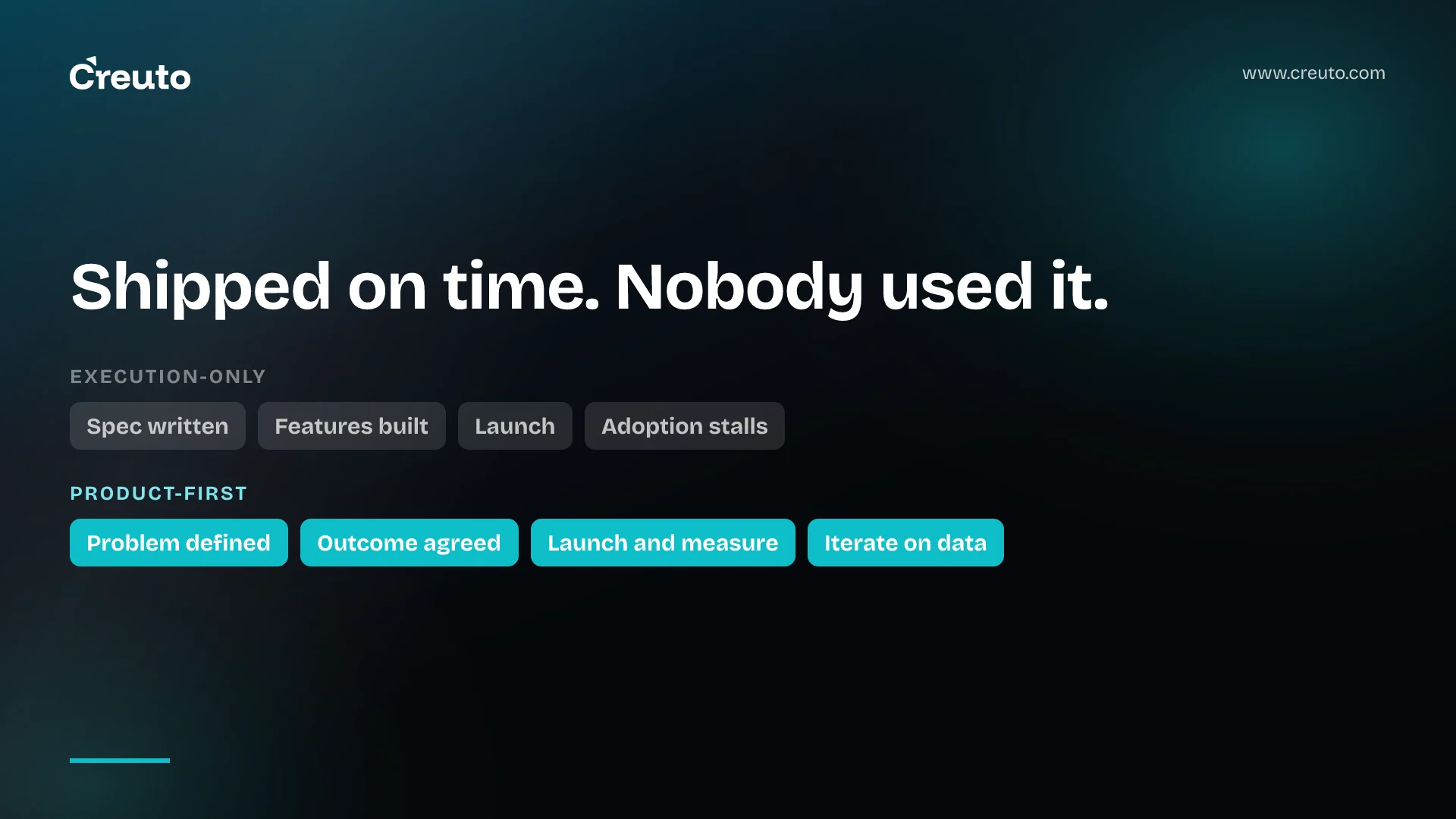
Building software has never been easier. Building products people adopt, that teams can extend and that businesses can grow with, has not got easier at all. Many projects are delivered on time and to specification, then stall: adoption plateaus, changes get slower and the system starts to feel rigid. The cause is rarely weak engineering. It is the absence of product thinking. Product-first engineering is the practice of putting it back.
The problem with execution-only development
In a traditional model, requirements are written, timelines are set and engineering executes. It looks efficient, but it creates a quiet disconnect:
- features are built on assumptions rather than observed user behaviour;
- architectural shortcuts are taken to meet dates, without long-term context;
- roadmaps become fixed commitments instead of tools for learning;
- success is measured in features shipped, not value delivered.
The result is software that works but does not evolve well. The risk has grown with AI-assisted coding: when code and tests are both generated from the same specification, nothing downstream questions whether the specification was right — a problem we examine in acceptance criteria review.
What product-first engineering changes
Instead of starting with "what are we building?", product-first engineering starts with three questions:
- What problem are we solving, and for whom?
- What outcome defines success, and how will we measure it?
- How will this system need to change over the next two years?
Engineers take part in answering them. Architecture is discussed in terms of future change. Prioritisation uses real usage data. Launch becomes the start of a feedback loop rather than the finish line.
Architecture as a product decision
In a product-first team, every significant technical choice is tested against product questions:
- Will this design let us release features faster later, or slower?
- Can we integrate with the platforms our customers use?
- What happens when usage doubles?
- Does this increase or reduce technical debt we will have to repay?
These are business questions, not engineering trivia. We explore the cost of getting them wrong in the true cost of poor software architecture.
Why product thinking matters more at scale
Early on, a small team can move fast despite imperfect systems. As complexity grows, weak product thinking multiplies: more time goes on maintenance, each feature is riskier, scaling needs rework and the user experience fragments. Product-first engineering keeps engineering a growth engine rather than a bottleneck.
From vendor to product partner
The difference between a development vendor and a product engineering partner is orientation, not skill. A vendor executes what is written. A product partner questions what should be written, brings evidence, and shares responsibility for the outcome. That requires engineers who understand business context and product owners who consider technical consequences early.
How to put product-first engineering into practice
- Include engineers in discovery and customer conversations.
- Define an outcome metric for every major feature before building it.
- Instrument usage from the first release.
- Review the roadmap against data at least every quarter.
- Record architecture decisions with the product reason behind them.
For the early stages of a new product, this starts with a focused MVP; for growth, see how to build and scale a SaaS product. Our custom software development teams work product-first: we ask what success looks like before we estimate what to build.
Frequently asked questions
Product-first engineering is an approach where engineering decisions start from the user problem, the outcome that defines success and how the product must evolve, rather than from a fixed feature list. Engineers take part in discovery and prioritisation uses real usage data.
A development vendor executes the specification it is given. A product engineering partner questions what should be built, brings evidence from users and data, considers long-term architecture, and shares responsibility for business outcomes rather than just delivery.
Product thinking matters because software built only to a specification often works but fails to be adopted or to evolve. Linking engineering to outcomes, usage data and future change keeps products valuable and development fast as they grow.
Introduce product-first engineering by involving engineers in discovery, defining an outcome metric for each major feature, instrumenting usage from the first release, reviewing the roadmap against data regularly and recording the product reasons behind architecture decisions.