Power Apps Premium price increase: $22, then a February block
The Power Apps Premium price increase takes it to $22 in January 2027, and unlicensed users in Managed Environments are blocked from February. Plan now.
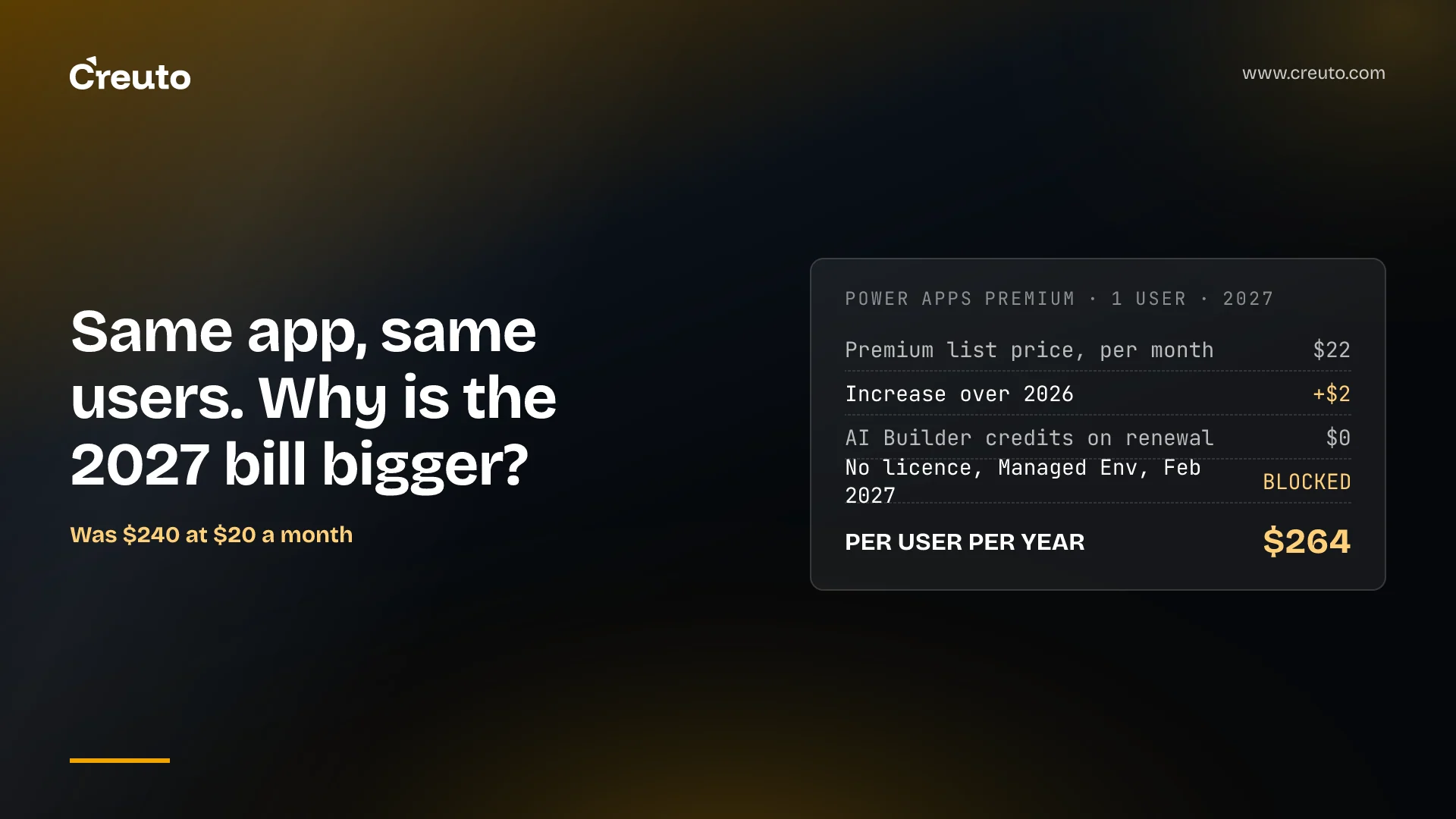
The Power Apps Premium price increase is the smaller of three changes landing within four months. Microsoft's 9 September 2026 notice raises Premium from $20 to $22 per user per month for terms starting on or after 1 January 2027. From February 2027, unlicensed users in Managed Environments can no longer open apps at all. By the end of this post you will know which of the three hits your tenant, and at what user count a custom app starts to beat the licence bill.
The price rise gets the headlines, but the February block is the change that can stop work. Microsoft says the licensing requirement behind it is not new. What is new is that it will be enforced in product.
The key dates and figures, as of October 2026
| Change | Date | Who it affects |
|---|---|---|
| Power Apps Premium list price rises from $20 to $22 per user per month | Terms starting on or after 1 January 2027 | New purchases, renewals and co-terminations |
| Premium with a 2,000-seat minimum rises from $12 to $14 per user per month | Same | Large agreements |
| No seeded AI Builder credits on new or renewed Power Platform and Dynamics 365 licences | 1 November 2026 | Licences bought or renewed from that date |
| Users without an appropriate licence are blocked from opening apps in Managed Environments | February 2027 (no exact day published) | Every user running an app in a managed environment, including standard apps |
What the Power Apps Premium price increase actually changes
Premium goes up $2 per user per month, which is 10%, or $24 per user per year. The 2,000-seat-minimum offer goes up $2 too, but from a lower base, so it rises by about 16.7%. Microsoft calls it "the first list price increase for the product in more than five years".
Timing depends on your agreement, not the calendar. Microsoft says existing subscriptions keep their current price through the end of their term, and the new price applies to new purchases, renewals and co-terminations with a term starting on or after 1 January 2027. If your renewal falls in mid-2027, that renewal is when your bill goes up.
Several things are not changing. Microsoft says only the two Premium plans are affected, and every other Power Apps and Power Platform product stays at its current price. The Power Apps rights inside Microsoft 365 (often called Power Apps Basic) and inside Dynamics 365 are untouched. The increase applies globally, with "comparable pricing in local currencies". So if you're looking for the Power Apps Premium cost in India, the notice gives no separate rupee figure; it promises comparable local-currency pricing. U.S. Government increases are capped at 10% a year, and phased over two years where the full rise would exceed that.
The February 2027 lockout in Managed Environments
From February 2027, a user without an appropriate licence who tries to open an app in a managed environment sees the standard message "You need a Power Apps license to use this app", and the app doesn't open. That is how Microsoft Learn's managed environment licensing page describes it. The apps aren't deleted. Access comes back once a licence is detected.
Do standard apps in managed environments need a premium license?
Yes. Microsoft Learn says every user who runs an app in a managed environment is in scope, "including users who run standard apps", because the requirement follows activity in the environment rather than the app type. This is the part most teams miss. A canvas app using only SharePoint and other standard connectors, which a Microsoft 365 user could run anywhere else, needs a standalone licence once its environment is managed.
Several licences satisfy it: Power Apps Premium, Power Automate Premium, qualifying Dynamics 365 Enterprise licences, Power Apps per app plans allocated to the environment, or the Power Apps per app pay-as-you-go meter. Microsoft adds a warning: the meter covers Power Apps usage only. Any Power Automate flow usage still needs standalone Power Automate licences or per flow plans.
The warning sequence before the block
Users don't get blocked without warning. Microsoft Learn describes in-app notices that step from informational to warning to error, moving to the next state after 7 days without a licence. Admin notices began in March 2026 and user notices in June 2026. The Power Platform admin center has a report called "Users requiring licenses in Managed Environments", under Licensing, then Power Apps, then Download report. Run it before you budget, because it lists the users who actually opened an app without a licence that month.
Where the secondary sources disagree on scope
SAMexpert's 6 October analysis lists the February 2027 scope as including model-driven apps and custom apps outside a licensed Dynamics 365 context, not only Managed Environments. It also notes that Microsoft's examples aren't exhaustive. Microsoft Learn is narrower. Under "Which environments are in scope?" it says "Only environments that you enable as managed environments are in scope".
Both can be true at once. The Power Platform licensing FAQ already says a user opening an app that runs on Dataverse needs a per app or per user licence, wherever the app lives. So model-driven apps outside managed environments were never free. What Microsoft has documented for February is the in-product block, and only for managed environments. Our reading is to plan the block around managed environments, and to treat unlicensed Dataverse use elsewhere as an audit risk you already carry.
What happens to AI Builder credits after November 2026
The common shorthand, "AI Builder credits are removed on 1 November", is too blunt. The licensing FAQ does say the 5,000 AI Builder credits "will be removed on November 1, 2026". But it says that under the heading for the per user plan with attended RPA, which is a Power Automate plan. The AI Builder licensing page is more precise. From 1 November 2026, no new or renewed Power Platform or Dynamics 365 licence receives seeded AI Builder credits. Licences bought or renewed before that date keep them until their contract term ends.
After the credits run out, AI Builder features in apps and flows fall back to Copilot Credits, at $0.01 per credit on pay-as-you-go. One page of receipt or invoice analysis costs 8 Copilot Credits ($0.08). A basic LLM prompt costs 0.1 credits per 1,000 tokens. If neither kind of credit is available, the model runs are blocked. For an app that processes documents, this is a new monthly bill on top of the licence. You should meter it before renewal, not after.
How much is Power Apps Premium in 2027, against the other options?
Premium isn't the only way to license a user, and the rise changes where the crossover points sit. These are US list prices. Your agreement may differ.
| Option | List price | Changes in 2027? |
|---|---|---|
| Power Apps Premium | $22 per user per month from 1 January 2027 (was $20) | Yes |
| Premium, 2,000-seat minimum | $14 per user per month (was $12) | Yes |
| Power Apps per app | $5 per user per app per month | No |
| Power Apps per app pay-as-you-go meter | $10 per active user per app per month | No |
| Power Automate Premium (also satisfies the Managed Environments rule) | $15 per user per month | No |
Three things follow from that table. First, per app plans stack, so a user on four apps used to cost the same either way ($20). From 2027 that user is cheaper on per app passes ($20 against $22), and the crossover moves to five apps. Second, the pay-as-you-go meter counts only users who open the app at least once in a month. At twice the per app price, it wins only for users who are active in fewer than half the months. Third, a user who mostly runs flows is often better served by Power Automate Premium at $15, since either Premium licence satisfies the managed environment rule for both apps and flows.
Is Power Apps cheaper than custom development?
Often it is, and the strongest case for staying deserves to go first. Premium covers unlimited apps per user. It includes Managed Environments governance. It lets business teams build their own tools without a ticket to engineering. A $2 rise doesn't change that. If you have dozens of small citizen-built apps, a custom rebuild means building and maintaining dozens of apps, and the licence is almost certainly cheaper.
The question gets interesting when one or two central apps account for most of your Premium seats. That's typically an operations, approval or ERP-style app used daily by most of the company. Then the comparison is no longer "low-code versus code" in general. It becomes the licence cost of that population over the life of the app, set against what it costs to build and run one application.
A model, not a quote
Here is a model with labelled assumptions. It is arithmetic on Microsoft's list prices, not a Creuto price or a measured outcome.
- Assumption 1: 300 users need Premium only because of one core app.
- Assumption 2: they pay the 2027 list price of $22 per user per month, with no discount.
- Assumption 3: a three-year horizon, which is roughly the life of one agreement cycle.
On those assumptions, licensing costs 300 × $22 × 12 = $79,200 a year, or $237,600 over three years. The 2027 rise alone adds 300 × $24 = $7,200 a year. That $237,600 is the ceiling a custom app has to come in under, and it must cover the build, hosting, maintenance and any change requests over the same three years. Those costs depend on scope, so the cost to build an app turns on the decisions in that link, not on a rate card. The model flips quickly in both directions. At 50 users the ceiling is $39,600, which rarely covers a serious build. If many of the 300 could move to $5 per app passes instead, the ceiling collapses.
When a custom app is the wrong choice
Custom development is the wrong call in these cases:
- Most of your users already hold a Dynamics 365 Enterprise licence that carries premium Power Apps rights.
- Your apps are many and small rather than few and central.
- The app leans on Power Automate flows that you'd have to rebuild as well.
- The real problem is that someone enabled Managed Environments on an environment that didn't need it.
That last one is worth checking first. If an environment holds only standard apps run by Microsoft 365 users, and no one relies on managed environment features there, it may not need to be managed.
What a custom replacement looks like from our side
We haven't migrated a Power Apps estate, and we won't pretend otherwise. What we have built is the kind of system these central apps tend to turn into. One example is a custom ERP for a large-scale industrial client that unified HR, CRM, inventory and finance across four departments in one browser-based platform. Another is an enterprise workflow management system with task boards, a collaboration engine, reporting and a full task audit trail. A custom app built this way has no per-user licence. Its costs are engineering and hosting. You trade a predictable per-seat bill for owning the code and its upkeep.
If you're weighing that trade for a specific app, the relevant work sits in our custom ERP development practice. We'd start from your licence report, not from a build estimate. The same per-seat logic drove our look at Salesforce Core pricing against a custom CRM, and the conclusion there was just as conditional.
What to do before your next renewal
- Download the "Users requiring licenses in Managed Environments" report from the Power Platform admin center now. That gives you your February exposure in names, not guesses.
- Check your renewal or co-term date. The $22 price applies from your first term starting on or after 1 January 2027, so the date on your agreement sets your budget year.
- Sort users by how many apps they run. Users on one to four apps are candidates for $5 per app passes, and occasional users are candidates for the meter.
- List any AI Builder usage and price it in Copilot Credits for licences renewing after 1 November 2026.
- Only then, for the one or two apps that carry most of your Premium seats, run the custom-build model with your own numbers.
Frequently asked questions
Power Apps Premium costs $22 per user per month at US list price for terms starting on or after 1 January 2027, up from $20. The offer with a 2,000-seat minimum rises from $12 to $14. Existing subscriptions keep their current price until their term ends, so the rise lands at your renewal or co-term.
From February 2027, users without an appropriate licence are blocked from opening apps in Power Platform managed environments and see the message 'You need a Power Apps license to use this app'. The apps are not deleted, and access returns as soon as a qualifying licence or pay-as-you-go meter is detected for that user.
Yes. Microsoft Learn says every user who runs an app in a managed environment is in scope, including users of standard apps, because the rule follows activity in the environment rather than app type. Power Apps Premium, Power Automate Premium, qualifying Dynamics 365 licences, per app plans or the per app meter all satisfy it.
From 1 November 2026, new or renewed Power Platform and Dynamics 365 licences no longer receive seeded AI Builder credits. Licences bought or renewed before that date keep their credits until the contract term ends. After that, AI Builder features in apps and flows consume Copilot Credits, priced at $0.01 each on pay-as-you-go.
Power Apps is usually cheaper than custom development when you run many small apps or users only need a $5 per app pass. A custom app becomes worth modelling when one central app forces hundreds of users onto $22 Premium seats, because three years of that licence bill is the budget a build must beat.
The Power Apps per app pay-as-you-go meter costs $10 per active user per app per month and only counts users who open the app that month. It covers Power Apps usage only, so flows still need Power Automate licensing. It suits occasional users of one or two apps rather than daily users of several.