Pay Per Use content AI: what a publisher actually gets
Cloudflare's Pay Per Use content AI beta pays publishers when an AI answer uses their work. What is published, what is not, and what to enable now.
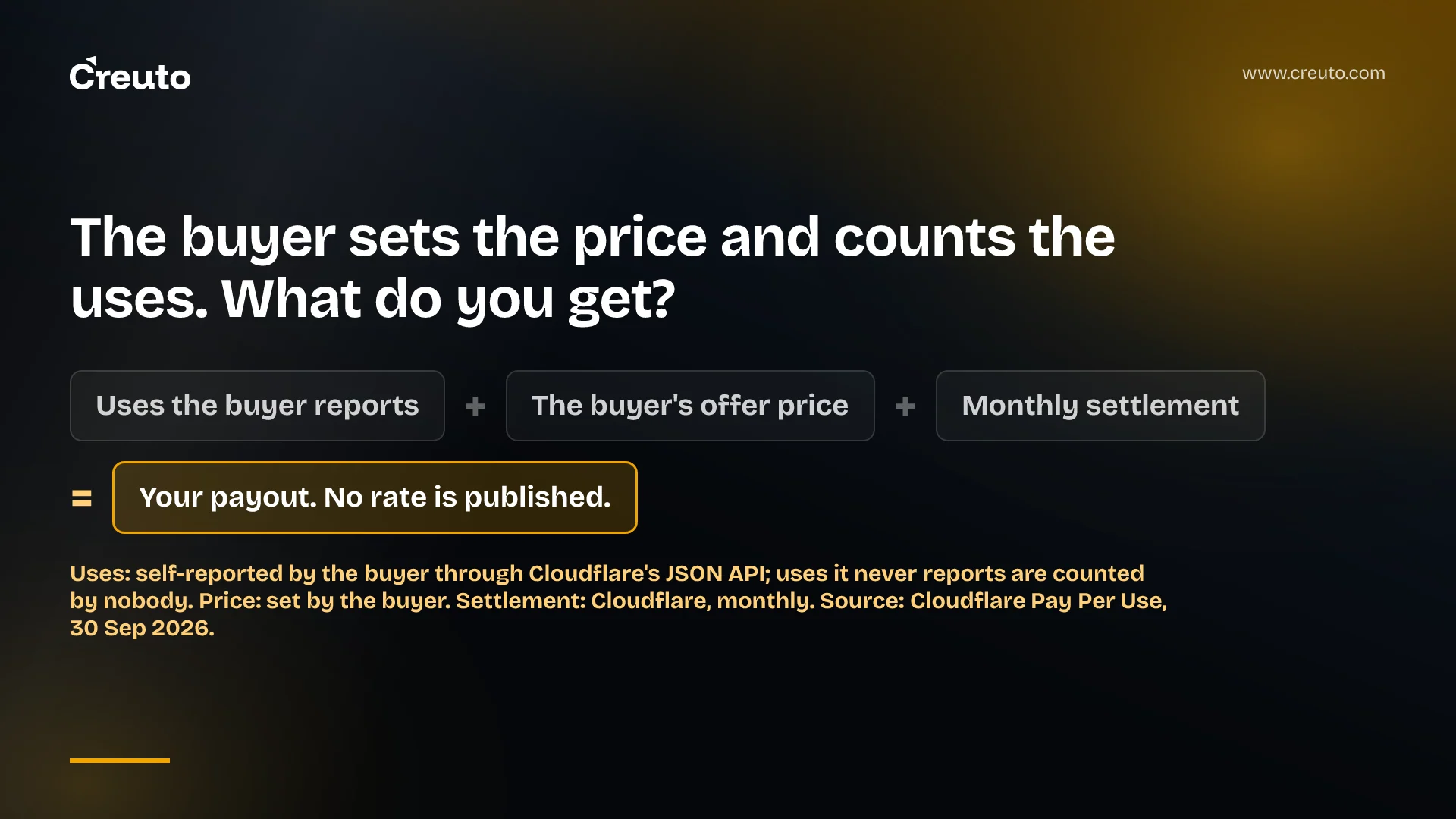
Cloudflare's Pay Per Use content AI programme went into beta on 30 September 2026, and the rate it pays you is not published. The buyer sets the price, defines what counts as a use, reports each use itself, and Cloudflare bills and settles monthly. That is the whole mechanism, and the missing number is the point: there is no published rate card, for any of the launched programmes.
If you run a content-heavy site, there are two Cloudflare products and one Microsoft pilot in play, at three different stages of readiness. Here is what each one is, what is actually knowable about the money, and what to switch on this week.
What Pay Per Use content AI pays, and what is not published
Pay Per Use charges for the downstream use of your content rather than for the crawl. A search service might pay when it returns an excerpt from your page to a customer; a shopping agent might pay when your review shapes a recommendation, even if the shopper never reads it. The AI company defines that use and sets the price. You accept or decline it in the Cloudflare dashboard under Monetize → Pay Per Use.
| Programme | Status as of 1 October 2026 | Who sets the price | Published rate |
|---|---|---|---|
| Cloudflare Pay Per Use | Beta, Cloudflare working directly with each buyer and opted-in publisher | The AI buyer, per programme | None published |
| Cloudflare Pay Per Crawl | Closed beta, signup or account executive required | You, per zone | Minimum $0.001 USD per crawl |
| Microsoft Publisher Content Marketplace | Pilot, onboarding demand partners | Publisher-defined licensing terms | None published |
Pay Per Crawl is the only one of the three with a figure attached, and it is a floor rather than a rate: Cloudflare's documentation states the minimum price is $0.001 USD per crawl, charged for each successful content retrieval. What the market will actually bear is not published anywhere, and nobody should estimate it for you.
Microsoft's Publisher Content Marketplace is the closest comparable. Microsoft Advertising described it on 3 February 2026 as a pilot, co-designed with The Associated Press, Business Insider, Condé Nast, Hearst Magazines, People Inc, USA TODAY and Vox Media, with publishers "paid on delivered value" through usage-based reporting. No rates there either.
How the money is counted: the buyer counts it
The mechanics are four steps. The AI company registers a programme with Cloudflare, identifies its crawler through Verified Bots, defines the paid use, sets a price and connects a payment account. Publishers see the offer and accept or decline. The buyer then fetches the list of domains that accepted and reports each use as one line of JSON — a timestamp, the URL and an event ID — to a single Cloudflare API endpoint. Cloudflare aggregates, charges the buyer and pays publishers monthly.
Step three is where a publisher should slow down. Cloudflare's own wording is that "usage is self-reported: the program terms require complete reporting, and Cloudflare checks that each reported use maps to an enrolled publisher." Read that validation carefully. It confirms that a reported use belongs to an enrolled publisher. It does not — and from outside the buyer's product, cannot — confirm that every use was reported.
The strongest case for the design is that the alternative is worse. No publisher below the scale of the Associated Press will ever negotiate a bilateral licence, and no AI company can negotiate with millions of sites. A contractual reporting obligation plus an auditable record beats the status quo, which is being read for free. Cloudflare is also honest that the beta exists to answer whether both sides want to continue. But "we checked the publisher exists" is a weaker claim than "we checked the count", and you should price your expectations to the weaker one.
Pay per crawl is a different product, and it is still a closed beta
Pay per crawl charges for access. An AI crawler either presents payment intent in request headers and gets an HTTP 200, or receives an HTTP 402 Payment Required response with pricing. Cloudflare is the merchant of record. It is currently in closed beta, so it is not something you can simply switch on.
The details that decide whether it is worth anything to you are in the documentation rather than the announcement:
- One price applies to every crawler you set to Charge. You cannot set different prices for different AI crawlers — only different actions: Block, Charge or Allow.
- Dynamic pricing is possible, but through your origin: enable it, then return a
crawler-price: USD 3.14header per response. - Five paths are always free:
/robots.txt,/sitemap.xml,/security.txt,/.well-known/security.txtand/crawlers.json. - Re-crawling the same page is charged every time. Error responses are not charged.
- Payouts run through a dedicated Cloudflare Stripe Connect account — pre-existing Stripe accounts are not compatible — monthly, subject to settlement periods and minimum thresholds. Your accrued balance is not currently visible in the dashboard.
What to enable this week, and what it breaks
Start with measurement, not monetisation. AI Crawl Control already shows which crawlers visit and what they take, and Business Insights reports it. Four weeks of that data is what tells you whether any of this is worth the configuration effort on your traffic, and it costs nothing.
If you want to be ready to accept an offer, an Administrator or Super Administrator sets each domain's Visibility to Visible under Manage Account → Settings → Pay Per Crawl. Cloudflare's documentation is explicit that this does not change any security rule; it only exposes the controls to domain administrators. Then connect the Stripe account, because the onboarding is bank-account paperwork and will not finish in an afternoon.
Three things break, in rough order of how much they will cost you:
- Your search traffic, if you charge the wrong bots. Cloudflare warns that setting search engine crawlers to Block or Charge may harm SEO, because they may not be able to index your content. Use the Category column, and leave search engine crawlers on Allow unless you have decided, deliberately, to leave the index.
- Your pay per crawl revenue, if your WAF already blocks the crawler. If a crawler is blocked by WAF or Bot Management rules, those rulesets override the Charge action and the crawler gets nothing — so you earn nothing. Audit the bot rules before you set a price, not after. This is the same failure mode as controls that agents route around: two systems with opinions, one of them silently winning.
- Crawler discovery, if you charge your navigation. Cloudflare's own guidance is to leave homepages, category pages and navigation free so crawlers can find the paid content, and to exclude login, search and API endpoints with a Configuration Rule. Charging for everything is the configuration most likely to earn nothing at all.
One more product landed the same day and is easy to confuse: Monetization Gateway, also in beta, which lets sellers charge agents per request using the open x402 protocol. That one is for APIs, tools and data, where every request is the use. Content goes through Pay Per Use; an endpoint goes through the gateway. If you are planning paid agent access to a product rather than an archive, that is an API and integrations decision, not a publishing one.
What this is actually worth deciding now
None of the three programmes is generally available, and none publishes a rate. That makes the honest position for most site owners a prepared one rather than a committed one: instrument the crawler traffic, get the dashboard access and the payment account in place, keep search engine crawlers allowed, and wait for an offer with a number on it before you model any revenue.
The work that survives either outcome is the boring kind — knowing which agents reach your content, through which paths, and what your rules currently do to them. That is a web application and infrastructure question before it is a commercial one, and in the systems we build it is usually the audit nobody has run. If AI answers are already taking traffic from a storefront, the same crawler data feeds the e-commerce decisions about what to gate and what to leave open.
Frequently asked questions
Yes, through Cloudflare's Pay Per Use programme, which entered beta on 30 September 2026. An AI company defines a paid use and offers a price, the publisher accepts or declines in the Cloudflare dashboard, the buyer reports each use through an API, and Cloudflare bills the buyer and pays monthly.
There is no market rate published. The site owner sets a price per zone, and Cloudflare's documentation states the minimum price is $0.001 USD per crawl, charged on each successful content retrieval. Dynamic pricing lets an origin return a crawler-price header to override the default price per response.
Pay per crawl charges an AI crawler for access to a page, using an HTTP 402 response when payment intent is absent. Pay Per Use charges for what happens afterwards: an excerpt returned to a user, or a review that shapes a recommendation. Publishers can choose either model.
The buyer measures it. It reports each use as one line of JSON containing a timestamp, the source URL and an event ID. Cloudflare states that usage is self-reported, that programme terms require complete reporting, and that it checks each reported use maps to an enrolled publisher.
It can. Cloudflare's documentation warns that setting search engine crawlers to Block or Charge may negatively affect SEO performance, because search engines may not be able to index your content properly. Use the Category column in AI Crawl Control to identify search engine crawlers and keep them allowed.
Microsoft Advertising's Publisher Content Marketplace is a pilot, described on 3 February 2026 as onboarding demand partners. It was co-designed with publishers including The Associated Press, Condé Nast, Hearst Magazines and Vox Media, with publishers paid on delivered value through usage-based reporting. No rates are published.