OpenAI implementation partner: 8 questions to ask first
Hiring an OpenAI implementation partner? Eight questions on deprecations, evals, caching, data residency and API keys, each checkable in OpenAI's own docs.
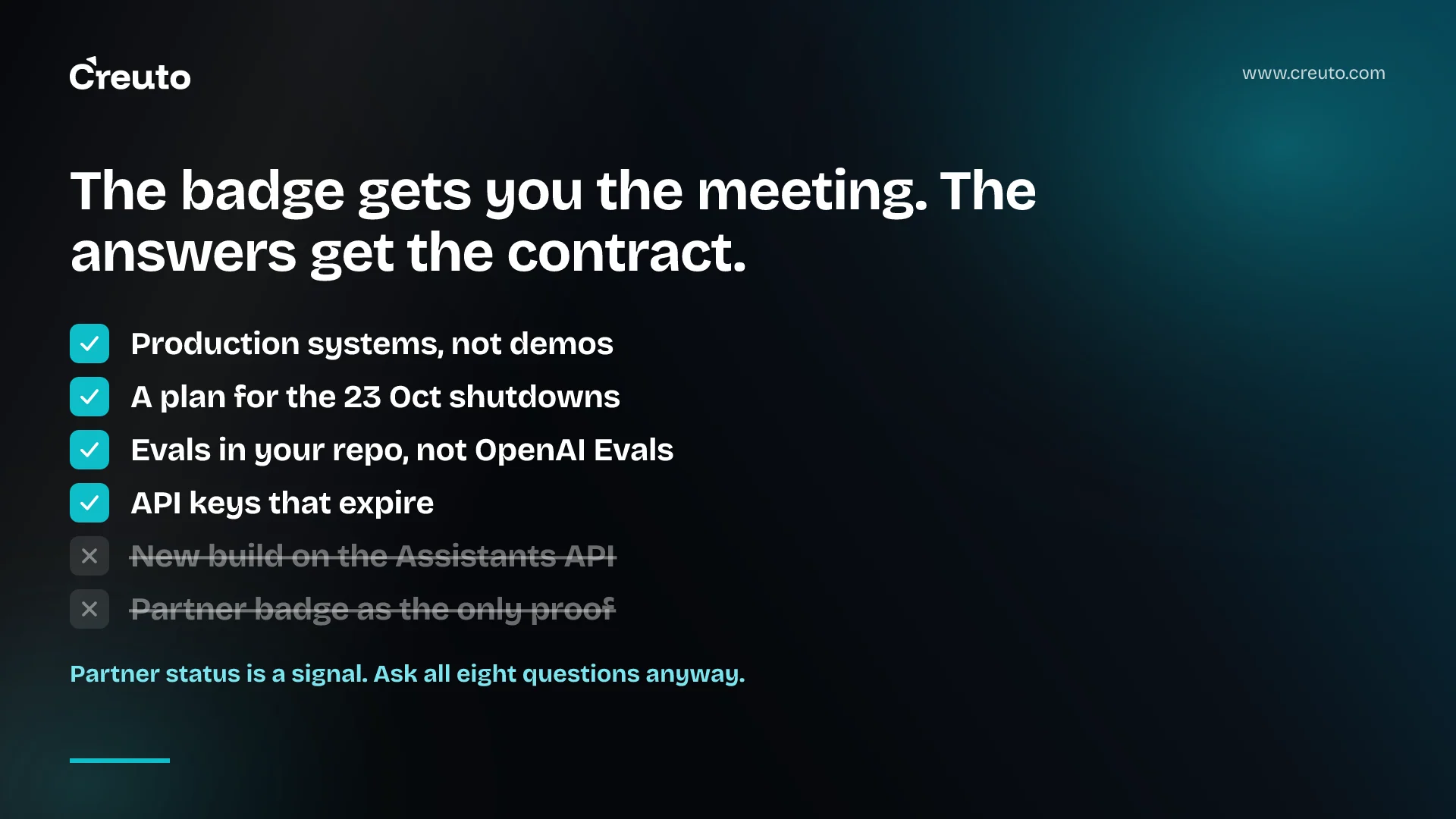
An OpenAI implementation partner should be able to tell you, without looking it up, which of your model IDs stop working on 23 October 2026, where your prompts will live after OpenAI shuts down prompt objects, and whether your API keys expire. Those answers separate a team that runs AI in production from one that demos it. Below are eight questions to ask before you sign, each tied to something you can check yourself in OpenAI's own documentation.
A disclosure first: Creuto is an OpenAI Select Partner, named within the OpenAI Partner Network on 21 September 2026. Partner status is a signal worth weighing, and it is not a substitute for the answers below. Hold us to the same eight questions.
| # | Question | What a good answer names |
|---|---|---|
| 1 | What are you running in production? | Live systems, model IDs, owners |
| 2 | What is your deprecation plan? | 23 October list, snapshot pinning, no preview models in critical paths |
| 3 | Where do the evals live? | Your repository, not the OpenAI Evals platform |
| 4 | How do you control cost? | Caching strategy, spend limits, per-key reporting |
| 5 | Where is our data processed? | Region, storage versus processing, the 10% uplift |
| 6 | Who owns and governs the keys? | Your organisation, expiry dates, creation controls |
| 7 | Which API surface will you build on? | Responses API, not retired surfaces |
| 8 | What do we keep if we part ways? | Account, prompts, evals and infrastructure as code |
How to choose an OpenAI implementation partner: start with production
1. Which AI systems are you running in production, and what do they call?
Ask for systems with real users, the model IDs they send, and who is on call for them. A demo proves a prompt works once. Production proves someone has handled rate limits, retries and a model changing underneath them. Our own example is the Škoda Auto sales training platform, which ships four AI-powered features and serves more than 100 dealerships. Ask any candidate for the equivalent, and ask to speak to the engineer who maintains it.
OpenAI's production best practices give you a second test. They recommend separate projects for staging and production, with production access limited and custom rate and spend limits per project. Ask how the candidate's live systems are split. If everything runs in one project with one key, you have your answer.
2. What happens when the model we launch on is retired?
This is the question that sorts partners fastest. OpenAI's deprecations page commits to at least six months' notice for generally available models and three months for specialised variants, but says preview models may be retired with much shorter notice, such as two weeks, and that it does not recommend them for business-critical production unless you can migrate on short notice.
The schedule is not theoretical. On 23 October 2026 OpenAI removes gpt-4, gpt-3.5-turbo, gpt-4-turbo, o1, o3-mini, o4-mini, gpt-4.1-nano and gpt-image-1, among others, and sooner still, on 28 September 2026, gpt-3.5-turbo-instruct, babbage-002 and davinci-002 go. A good partner can say which of your calls are affected, which substitute OpenAI recommends for each, and how they will prove the substitute behaves the same before the switch.
Listen for how they talk about snapshots. Pinning a dated snapshot protects you from behaviour drift, not from shutdown: on 23 October the alias gpt-4 and the snapshot gpt-4-0613 go together. And the newest models currently list a single snapshot each, so gpt-6-astra and gpt-5.6-sol are both the name and the version today. A partner should explain how they will detect the next snapshot and re-run your tests against it before switching.
3. How will you prove a model change did not break anything, and where do those evals live?
Model migrations are only safe if you have tests that describe what "working" means for your product. Ask what the candidate's evaluation suite checks and where it is stored. The trap here is specific: OpenAI deprecated its Evals platform on 3 June 2026. Existing evals become read-only on 31 October 2026, and the dashboard and API shut down on 30 November 2026. OpenAI points users to Promptfoo as a migration path.
A partner who built your evaluations inside that platform now owes you a migration. A better answer is evals kept as code in your repository, versioned with the prompts they test, and run on every model change. If the candidate uses an LLM to grade outputs, ask how they correct for its biases.
Questions about cost, data and security
4. How do you keep token spend predictable?
Ask for mechanisms, not estimates. The first is prompt caching, which changed with GPT-5.6. On GPT-5.6 and later models, cache writes cost 1.25x the uncached input rate and reads cost 0.1x; OpenAI's own worked figure is that one write and nine full reads across ten requests cost 2.15x the ordinary input cost, against 10x without caching. The cacheable prefix must be at least 1,024 visible input tokens. A partner who structures prompts with stable instructions first and variable content last is designing for that discount.
The second is hard limits. Since July 2026 OpenAI supports hard monthly spend limits per organisation and project, which return a 429 error once tracked spend reaches the cap, and since August usage and cost can be broken down by API key. Ask whether the candidate sets both, and what your product does when the cap is hit. We compared where the money actually goes across model tiers in LLM cost optimisation.
5. Where will our data be stored and processed?
Data residency is where vague answers hurt most, because OpenAI's data controls guide states that support for regional storage does not imply support for regional processing. India and Australia offer regional storage without regional processing. The UAE offers both, but regional processing there covers a subset of models, such as GPT-5.6 Luna, and selecting the region requires additional approval.
Every non-US region also requires approval for abuse monitoring controls and a Modified Retention amendment, and on Chat Completions you cannot set store=true outside the US. Residency endpoints carry a 10% price uplift for models released on or after 5 March 2026. A partner who has done this before will ask about your residency requirement before recommending a model, because in the UAE the requirement can decide the model.
6. Whose API keys are these, and do they expire?
The right answer is that the keys belong to your organisation and your partner works inside it. OpenAI added expiry dates for project API keys on 10 September 2026 and lets administrators enforce a maximum key lifetime; on 15 September it added governance controls to allow only service-account keys, only user-owned project keys, or no new keys at all. The production guidance strongly recommends setting an expiration date and running a regular rotation process.
Note that these controls apply only to new keys; existing keys are unaffected. Ask a candidate how they would audit the keys already in your account. Better still, ask whether your agents need raw keys at all; we argued for identity-based access over shared keys in AI gateway model routing.
Questions about architecture and exit
7. Which OpenAI API surface will you build on?
Three OpenAI surfaces have been retired or scheduled for shutdown this year. The Assistants API was sunset on 26 August 2026. Agent Builder and the v1/prompts API are both scheduled to shut down on 30 November 2026. A proposal in September 2026 that builds on any of them is a proposal to migrate twice.
The current default is the Responses API. It is also a hard requirement for some work: GPT-6 Astra supports Chat Completions, but tool calling requires Responses, and Astra drops custom temperature and top_p. Ask the candidate which surface they propose and why.
If you already have an Agent Builder workflow, ask how they will move it. OpenAI's migration guide exports the workflow as Agents SDK code or recreates it as a ChatGPT Workspace Agent, and warns that the process does not convert the workflow graph or guarantee that every behaviour transfers unchanged. That warning is the reason to have evals before you migrate, not after.
8. What do we keep if we stop working with you?
Ask this before you need it. You should keep the OpenAI organisation and its billing, the prompts, the evals and the infrastructure. OpenAI's own migration advice for prompt objects is to move prompt content into your application code for control over review, testing, deployment and versioning, which is also where prompts belong for ownership. Platform resources such as projects, service accounts and project rate limits can be managed with the official OpenAI Terraform provider, so your configuration can live in your repository rather than in someone's memory.
How much OpenAI integration costs, and what the badge is worth
Integration cost has two parts that a good OpenAI implementation partner will quote separately. Running cost is token pricing, and the spread is wide: at Standard rates GPT-6 Astra is $10 per million input tokens and GPT-5.6 Luna is $0.20, a 50x difference, so model choice per feature matters more than any discount. Build cost depends on scope; for reference, a focused MVP typically takes us 6 to 10 weeks and a larger enterprise platform 3 to 6 months.
As for partner status: the strongest argument for weighting it heavily is that OpenAI has chosen to work with that firm. The counter is that no programme answers the eight questions above for your system. Use the badge to decide who gets a meeting, and use the answers to decide who gets the contract. If you want to put these questions to us, our AI engineering services team will answer them in writing.
Frequently asked questions
Choose an OpenAI partner by asking for production systems rather than demos, a written plan for model deprecations such as the 23 October 2026 shutdowns, evals stored in your repository, cost controls, a data residency answer, API key governance, a Responses API architecture, and a clear list of what you keep if the engagement ends.
OpenAI partner status is a useful signal but not enough on its own. Creuto is an OpenAI Select Partner, and we still expect buyers to test us on deprecation planning, evaluations, cost controls, data residency and key governance, because no programme badge answers those questions for your specific system.
An AI development partner should provide working software in your own OpenAI organisation, prompts and evaluations stored as code in your repository, cost and spend controls, documented model choices with a migration plan, and monitoring, so that the system keeps working after models are retired and after the engagement ends.
OpenAI integration cost splits into build cost and running cost. Running cost follows OpenAI's token pricing, from $0.20 per million input tokens on GPT-5.6 Luna to $10 on GPT-6 Astra at Standard rates. Build cost depends on scope; a focused Creuto MVP typically takes 6 to 10 weeks.
When OpenAI retires a model, requests to that model ID stop working on the shutdown date. OpenAI gives at least six months' notice for generally available models and publishes a recommended substitute, but you still need to test the substitute against your own cases and update the model ID before the date.