OpenAI fine-tuning deprecated: what to use instead in 2026
OpenAI fine-tuning deprecated in stages to 6 January 2027, and some fine-tunes stop on 23 October. Dates, costed alternatives and how to choose per use case.
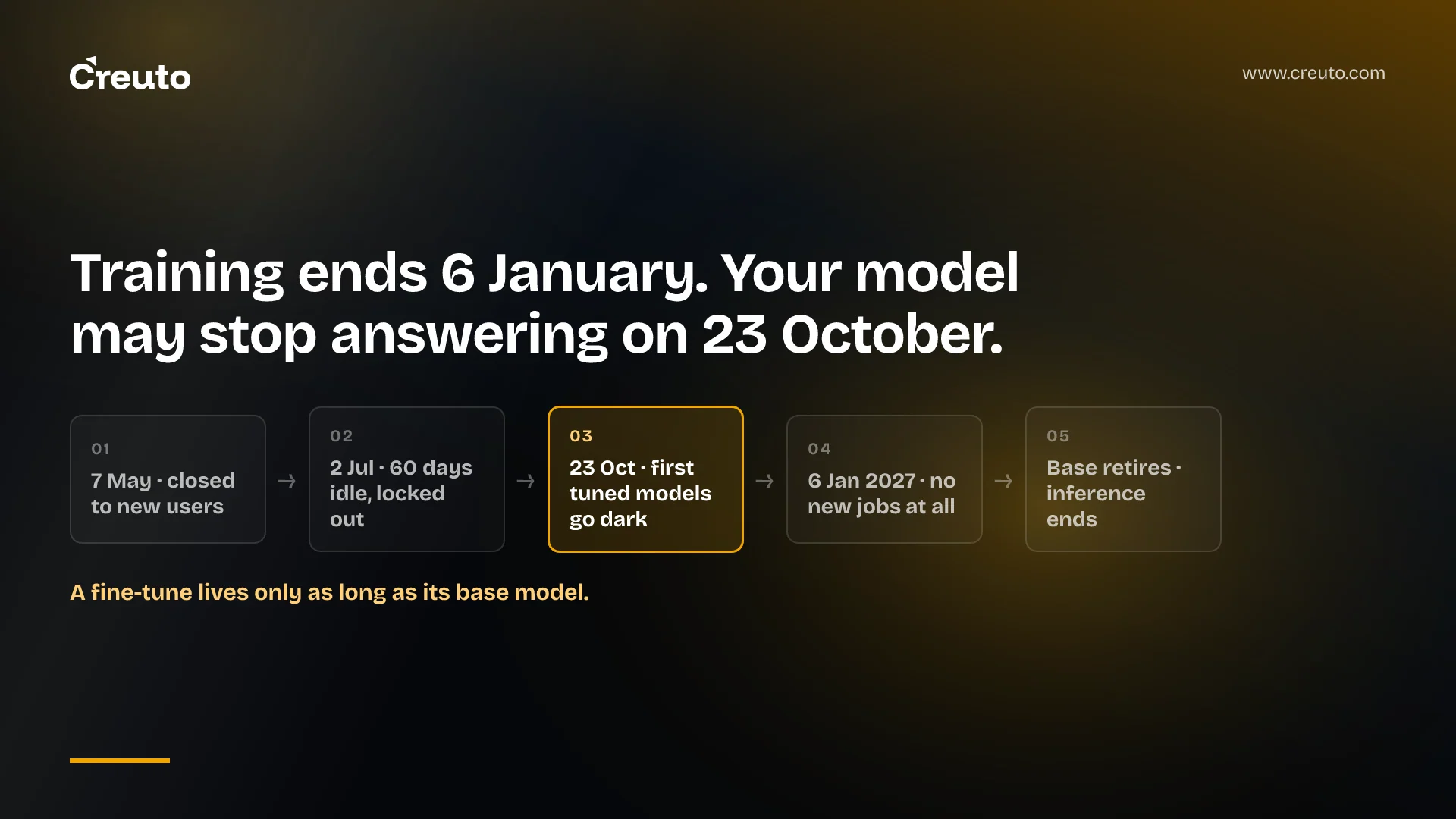
The date most teams have noted for OpenAI's fine-tuning wind-down is 6 January 2027. For anyone running a fine-tuned o4-mini or GPT-4.1 nano model, the date that matters is 23 October 2026, when those models stop answering. With OpenAI fine-tuning deprecated in stages, inference on a fine-tune lasts only as long as its base model. This post gives the full timeline, what each alternative costs on published prices, and how to choose per use case.
If your product depends on a fine-tuned OpenAI model, you have two deadlines, not one: the day you can no longer retrain it, and the day its base model is retired. The second is the one that takes a feature offline.
OpenAI fine-tuning deprecated: the dates, by who is affected
OpenAI notified self-serve fine-tuning customers on 7 May 2026. The deprecations page sets out the stages as of September 2026:
| Date | What changes | Who is affected |
|---|---|---|
| 7 May 2026 | Creating fine-tuning jobs or training is unavailable | Organisations that had never run fine-tuning |
| 2 July 2026 | Creating fine-tuning jobs is unavailable | Organisations with no inference on a fine-tuned model in the past 60 days |
| 23 October 2026 | Shutdown of ft-o4-mini-2025-04-16, ft-gpt-4.1-nano-2025-04-14 and older fine-tunes of gpt-3.5-turbo, gpt-4, babbage-002 and davinci-002 | Anyone serving those fine-tunes |
| 6 January 2027 | No new fine-tuning jobs for anyone | Active existing customers |
| Base model retirement | Inference on fine-tuned models disabled | Each fine-tune, on its own base model's date |
The model optimization guide says the same in plainer words: the platform is no longer accessible to new users, existing users can create training jobs for the coming months, and all fine-tuned models remain available for inference until their base models are deprecated.
Will my fine-tuned model stop working?
Yes, eventually, and for some models next month. A fine-tuned model stops working when OpenAI retires its base model. The 23 October 2026 shutdown list includes o4-mini-2025-04-16 and gpt-4.1-nano-2025-04-14 alongside their fine-tuned versions, with gpt-5.6-terra and gpt-5.6-luna as the recommended replacements. Fine-tunes on gpt-4.1, gpt-4.1-mini and gpt-4o-2024-08-06 have no shutdown date on the page today.
That second group is not safe indefinitely, but it does have a floor. OpenAI's stated policy is at least six months' notice before retiring a generally available model. The October shutdowns were announced on 22 April, which fits that pattern.
Can I still fine-tune GPT models?
Only if your organisation is an active existing customer, and only until 6 January 2027. The guide lists supervised fine-tuning and direct preference optimisation on the gpt-4.1 family, vision fine-tuning on gpt-4o-2024-08-06, and reinforcement fine-tuning on o4-mini-2025-04-16 only. That last base model is on the 23 October shutdown list, so reinforcement fine-tuning has, in practice, a shorter runway than the rest.
What a fine-tune was buying you
Before picking a replacement, name what the fine-tune did. OpenAI's own guide lists four benefits over prompting alone: more examples than fit in one context window, shorter prompts that save tokens and latency at scale, training on sensitive data without sending it in every request, and making a smaller, cheaper model good at one task. Each has a different replacement.
| What the fine-tune did | Replacement to test first |
|---|---|
| Consistent format or classification | A stronger base model with few-shot examples in a cached prefix |
| Domain knowledge | Retrieval over your documents |
| Shorter prompts to cut cost | Prompt caching, then a cheaper base model |
| A small model doing one narrow task | Distillation into a model you host |
OpenAI fine-tuning alternatives, costed on published prices
The replacements OpenAI names are cheaper on list price in one case and more expensive in the other. All rates below are standard per-million-token prices from the OpenAI pricing page on 21 September 2026. The workloads are our assumptions, stated as such.
From fine-tuned o4-mini to GPT-5.6 Terra
A fine-tuned o4-mini bills at $4.00 input and $16.00 output per million tokens. Terra lists at $2.00 and $12.00. Assume 100,000 calls a month at 2,000 input and 500 output tokens: the fine-tune costs 200M x $4.00 plus 50M x $16.00, which is $1,600. Terra costs 200M x $2.00 plus 50M x $12.00, which is $1,000. That comparison assumes the same token counts; reasoning models vary in how many output tokens they spend, so measure it on your own traffic before trusting the saving.
From fine-tuned GPT-4.1 nano to GPT-5.6 Luna
This one goes the other way. A fine-tuned gpt-4.1-nano bills at $0.20 input and $0.80 output; Luna lists at $0.20 input and $1.20 output. Assume 1,000,000 calls a month at 500 input and 100 output tokens. The fine-tune costs $100 plus $80: $180. Luna with the same short prompt costs $100 plus $120: $220.
The catch is that the fine-tune needed no examples, and Luna may. Add a 2,000-token few-shot prefix, read from cache on 99% of calls and written on 1%, and Luna costs $264.60. Make the prefix 10,000 tokens and it costs $443.00, nearly two and a half times the fine-tune.
| Setup (1M calls a month) | Arithmetic | Monthly |
|---|---|---|
| ft-gpt-4.1-nano, no prefix | 500M x $0.20 + 100M x $0.80 | $180.00 |
| Luna, no prefix | 500M x $0.20 + 100M x $1.20 | $220.00 |
| Luna, 2,000-token cached prefix | $220 + 1.98B x $0.02 + 20M x $0.25 | $264.60 |
| Luna, 10,000-token cached prefix | $220 + 9.9B x $0.02 + 100M x $0.25 | $443.00 |
The fine-tuning premium you stop paying
One line in the comparison is easy to miss. Fine-tuned models have always billed above their base model: on the same pricing page, a fine-tuned gpt-4.1-mini costs $0.80 input and $3.20 output per million tokens, against $0.40 and $1.60 for the base gpt-4.1-mini. That is exactly double on both lines. A fine-tuned gpt-4.1 bills $3.00 and $12.00 against $2.00 and $8.00 for the base. When you move off a fine-tune you lose the training, but you also stop paying that premium, and the saving is what funds the longer prompt that replaces it. Run the comparison with the fine-tuned rate, not the base rate, or you will understate what you are saving.
Replace fine-tuning with prompt caching, carefully
Prompt caching is the lever that makes a long instruction block affordable. For GPT-5.6 models, the prompt caching guide bills cache reads at 0.1x the uncached input rate and writes at 1.25x, with a 1,024-token minimum prefix and a lifetime of at least 30 minutes after the last use. It turns examples you used to train into examples you send, at a tenth of the price.
The table above shows the limit. At high volume with tiny prompts, a tenth of the price of many tokens is still more than nothing, and a narrow fine-tune on a cheap model was hard to beat on cost. Caching is the right replacement when the fine-tune existed for quality or format; it is the wrong one when the fine-tune existed to make a very high-volume call cheap.
Fine-tuning vs RAG, and when to distil
If the fine-tune was teaching the model facts about your products, policies or catalogue, it was the wrong tool already. Retrieval-augmented generation, where you fetch relevant documents at request time and put them in the prompt, keeps knowledge current without retraining and lets you show where an answer came from. Fine-tuning was always better at behaviour than at knowledge; the deprecation just removes the option to pretend otherwise.
Distillation is the answer for the case caching loses: a narrow, high-volume task where a small model was the point. You generate labelled outputs from a strong model, check them, and train a smaller open-weight model you host yourself. You own the weights, and no base-model retirement can switch it off. The cost is that you now run inference infrastructure, with the capacity planning, monitoring and upgrades that come with it. We set out when that trade is worth making in custom machine learning solutions: when they beat an API, and our analysis of open-weight models against frontier spend shows where the savings tend to come from. Check your model provider's terms on using outputs as training data before you start.
The strongest argument for staying put is real: if your fine-tune sits on gpt-4.1 or gpt-4.1-mini, it has no announced shutdown and at least six months' warning when one comes. Retraining it now, before 6 January, buys time. It does not buy a future, because after that date you cannot retrain it again when your data or requirements change.
What to do before 23 October
Every replacement above needs the same thing first: an evaluation set built from real traffic that scores the fine-tune today, so you can tell whether the replacement is as good. Build it while the fine-tune still answers. If you use a model as the grader, correct for the biases we covered in LLM as a judge evaluation.
- List every fine-tuned model ID in production and its base model. Anything on o4-mini or gpt-4.1-nano has until 23 October.
- Capture a few thousand real inputs and the fine-tune's outputs now, as your baseline and your future distillation data.
- Test the recommended replacement with a cached few-shot prefix, and cost it at your volume with the arithmetic above.
- Where quality holds and cost does not, plan distillation; where knowledge was the goal, move to retrieval.
As an OpenAI Select Partner that also builds on Claude, Gemini and custom models, we are not tied to one answer, and our AI engineering services team starts every one of these migrations with that baseline. The decision for this week is simpler: find out which of your fine-tunes sit on a base model that retires on 23 October.
Frequently asked questions
Yes. OpenAI is winding down self-serve fine-tuning in stages. New organisations lost access on 7 May 2026, organisations inactive for 60 days lost job creation on 2 July 2026, and all customers lose the ability to create new fine-tuning jobs on 6 January 2027. Existing fine-tunes run until their base model retires.
A fine-tuned OpenAI model stops working when its base model is retired. Fine-tunes of o4-mini-2025-04-16 and gpt-4.1-nano-2025-04-14 shut down on 23 October 2026. Fine-tunes on gpt-4.1, gpt-4.1-mini and gpt-4o-2024-08-06 have no announced date yet, and OpenAI promises at least six months' notice for generally available models.
Only active existing fine-tuning customers can still create jobs, and only until 6 January 2027. The platform is closed to new users. Supported methods are supervised fine-tuning and preference optimisation on the gpt-4.1 family, vision fine-tuning on gpt-4o, and reinforcement fine-tuning on o4-mini, whose base model retires 23 October 2026.
The replacement for fine-tuning depends on what the fine-tune did. For format or classification, try a stronger base model with cached few-shot examples. For domain knowledge, use retrieval. For a cheap, narrow, high-volume task, distil into a smaller open-weight model you host. Measure each against a baseline from the current fine-tune.
Prompt caching is not always cheaper than a fine-tuned model. On published prices, a fine-tuned gpt-4.1-nano at one million short calls costs $180 a month in our example, while GPT-5.6 Luna with a cached 2,000-token few-shot prefix costs $264.60. Caching wins on quality workloads, not on tiny high-volume calls.