Odoo vs custom ERP: what Odoo really costs in India
Odoo vs custom ERP in India: Odoo's ₹580 price is a first-year discount, and most firms need the ₹1,140 Custom plan. A five-year cost comparison.
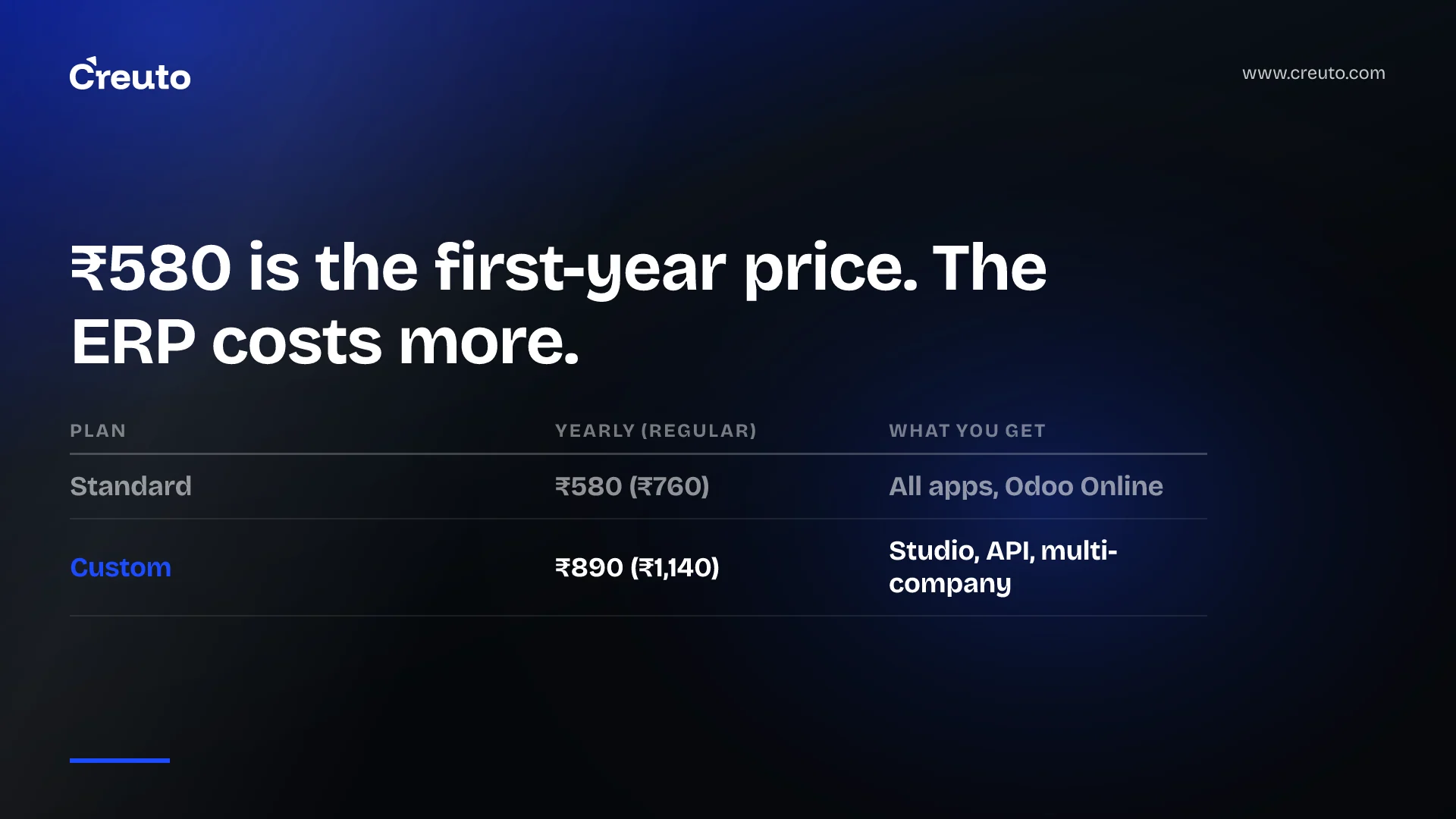
"Should we customise Odoo or build our own ERP?" is the question we hear most often from manufacturers and distributors. The honest answer to Odoo vs custom ERP starts with a correction: the per-user price on Odoo's website is the smallest line in an ERP budget, and the first number you see is a first-year discount. What decides the choice is implementation, customisation, and who owns the workflow five years from now.
This guide uses Odoo's own published India pricing, checked on 18 September 2026, and is written by a team that builds custom ERP systems — so weigh our perspective accordingly. We think Odoo is the right answer for many companies, and we say where.
How much does Odoo cost in India?
Odoo's pricing page for India lists three plans, priced per user per month:
| Plan | Billed yearly | Billed monthly | What it adds |
|---|---|---|---|
| One App Free | ₹0 | ₹0 | One app, unlimited users |
| Standard | ₹580 (regular ₹760) | ₹725 (regular ₹950) | All apps, Odoo Online only |
| Custom | ₹890 (regular ₹1,140) | ₹1,150 (regular ₹1,420) | Odoo Studio, multi-company, external API, Odoo.sh or on-premise |
Two footnotes on that page matter more than the headline figures. The lower price is a discount "valid for 12 months, for initial users ordered" — users added later, and every user from year two, pay the regular rate. And Odoo.sh hosting is not included in the Custom plan price.
Odoo Standard vs Custom plan: the one that applies to you
Odoo describes the Custom plan as being for companies that want to manage multiple companies in one database and "that need to customize Odoo through Odoo Studio, custom developments or through the API". Adding Studio or another company switches a database to Custom automatically.
In practice, this is the plan most businesses weighing a custom ERP end up on. If you need to connect Odoo to your existing systems through its API, add a field to a form in Studio, or run two legal entities, you are on Custom. So the realistic comparison is ₹1,140 a user a month billed yearly, not ₹580.
What are the hidden costs of Odoo?
"Hidden" is unfair; Odoo is transparent about most of this. But these are the costs that do not appear in the licence line.
- Implementation. Odoo says small companies use its Success Packs, mid-size and large companies with more than 50 employees usually work with a partner offering local project management, and companies above 250 employees should contact Odoo directly. Partner rates vary widely and we will not quote them; get two or three proposals.
- Customisation you then maintain. Every custom module and Studio change has to survive Odoo's version upgrades. The more you customise, the more each upgrade becomes a project in its own right.
- Hosting. Odoo Online is included; Odoo.sh or on-premise hosting, which heavy customisation usually requires, is a separate cost.
- Data migration and training. These are the same for any ERP, bought or built, and are routinely underestimated.
- Growth. Licences scale per user. A company that doubles its headcount doubles that line.
Odoo Community vs Enterprise
Some teams sidestep licence fees with Odoo Community, the open-source edition published under the LGPLv3. It is a legitimate option, but it is not "Odoo for free". Several applications and features in the paid plans are not part of Community, hosting and upgrades are entirely yours, and you still need someone who can implement and maintain it. In effect Community turns a licence cost into an engineering cost. For a company with an in-house technical team that is sometimes the right trade; for one without, it usually is not.
Odoo upgrade cost with customisations
The line most often missing from Odoo budgets is the upgrade. Odoo releases new major versions regularly, and each one can change the models and views your custom modules depend on. A lightly customised database upgrades with little effort. A heavily customised one needs every module reviewed, adapted and retested, and data migrated through any schema changes. Ask any implementation partner two questions before signing: how many of the proposed modules are custom, and what did the last version upgrade cost a client with a similar footprint? The answer tells you whether you are buying a product or commissioning a custom system built on someone else's foundations.
Total cost of ownership: Odoo vs custom ERP
A fair comparison runs over five years, because that is roughly how long an ERP decision lasts before it is revisited. Here is the licence arithmetic at Odoo's regular Custom rate billed yearly, before tax, hosting or implementation:
- 25 users: ₹1,140 × 25 × 12 = ₹3.42 lakh a year, about ₹17.1 lakh over five years.
- 50 users: ₹6.84 lakh a year, about ₹34.2 lakh over five years.
- 150 users: ₹20.52 lakh a year, about ₹1.03 crore over five years.
First-year discounts lower the first twelve months slightly; list prices can also change. Add implementation, hosting and upgrade work to get the Odoo side of the ledger.
A custom ERP has the opposite shape: most of the cost is up front, in discovery, design and build, and the ongoing cost is hosting, support and enhancement rather than a per-user fee. Its build cost depends entirely on scope — the number of modules, integrations and user roles — which is why a credible vendor will not quote one without a discovery phase. The questions that decide which side is cheaper are:
- How many users will you have in year five, not today?
- How much of your process is standard — accounting, purchasing, inventory — and how much is specific to how you make money?
- How much of Odoo would you need to change to fit that specific part, and who will carry those changes through each upgrade?
When Odoo is the right choice
We recommend Odoo, or another packaged ERP, when:
- your processes are close to standard practice and you are willing to adapt to the software where they are not;
- you have fewer users, or user growth is modest;
- you need to be live quickly and can accept the vendor's roadmap;
- you have, or can hire, a good implementation partner.
For a trading company or a services business with conventional accounting, sales and inventory, Odoo's breadth is hard to match, and building those modules from scratch would be a poor use of money. Our general framework for custom versus off-the-shelf software applies here.
When should a company build its own ERP?
A custom ERP earns its cost when the part of your business that is not standard is also the part that makes money. Typical signals:
- Production logic that is your advantage. Multi-stage manufacturing with process-specific costing, yield tracking or quality holds that packaged ERPs model only approximately.
- Heavy customisation already. If an Odoo implementation plan lists dozens of custom modules, you are building a custom ERP anyway — on someone else's upgrade schedule.
- Large, growing headcount where per-user licensing becomes the dominant cost over five years.
- Deep integration with machines, legacy systems or partner platforms that must work exactly your way.
We built a custom ERP for large-scale industries on exactly that reasoning: the client's production and approval workflows did not fit a packaged model without extensive modification, and the modification would have been the product.
If you do go custom, hold the vendor to the same standard you would hold Odoo. Ask for a phased scope with the first usable module live within months rather than a single big launch, for source code and data you own outright, and for a written estimate of annual support and enhancement costs. A custom ERP without those commitments can be as hard to leave as any licence.
Odoo vs custom ERP for manufacturing: a middle path
The choice is not always binary. Many clients do best with a packaged system for standard functions — Odoo or another accounting-centric ERP — and a custom application for the process that differentiates them, connected through APIs. That keeps the custom scope small and lets the packaged system do what it does well. The integration then becomes the critical piece, and it is worth designing as carefully as either side.
Before you commit either way, be sceptical of any single number — including ours. The widely quoted ERP implementation failure rate turns out to be hard to source, and so are most cost benchmarks. What you can get is a scoped estimate for your processes.
If you want that comparison done properly — Odoo licences and partner quotes on one side, a scoped custom build on the other — our custom ERP development team will lay out both, including when the answer is Odoo.
Frequently asked questions
Odoo's India pricing lists Standard at ₹760 per user per month billed yearly, discounted to ₹580 for the first 12 months, and Custom at ₹1,140, discounted to ₹890. Monthly billing costs more. Implementation, hosting on Odoo.sh and customisation are extra.
Odoo is usually cheaper than a custom ERP for companies with standard processes and modest user counts. A custom ERP can cost less over five years when headcount is large, per-user licences dominate, or the business would need extensive Odoo customisation that must be maintained through every upgrade.
A company should consider building its own ERP when its differentiating processes, such as multi-stage production costing or custom approval flows, do not fit packaged software without heavy modification, and when per-user licensing across a growing workforce becomes the largest cost over five years.
Odoo's Custom plan adds Odoo Studio, multi-company support, external API access and the option of Odoo.sh or on-premise hosting. Odoo says it is for companies that need to customise Odoo through Studio, custom developments or the API, so most integrated deployments need it.
Odoo says small companies typically use its Success Packs, while mid-size and large companies with more than 50 employees usually work with a partner offering local project management. Companies with more than 250 employees are asked to contact Odoo directly.