November 2026 core update: read the damage before you react
The November 2026 core update ended 24 Nov. How to read the drop in Search Console and tell a core update loss from a release your team shipped.
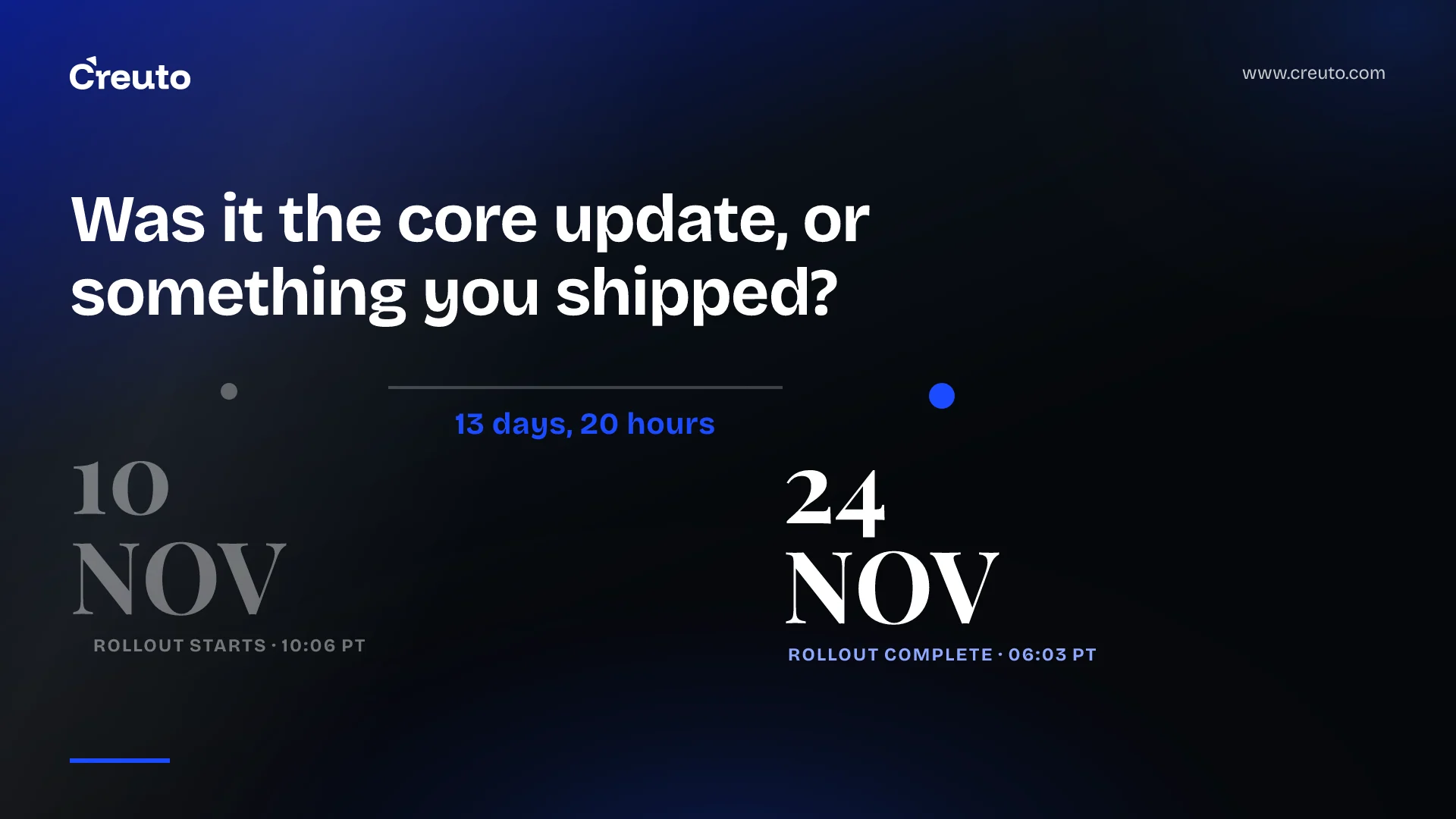
The November 2026 core update finished at 06:03 Pacific on 24 November, and 59 minutes later Google preannounced a December core update with no start date. If your organic traffic fell in the second half of November, you have a short window to work out why before another update muddies the data. This post gives you the dates, Google's own method for reading the drop in Search Console, and a way to tell a core update loss from something your engineering team shipped.
The key facts, from the Google Search Status Dashboard incident and its ranking update history, as of 27 November 2026:
| Item | Detail |
|---|---|
| Rollout started | 10 November 2026, 10:06 US/Pacific |
| Rollout complete | 24 November 2026, 06:03 US/Pacific |
| Duration | 13 days, 20 hours |
| Scope | Global, all languages |
| Earlier 2026 core updates | March (from 27 March, 12 days 4 hours) and May (from 21 May, 11 days 21 hours) |
| Next core update | December 2026, preannounced 24 November, no start date given |
What changed in the November 2026 core update: Google did not say
Google's notice for the November 2026 core update says only that it "applies globally and to all languages" and that "the rollout may take up to 2 weeks to complete". It names no system, no content type and no ranking signal. It was the third core update of 2026, after March and May.
Compare that with the December preannouncement in the dashboard feed, which says the next update "focuses on multiple improvements to how our systems understand and rank relevant content, including for longer and more complex questions" and on "improving personalized results for people who have personalization turned on". Any recap that tells you what November targeted is inferring it from rank-tracker samples, not quoting Google. Treat those patterns as hypotheses to test against your own pages, not as a diagnosis.
Why the analysis window opens on 1 December
Google's core updates guide says: "We recommend waiting at least a full week after a core update completes before analyzing your site in Search Console." With completion on 24 November, that puts the first fair read at 1 December. Numbers taken during the rollout mix pre-update and post-update rankings.
The December update compresses that window. A Google spokesperson told Search Engine Roundtable "We don't have a date yet -- we will announce it as usual the day it starts rolling out" and "It's not imminent." The advance notice itself is new: Google's stay-informed page ties it to the UK CMA's fair ranking requirements, giving notice "for changes where UK users may experience a significant ranking shift". Subscribe to the dashboard's Atom feed so you know the day December starts, and export your Search Console data now so the November comparison stays clean.
How to tell if the November core update hit your site
A core update loss shows up as lower positions on many pages from 10 November onwards. Google's guide to debugging traffic drops sets out the Search Console steps:
- Open the Performance report and set the date range to "Last 16 months", so you can see whether the dip repeats every November.
- Use the compare option to put the period after 24 November against an equal-length period before 10 November, with the Search type filter set to the surface you care about.
- Turn on Average position. Falling clicks with steady positions points to demand or click-through, not ranking.
- On the Pages tab, sort by "Clicks Difference" to find the pages that lost the most.
- Run the worst pages through URL Inspection, and check Google Trends to see whether interest fell across your whole industry.
Also check whether Search Console has flagged a data anomaly for your date range. A reporting gap can look exactly like a traffic loss.
Rule out what your own team shipped first
Google's debugging guide lists six causes of a drop: algorithmic updates, technical issues, security issues, spam and manual actions, seasonality, and site moves or migrations. Only one of them is the core update. Before anyone rewrites content, check the Crawl stats, Page indexing, Security Issues and Manual Actions reports. If a release or a CDN or infrastructure change landed between 10 and 24 November, the two causes will overlap on the same chart.
That overlap is not hypothetical. On 11 November, the day after the rollout began, Google published a post on moving to a CDN. It warns that a new CDN starts with a cold cache, and that "leaving blanket bot protection enabled without exempting verified crawlers" leaves Googlebot on error pages. Its fix is to allow verified bots using Google's published IP ranges, and to use 429 or 503 only as a temporary brake for hours, or one to two days at most.
| What you see | Likely cause |
|---|---|
| Drop starts 10-24 November, positions fall across many pages, crawl and indexing reports clean | Core update |
| Drop starts on a deploy date, Page indexing errors or Crawl stats server errors rise | Technical regression |
| An entry in the Manual Actions report | Spam policy action |
| Drop starts in late September or early October | September 2026 spam update window (from 24 September, 13 days 16 hours), not November |
| Same fall in Google Trends for your category | Demand or seasonality |
Manual actions deserve a separate look. Google's spam policies define scaled content abuse as "when many pages are generated for the primary purpose of manipulating search rankings and not helping users", and say violations can "result in a manual action". That is a message in Search Console, not a core update effect, and the fix is different.
Small drop or large drop: Google gives two different answers
Google's core updates guide separates the two. For a small drop, such as "dropping from position 2 to 4", it says "There's no need to take drastic action". For a large one, such as "dropping from position 4 to 29", it says "Do a deeper assessment" and "Evaluate the pages that were most impacted", while asking you to "Take a close look at your site as a whole, and try to be objective."
The deeper assessment runs through the helpful content self-assessment questions, such as "Does the content provide original information, reporting, research, or analysis?" Google also says to "Avoid doing 'quick fix' changes" and calls deleting content "a last resort".
The strongest argument against waiting is lost revenue: every week of lower traffic costs money. That's true, but the technical checks above can start today. Only the content judgment should wait, because a partial-data read sends you rewriting pages that would have settled anyway.
How long recovery from a core update takes
Google says that after you make changes, "some changes can take effect in a few days, but it could take several months", and that if nothing has moved after a few months, "that could mean waiting until the next core update."
One measured figure shows how much the next update can reverse. SE Ranking's May 2026 analysis, covering about 100,000 keywords across 20 niches for a New York location, found that "32.20% of the domains that lost their TOP 10 spots after March climbed back into the TOP 10 after May". Its "March" combines the March spam and core updates. Read it as one vendor's sample: roughly a third came back, which means most did not. Many recovery percentages you will see quoted elsewhere have no source at all.
If the cause turns out to be your release
By 1 December you should know which row of the table you are in. If it is the first row, the work is editorial and follows Google's guide. If the drop lines up with a deploy, a rendering change, new bot protection or a CDN switch, it is an engineering problem, and fixing it before December starts keeps the next comparison clean. Adding release checks for status codes, robots rules and rendered HTML stops the same regression shipping twice.
We don't sell SEO, and we won't promise rankings. What we do is build and fix the software. If your diagnosis points to something your site or app shipped in November, our web app development team can work through the releases, rendering, caching and crawler access from that fortnight with your engineers and fix what broke.
Frequently asked questions
The November 2026 core update finished on 24 November 2026 at 06:03 US/Pacific, according to the Google Search Status Dashboard. It started on 10 November at 10:06 US/Pacific, so the rollout took 13 days and 20 hours, inside the two weeks Google said it might need.
Google's notice for the November 2026 core update says only that it applies globally and to all languages. It names no specific system, signal or content type, so any claim about what it targeted comes from third-party rank-tracking samples rather than from Google itself.
Google recommends waiting at least a full week after a core update completes before analysing your site in Search Console. For the November 2026 core update, which completed on 24 November, that means starting the analysis on or after 1 December 2026.
A November core update hit usually shows as lower average positions across many pages from 10 November onwards, with clean crawl, indexing, security and manual action reports. If the drop starts on a deploy date or alongside indexing errors, a technical regression is the more likely cause.
As of 27 November 2026, the December 2026 core update had been preannounced but not released. Google said it had no date yet, that the update was not imminent, and that it would announce the rollout on the Search Status Dashboard on the day it starts.