Multi vendor marketplace development cost: payouts decide it
Multi vendor marketplace development cost in India: Sharetribe, CS-Cart and Webkul prices, and why Stripe invites and Razorpay Route rules force a build.
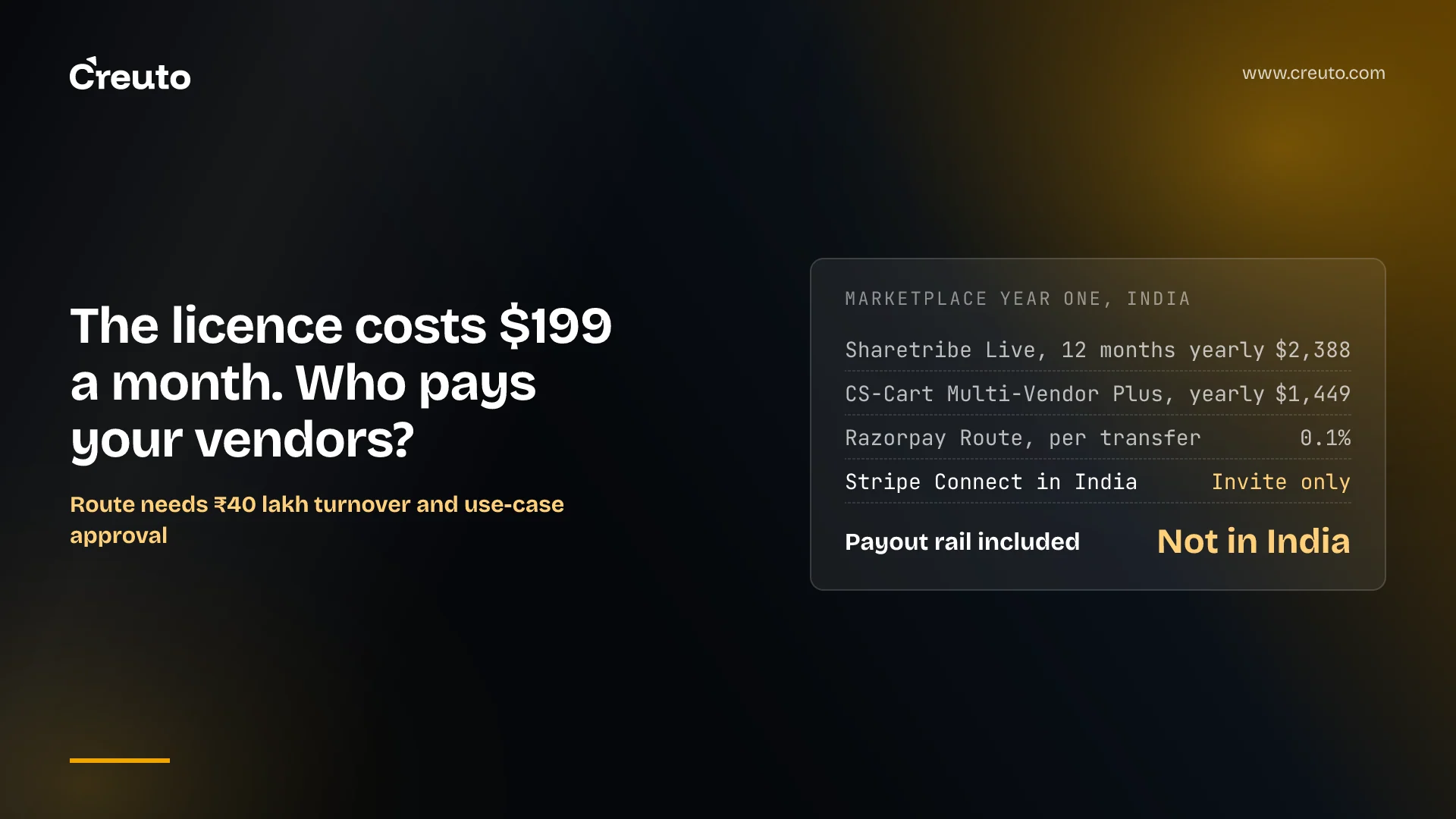
Sharetribe's built-in payments run on Stripe Connect, and India is not on Sharetribe's list of supported Stripe countries. Neither is the UAE. That single fact moves the multi vendor marketplace development cost more than any licence fee. By the end of this post you will know what Sharetribe, CS-Cart, Webkul and Mirakl charge as of November 2026, what Stripe Connect and Razorpay Route require before they will split a payment, and when a custom build is cheaper than fighting the platform.
The short version: a marketplace licence costs between a few thousand rupees and a few thousand dollars a year. The expensive part in India is the payout rail, because Stripe is invite-only and Razorpay Route now has a turnover gate. Decide the payout path first and the build-or-buy answer usually follows.
| Item | What it costs or requires (checked 4 November 2026) |
|---|---|
| Sharetribe Live | $199/month billed yearly, $259/month billed monthly, no transaction fees |
| CS-Cart Multi-Vendor | From $725/year (Standard); Plus $1,449/year or $3,590 lifetime |
| Stripe in India | Invite-only, including new connected accounts on platforms |
| Razorpay Route | 0.1% per transfer (limited-time; regular 0.25%), domestic turnover above ₹40 lakh in FY25 or FY26 |
Multi vendor marketplace development cost starts with payouts, not the licence
A marketplace is a shop that takes money on behalf of other people. The storefront, listings and search are the parts every platform demos well. The part that decides your cost is what happens after a customer pays: who holds the money, how the commission is taken, when each vendor is paid and who files the tax.
Every hosted marketplace platform answers that question by plugging into one payment provider's split-payment product. If that provider will not onboard you, or will not onboard your vendors, the platform's payment module is dead weight and you are writing a custom integration on top of someone else's codebase. That is the point at which a build stops being the expensive option.
Marketplace platform pricing as of November 2026
We pulled every figure below from the vendor's own pricing page on 4 November 2026. Several comparison sites still list older numbers, so check the primary page before you put a figure in a budget.
| Platform | Entry price | Upper tier | Payments model |
|---|---|---|---|
| Sharetribe | Build $39/month (test mode only) | Live $199/month yearly, $259 monthly | Stripe Connect built in |
| CS-Cart Multi-Vendor | Standard $725/year | Ultimate $3,599/year or $7,990 lifetime | Vendor money flow and custom commissions from Plus |
| Webkul MultiVendor (Shopify app) | Starter ₹2,841.66/month, 7 sellers | Ultra ₹47,361.04/month | Automatic PayPal and Razorpay payments from Growth |
| Mirakl | No published price | Sales-led | Enterprise contract |
Sharetribe's pricing page lists Build at $39 a month "for building and testing your marketplace platform before launching", with test payments only. Live is $199 a month billed yearly; the FAQ on the same page puts monthly billing at $259. Both include 1M usage credits a month, and Live carries no transaction fee, though Sharetribe notes that Stripe's own fees are "typically around 1.5-3% of the transaction size".
CS-Cart's licence page prices Multi-Vendor Standard at $725 a year, Plus at $1,449 a year or $3,590 lifetime, and Ultimate at $3,599 a year or $7,990 lifetime. The detail that matters for payouts sits in the feature list: "simplified vendor money flow" and custom commissions start at Plus, not Standard. Every edition includes full code access.
The Webkul MultiVendor Marketplace listing on the Shopify App Store shows Starter at ₹2,841.66 a month for 7 active sellers, Growth at ₹5,683.33 for 25, Max at ₹9,472.21 for unlimited sellers and Ultra at ₹47,361.04. Those rupee figures are Shopify's conversion estimates from US dollars, so they move with the exchange rate. Mirakl publishes no operator price at all; its homepage sends you to "Talk to a Marketplace expert".
Sharetribe vs CS-Cart vs custom build
Sharetribe vs CS-Cart vs custom build is really a question about who owns the code. Sharetribe is hosted and you extend it through its developer platform. CS-Cart gives you the source and you host it. A custom build gives you both, and the bill for both. On licence cost alone, Sharetribe Live paid yearly comes to $2,388. At that price, licence cost is not where these options differ.
Sharetribe's payments stop at the Indian border
Sharetribe describes Stripe Connect as "the built-in payment and payout system in your Sharetribe marketplace". Its supported-countries article lists 36 countries and territories, from Australia to the United States. India is not among them, and neither is the United Arab Emirates. For providers outside the list, the same article says "integrating a custom payment system with your marketplace is done by custom coding", and adds that "PayPal is not available to use for most new marketplace businesses".
Sharetribe's own Stripe Connect overview, last updated 8 October 2026, says "India is only available in preview". So an Indian founder on Sharetribe is not choosing a payments setting. You are commissioning a payment integration against Sharetribe's APIs, which is custom development with a monthly platform fee on top.
That is a legitimate path, and some teams take it. But it is the moment to compare the two kinds of custom work honestly: extending a hosted platform you do not control, or building the marketplace core yourself. Our build vs buy enterprise software post sets out how we decide which layers to own.
Is Stripe Connect available in India?
Stripe Connect is available in India only by invitation. Stripe's support article states that "Stripe services are invite-only in India", that Indian businesses "are not able to sign up for a new Stripe account through our website", and that "for Platforms using Stripe in India, we support the addition of new connected accounts by invite only". Existing accounts continue to be supported.
Even with an invitation, the marketplace toolkit is narrower. Stripe's India marketplace support page says separate charges and transfers, and standalone transfers, are "currently not supported", and that manual payouts to connected accounts are "supported for limited use-cases". Separate charges and transfers is the pattern most multi-vendor carts depend on, because one order pays several sellers.
If you are invited, the Stripe Connect price list for India under the "you handle pricing" model is ₹150 per monthly active account, 0.25% plus ₹20 per payout, and 0.25% of payout volume for funds routing. Under "Stripe handles pricing", the platform pays no Connect fee and Stripe bills connected accounts directly.
Razorpay Route: the split payments rail with a turnover gate
Split payments for a marketplace in India mostly mean Razorpay Route. Razorpay's Route page lists 0.1% on every transfer as a limited-time offer against a regular 0.25%, charged on top of standard payment gateway pricing, with unlimited linked accounts, multiple transfers per payment and settlements that can be held "until business conditions are met".
The constraint is eligibility. Razorpay's Route documentation requires domestic turnover above ₹40 lakh, shown through GST-3B returns, or export turnover above ₹5 lakh, in either FY26 or FY25. You must also submit a written confirmation of your Route use case showing that each linked account deals directly with your customers, which Razorpay treats as your declaration of payer-payee transparency.
The deadline has already passed. The same page says "the deadline to submit compliance information was December 31, 2025", and that existing users who did not submit proofs have had Route access disabled. The Route FAQ adds that denied accounts had Route "discontinued effective January 1, 2026", that review takes 5 to 7 business days, and that Route currently supports only INR.
Read that as a founder turning a single-seller business into a marketplace. If your existing business already clears ₹40 lakh, Route is a cheap, well-documented rail. If you are a new marketplace with no trading history, the FAQ allows a self-declaration of turnover for GST-exempt or first-year businesses, but your payout design should not assume approval until you have it in writing.
Razorpay Route vs Stripe Connect for marketplaces
| Question | Razorpay Route | Stripe Connect (India) |
|---|---|---|
| Can a new Indian business sign up online? | Subject to turnover proof and use-case review | No, invite-only |
| Fee on the split | 0.1% per transfer (limited-time; regular 0.25%) | ₹150 per active account plus 0.25% + ₹20 per payout |
| One payment to several sellers | Multiple transfers per payment | Separate charges and transfers not supported |
| Currencies | INR only | Cross-border limits apply |
Tax collected at source is yours to build, whichever platform you pick
If you operate as an e-commerce operator under GST, you collect tax at source on what your vendors sell through you. Notification 15/2024–Central Tax, dated 10 July 2024, set that collection at 0.5% of the net value of taxable supplies made through the operator by other suppliers.
None of the pricing pages we read mention TCS on e-commerce operators. Your commission engine has to deduct it, your ledger has to record it per vendor and your finance team has to reconcile it. That ledger is the same piece of code your payout rail needs, which is why payouts and tax tend to arrive as one work package. Our post on what API integration price ranges leave out covers how that kind of reconciliation work hides in a quote.
The strongest case for staying on Sharetribe or CS-Cart
The counter-argument deserves its full weight. A new marketplace's first risk is liquidity, not software: getting enough vendors and buyers onto the same page. Sharetribe's Build plan costs $39 a month with a 14-day free trial, and you can test the supply side for weeks before you have written any payment code. If you are outside India and the UAE, in one of Sharetribe's 36 supported countries, the built-in Stripe Connect flow may be all you need for years.
CS-Cart has a similar argument in its favour. A $3,590 lifetime Plus licence with full code access, vendor money flow and custom commissions is a serious head start, and you own the source. If your marketplace is a product catalogue with standard checkout and you have a team to maintain it, starting there is reasonable.
A custom build is the wrong choice if you have not yet proven that vendors will list and buyers will pay. It is also the wrong choice if your payout rail is already approved and your platform supports it out of the box. Spend the money on vendor acquisition instead.
When to build a custom marketplace platform
Build a custom marketplace platform when the payout rail forces custom code anyway, or when your transaction is not a cart checkout. In India the first condition is common: if Sharetribe needs a custom gateway integration and Stripe needs an invitation, you are already paying engineers. The question becomes whether they spend that time adapting someone else's data model or building yours.
The second condition matters for service marketplaces. A salon booking, a venue booking or a home service is a time slot with a provider, a cancellation policy and sometimes payment at the venue. Product-catalogue platforms model that badly, and the booking calendar is where the custom work concentrates.
Salon booking marketplace app development cost: what we saw
We built MakeMyLook, a salon and wellness booking marketplace, in 16 weeks from kick-off to public launch. It onboarded 200+ vendors and cut booking drop-offs by 40% against the client's previous manual system. Customers pay online through Razorpay at booking or pay at the salon on arrival, and refunds for cancelled bookings go back through the gateway automatically.
Two things from that build apply to most service marketplaces. Pay-at-venue has to coexist with online payment, which means your commission logic cannot assume you hold the money. And vendor onboarding is a workstream, not a form: we ran a dedicated onboarding sprint before public launch so the marketplace opened with supply already on it.
We do not publish a range for custom marketplace app development cost, because the variables that move it are the ones above: the payout rail you are approved for, how many vendor roles you need, and whether bookings or carts drive the transaction. What we state publicly is that a focused MVP typically takes 6-10 weeks and larger platforms 3-6 months, depending on complexity, integrations and scope.
Settle the payout path before you pick a platform
The order of decisions that keeps the multi vendor marketplace development cost honest is short. First, confirm which split-payment rail will actually onboard you: Route if you clear ₹40 lakh and pass use-case review, Stripe only with an invitation. Second, check whether your chosen platform supports that rail without custom code. Third, map who deducts TCS and where the per-vendor ledger lives. Only then compare licence prices, because by that point you will know whether the licence is the whole cost or the smallest line on the invoice.
If the answer to the second question is no, our e-commerce solutions team can scope a custom marketplace around the payout rail you are approved for, including vendor onboarding, the commission engine and the booking or cart model your transaction actually needs.
Frequently asked questions
A multi vendor marketplace costs little to license and more to make pay vendors. Sharetribe Live is $199 a month billed yearly and CS-Cart Multi-Vendor starts at $725 a year, but in India the payout integration, commission engine and tax ledger usually drive the real cost, which is why we scope from the payout rail first.
Stripe Connect is available in India only by invitation. Stripe says its services are invite-only in India, new Indian businesses cannot sign up through its website, and platforms can add new connected accounts by invite only. Separate charges and transfers, the usual multi-seller cart pattern, is not currently supported there.
Most Indian marketplaces split payments to vendors through Razorpay Route, which creates multiple transfers from one payment to linked vendor accounts. Route charges 0.1% per transfer as a limited-time rate against a regular 0.25%, and needs domestic turnover above ₹40 lakh plus an approved written use-case confirmation.
Sharetribe suits founders who want to test supply and demand cheaply in one of its 36 Stripe-supported countries. For an Indian or UAE marketplace, Sharetribe's built-in Stripe payments do not apply, so payouts need custom code anyway, and building the marketplace core yourself often becomes the better use of that engineering time.
Indian e-commerce operators collect tax at source on supplies other vendors make through them. Notification 15/2024 Central Tax, dated 10 July 2024, set the collection at 0.5% of net taxable supplies, so a marketplace's commission engine and per-vendor ledger must deduct, record and reconcile it alongside payouts.