How Much Does It Cost to Build a Mobile App in 2026?
Mobile app development cost in 2026 depends on features, platforms, design, backend and upkeep. What drives the price and how to get an accurate estimate.
"How much does an app cost?" is the first question most founders and business owners ask, and the honest answer is that mobile app development cost depends on a handful of decisions you can control. This guide explains what drives the price in 2026, where money is usually wasted, and how to get an estimate you can trust.
What drives mobile app development cost
1. Features and complexity
This is the biggest factor. A simple app with sign-in, a few screens and basic content is a small project. Real-time features, payments, maps, chat, offline sync, complex permissions and admin dashboards each add significant work. Every integration with another system — ERP, CRM, payment gateway, logistics — adds design, build and testing time.
2. Platforms and approach
Building for iOS and Android natively means two codebases. Cross-platform frameworks such as React Native and Flutter share most of the code between platforms, which usually reduces cost and speeds up delivery; our React Native vs Flutter guide covers the choice. Native still makes sense for apps that depend heavily on the newest platform features or maximum performance.
3. Design
Good UI and UX design is not decoration: it determines whether people complete tasks and come back. A standard design system costs less than a fully custom visual language with bespoke animation.
4. Backend and infrastructure
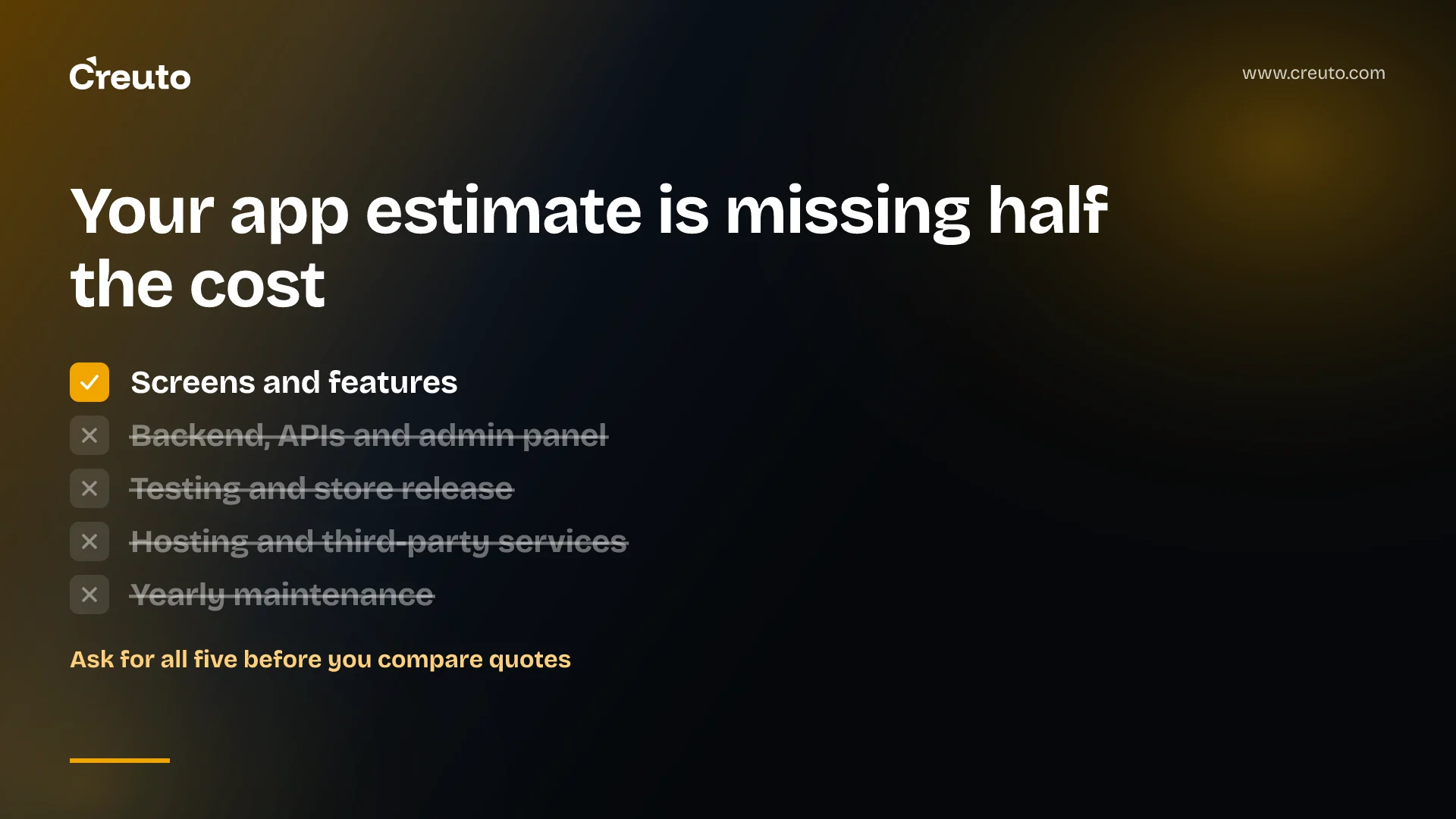
Most apps need a backend: APIs, databases, authentication, notifications, file storage and an admin panel. This is often a third or more of the work and is frequently left out of early estimates.
5. Testing and release
Testing across devices, OS versions and network conditions, plus app store preparation and review, takes real time. Store rules change regularly — recent examples include iOS 27's age-rating requirements and Android developer verification.
6. Team location and model
Rates vary widely between countries and between freelancers, agencies and in-house teams. Lower hourly rates only save money if the team delivers quality work at a sensible pace; the cheapest estimate often becomes the most expensive project.
Costs people forget
- Store accounts. Apple's Developer Program has an annual fee, and Google Play charges a one-time registration fee.
- Hosting and services. Cloud hosting, databases, push notifications, maps, SMS and email services are monthly costs that grow with usage.
- Maintenance. Every year brings new OS versions, store policy changes, security updates and dependency upgrades. Budget for ongoing maintenance, not just the build.
- Analytics and support. Crash reporting, analytics and customer support tools.
App development cost for startups
Startups get the best value by building a focused minimum viable product first: the smallest version that proves users want it. It costs a fraction of a full product, reaches the market sooner, and makes the next phase of spending evidence-based.
Mobile app development cost in India
India is a common choice for app development because it combines a large pool of experienced engineers with competitive rates. As anywhere, quality varies: judge teams on their portfolio, process, communication and how they handle testing and security, not just on price. Our checklist of what to look for in a development partner applies directly.
How to get an accurate estimate
- Write down the core user journeys, not just a feature list.
- List every system the app must connect to.
- Decide platforms and whether you need an admin panel.
- Ask for a phased estimate: MVP first, then later releases.
- Check that the estimate includes backend, testing, release and a maintenance plan.
A short paid discovery phase — a week or two of workshops and wireframes — usually produces a far more reliable estimate than a quote from a one-page brief.
Is it worth the investment?
An app is worth building when it saves money, earns money or keeps customers in ways the alternatives cannot. Focus the budget on the journeys that deliver that value, and the rest can wait. Our mobile app development team can scope your app in phases and give you an estimate that covers everything from build to maintenance.
Frequently asked questions
Mobile app development cost in 2026 depends mainly on features and complexity, platforms, design, backend work, testing and maintenance. A focused MVP costs a fraction of a full-featured app, so a phased estimate from a short discovery phase is the most reliable way to budget.
Cross-platform development with React Native or Flutter is usually cheaper than building separate native iOS and Android apps because most code is shared. Native development can still be worth the extra cost for apps that need maximum performance or the newest platform features.
Ongoing mobile app costs include Apple and Google developer accounts, cloud hosting and third-party services, maintenance for new OS versions and store policy changes, security updates, analytics and customer support.
A startup can reduce app development cost by building a focused MVP around one core user journey, using a cross-platform framework, choosing a standard design system and adding features only after real usage shows they are needed.