Jev model explained: when a decision model beats an LLM in your software
The Jev model from TypeSafe returns calibrated decisions, not text. Where it beats an LLM for classification, routing and guardrails, and where it does not.
The Jev model from TypeSafe AI is the most talked-about AI launch of the week, and it is not a large language model. Jev does not write text. It takes context and a set of questions you define, and returns typed decisions with probabilities attached. That makes it much faster and cheaper than an LLM for the many small decisions inside software — classify this, route that, allow or block — and useless for anything that needs an open-ended answer. Here is where it fits.
What is the Jev model?
TypeSafe AI released Jev on 15 September 2026. According to TechCrunch, the company was founded by Diogo Almeida, a former OpenAI researcher who worked on ChatGPT and on reinforcement learning from human feedback. Jev is a transformer-based model, but instead of generating text it produces probabilities — what TypeSafe calls "calibrated decisions". Because developers define the possible outputs in advance, it cannot produce an answer outside those options. Output tokens are free, and input is metered by the billion tokens rather than the million.
Vercel describes the interface: an application sends context and a set of questions; Jev evaluates them in parallel and returns typed choices, scores or true/false answers, with probabilities, in a format code can use directly. TypeSafe calls it a "System One" model — fast intuition rather than step-by-step reasoning.
Why developers are paying attention
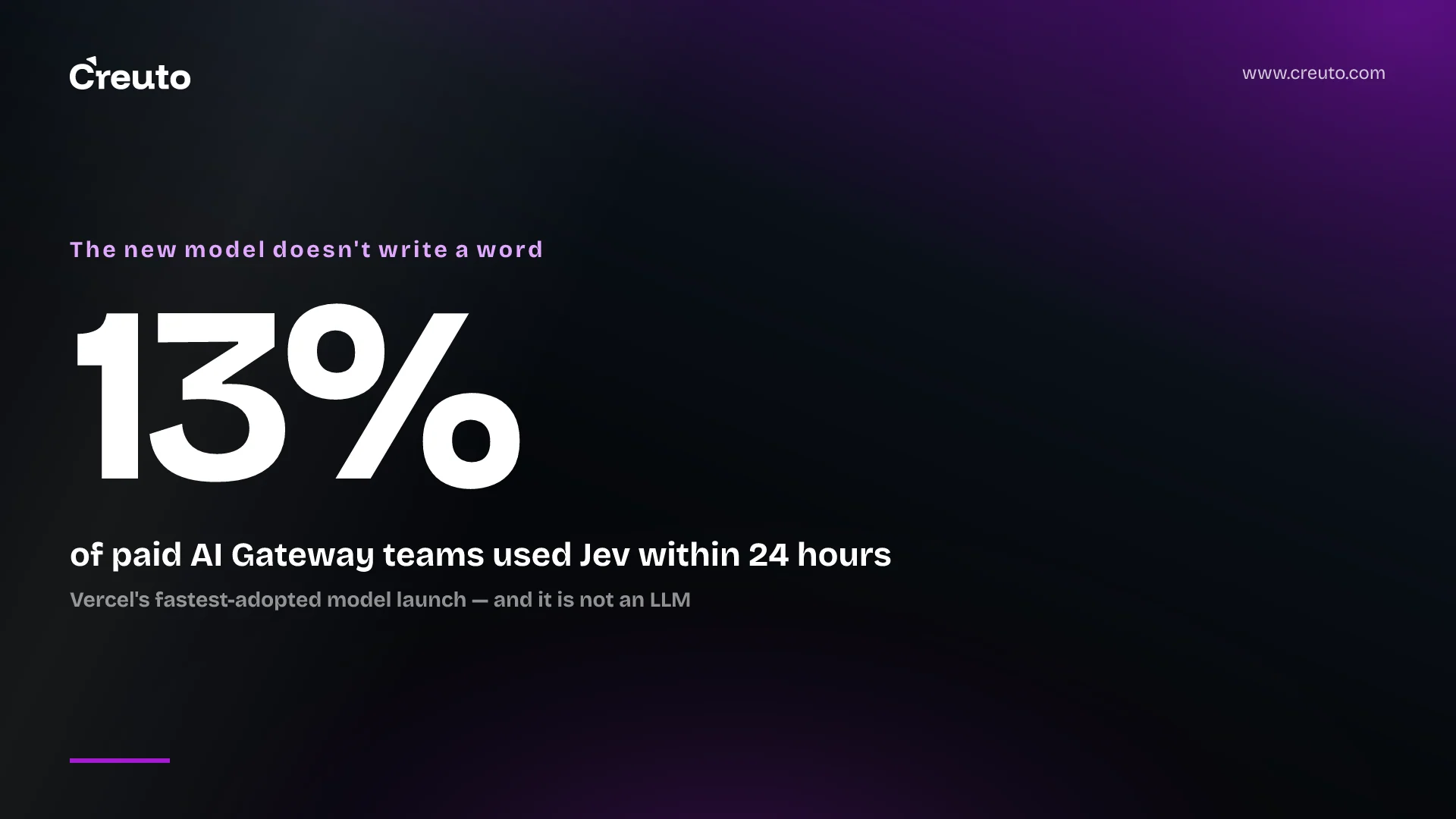
Adoption was unusually fast. Vercel reports that within 24 hours of launching on its AI Gateway, Jev was used by nearly 13% of paid teams — twice as many as the GPT-5.6 family and more than six times as many as Fable 5.1 — making it the fastest-adopted model in the gateway's history. TechCrunch notes that TypeSafe briefly could not serve API requests because demand was so high. An open-source take on the same interface pattern, OpenJev, reached the top of Hacker News within days.
The early results are specific. Vercel engineer Pranit Sharma told TechCrunch that swapping an LLM safety classifier for Jev gave results five to 18 times faster, with better accuracy. Another CTO testing business-email classification found Gemini slightly more accurate but 10 to 20 times more expensive — and valued Jev's real probability scores most. TypeSafe's own workflow evaluations claim up to 194 times faster and 445 times cheaper than language models; treat vendor benchmarks as a starting hypothesis, not a result.
Jev vs LLM: where each wins
| Task | Better fit | Why |
|---|---|---|
| Route a support ticket to one of ten queues | Jev | Fixed options, high volume, needs a confidence score |
| Decide whether an agent's command is safe to run | Jev | Fast guardrail on every step, cheap enough to run always |
| Pick which model should handle a request | Jev | Routing must cost less than the work it routes |
| Draft a reply to a customer | LLM | Needs generated text |
| Summarise a contract or answer an open question | LLM | Open-ended output |
| Multi-step reasoning over new problems | LLM | Jev is designed for intuition, not reasoning |
Model routing is a particularly good fit. We have written about routing requests between models and cutting LLM costs by task; the catch has always been that deciding which model to use with an LLM costs almost as much as doing the work. A cheap decision model changes that arithmetic.
Does Jev hallucinate?
Not in the way an LLM does — it cannot invent an option you did not define. But it can still be wrong. Armin Ronacher, CTO of Earendil, put it well to TechCrunch: Jev "delegates the hallucination problem a little bit to the user." If a decision comes back at 50%, it is a coin toss; at 95%, you can act on it. The engineering work moves from checking text to choosing thresholds and deciding what happens below them.
How to use Jev in a real application
- Find your hidden LLM classifiers. Many apps call a large model just to get a label or a yes/no. Those calls are the obvious candidates.
- Define the decision precisely. Options, labels and the question wording. Ambiguous options produce ambiguous probabilities.
- Build an evaluation set. Fifty to a few hundred real examples with known answers, as we recommend for any AI evaluation.
- Set thresholds per action. Act automatically above a high confidence, send the middle band to a person or a larger model, and log everything.
- Keep a fallback. It is a new model from a young company; design so you can swap it out.
What to watch
Jev's architecture is not public, and TechCrunch notes outside observers suspect it is built on an open-weight LLM. It is trained on synthetic data, and it is one vendor's product in its first week. The broader idea — small, calibrated decision models instead of chat models for machine decisions — is likely to outlast any single launch. Our AI engineering services team can help you find the decisions in your software that a model like this should be making, and measure whether it does them well.
Frequently asked questions
Jev is a decision model from TypeSafe AI, released on 15 September 2026. It is not a large language model: it takes context and developer-defined questions and returns typed decisions such as choices, scores or true/false answers, each with a probability.
Jev cannot return an option the developer did not define, so it does not invent answers like an LLM can. It can still be wrong, so applications should act on high-confidence decisions and route uncertain ones to a person or a larger model.
An LLM generates text token by token and can answer open-ended questions. Jev evaluates predefined questions in parallel and returns probabilities, which makes it much faster and cheaper for classification, routing and guardrails, but unsuitable for writing or reasoning tasks.
Use Jev where software needs a fast, repeatable decision from a fixed set of options, such as ticket routing, safety checks on agent actions, or choosing which model handles a request. Use an LLM when the output must be generated text.