Is Java 11 affected by Java4Shell? No. Upgrade anyway
Is Java 11 affected by Java4Shell? No, and nor is standard Java 8. But Oracle's November patch still lists Java 11 under five other CVEs. What to budget.
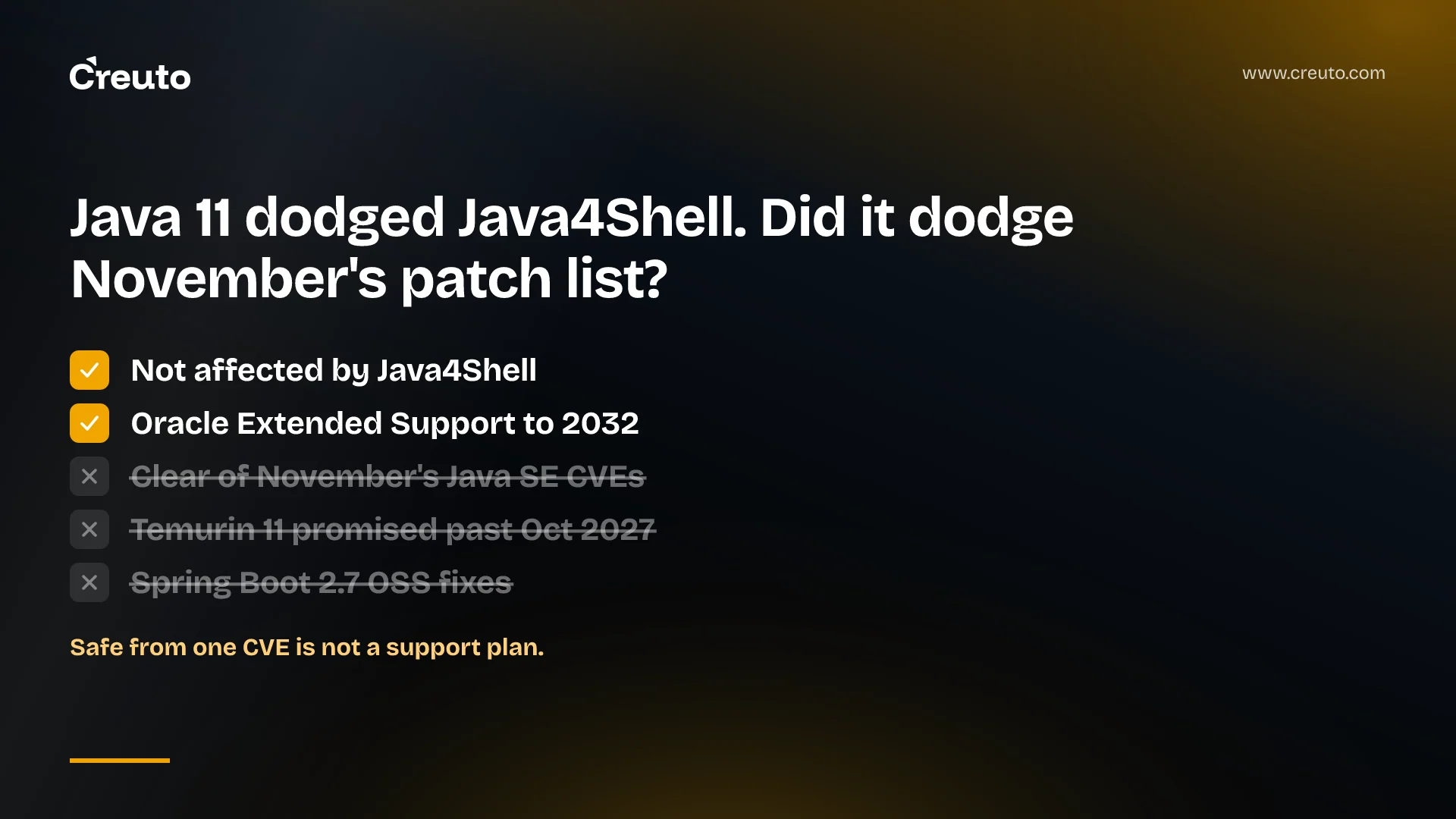
Is Java 11 affected by Java4Shell? No. Standard OpenJDK 11 and standard Java 8 builds do not contain the vulnerable code behind CVE-2026-114938, according to OX Security and Qualys. The one Java 8 exception is Oracle's 8u511b33-perf build. Java 11 still needs patching this month for five other CVEs.
That last sentence is the one most coverage skips. By the end of this post you will know exactly why your Java 8 and 11 services escaped, what the same Oracle patch release still asks of them, and how to decide whether the upgrade to Java 21 or 25 stays in next year's budget. The short version: Java4Shell is not evidence for staying, and it is not evidence for moving. Support dates are.
The facts as of 18 November 2026
Java4Shell was disclosed by Calif with Oracle's patch at 1:00pm PT on 17 November 2026. Calif scores it 9.2 under CVSS 4.0; Oracle's November 2026 Critical Security Patch Update scores it 8.1 under CVSS 3.1, with attack complexity rated High. Tenable reports no known exploitation and no CISA KEV listing as of 17 November.
| Java line | Java4Shell (CVE-2026-114938) | Oracle Extended Support until | Temurin builds until at least |
|---|---|---|---|
| Java 8 (standard) | Not affected | December 2030 | December 2030 |
| Java 8 Enterprise Performance Pack | 8u511b33-perf affected; fixed in 8u513-perf | December 2030 | Not a Temurin build |
| Java 11 | Not affected | January 2032 | October 2027 |
| Java 17 | 17.0.0 to 17.0.5 not affected; 17.0.6 and later affected; fixed in 17.0.21.1 | September 2029 | October 2027 |
| Java 21 | Affected; fixed in 21.0.13.1 | September 2031 | December 2029 |
| Java 25 | Affected; fixed in 25.0.5.1 | September 2033 | September 2031 |
Affected ranges and fixed builds are from OX and Oracle's patch matrix; support dates are from the Oracle Java SE Support Roadmap and the Adoptium support page, which lists its dates as minimums.
Is Java 11 affected by Java4Shell? Why the answer is no
The bug lives in a HotSpot shortcut, not in the Java language or the java.util.Base64 API itself. The vulnerable path is the x86-64 intrinsic that speeds up the basic and URL decoders on processors with AVX-512 VBMI; OX notes that the MIME decoder and third-party Base64 libraries are not on the path. OX states that "Standard Java 8 and Java 11 builds and Java 17.0.0 to 17.0.5 do not contain the vulnerable code." In other words, the vulnerable code first shipped in 17.0.6.
The hardware condition narrows things further. Calif and Qualys both say only x86-64 processors with AVX-512 VBMI can be affected: Intel Ice Lake, Sapphire Rapids, Emerald Rapids and Granite Rapids, and AMD Zen 4 or newer. ARM64 hosts are out, and so are Skylake-SP, Cascade Lake and Zen 2/3 according to OX. If you also run Java 17 or later, the am-I-affected check is a CPU flag test plus a version check; that triage belongs in its own runbook, not in this decision.
Is Java 8 affected by CVE-2026-114938?
Standard Java 8 is not. The exception is Oracle's Java SE 8 Enterprise Performance Pack, which Oracle lists as 8u511b33-perf in the CVE-2026-114938 row, fixed in 8u513-perf. The reason is lineage: when Oracle launched the pack in October 2022, InfoWorld reported that it brought improvements from the JDK 8-to-JDK 17 period back to Java 8. If you bought the performance pack, you bought some JDK 17-era HotSpot, and with it this exposure. Check which Java 8 build you actually run before you close the ticket.
You were spared by an optimisation you never received
Here is the uncomfortable framing. Java 11 did not resist Java4Shell. It simply predates the code that contained the flaw. Your Java 8 and 11 fleet is clean for the same reason a car without a sunroof never has a leaking sunroof.
The strongest argument for staying put deserves a fair hearing: new JIT intrinsics are new attack surface, Java4Shell proves it, and a mature runtime that only receives fixes is the conservative choice for back-office systems that just need to keep running. For this one CVE, that argument is correct.
It fails as a general policy because old runtimes keep collecting their own CVEs. Staying on 11 does not exempt you from patching; it commits you to patching 11 for as long as someone will ship fixes for it. That turns the question into one about who ships those fixes, and until when.
November's patch list still includes Java 11
The same Oracle release that fixed Java4Shell contains 11 new security patches for Java SE, and Oracle lists Java 11 (11.0.33.0.3) as affected by five of them. Every Java SE fix in that matrix is described by Oracle as remotely exploitable without authentication.
| CVE | Component | CVSS 3.1 | Applies to server deployments? |
|---|---|---|---|
| CVE-2026-114940 | JSSE (TLS) | 7.4 | Yes, through APIs such as a web service |
| CVE-2026-114939 | JGSS | 7.4 | No; sandboxed clients running untrusted code |
| CVE-2026-114943 | Hotspot | 6.5 | Yes, through APIs such as a web service |
| CVE-2026-114944 | Core Java Libraries | 5.9 | Yes, through APIs such as a web service |
| CVE-2026-114946 | Compiler | 4.8 | Yes, through APIs such as a web service |
Four of the five carry Oracle's note that they can be exploited through APIs, for example a web service, which is exactly how an ERP integration or back-office service talks to the world. Standard Java 8 (8u511b33) appears in this release too. So the practical instruction for Java 8 and 11 teams this week is not "do nothing". It is "apply your vendor's November update on the normal cycle, without the emergency".
The Java 11 extended support end date depends on who builds your JDK
The Oracle roadmap gives Java 11 Extended Support until January 2032, and states that "the Extended Support uplift fee will be waived for the period October 2023 – January 2032 for Java SE 11." If you are an Oracle Java SE customer, Java 11 is covered for another five years. That is the honest case for not rushing.
Most mid-sized teams are not running Oracle-supported Java 11, though. On Eclipse Temurin, Adoptium commits to Java 11 builds until at least October 2027, under a year from now. And note the trap in the table above: Temurin 17 carries the same "at least October 2027" date, so a hop from 11 to 17 buys no extra runway on that distribution. Java 21 (at least December 2029) or 25 (at least September 2031) does.
Licensing matters if you use Oracle JDK rather than an OpenJDK build. Oracle's roadmap says Oracle JDK 21 releases from 20 October 2026 are under the OTN license, and that "users wanting to continue with permissively licensed versions of Java should move to Oracle JDK 25 or later." We covered that change in detail in our post on the Oracle JDK 21 license change.
The framework sets your deadline before the JDK does
For a typical Java 8 or 11 back-office service, the JDK is rarely the binding constraint. Spring Boot usually is. According to Spring's published support generations, open-source support for Spring Boot 2.7 ended on 30 June 2023, with commercial support running to 30 June 2029. Every 2.x line before it is fully out of support.
Moving off 2.7 is where the real work hides. The Spring Boot 3.0 release notes state that "Spring Boot 3.0 requires Java 17 as a minimum version" and that it "has migrated from Java EE to Jakarta EE APIs for all dependencies." That javax to jakarta package rename reaches every class that imports the old Java EE APIs, and every library that does the same, which is why a Java 11 to Java 21 migration is usually a framework migration with a JDK attached. Even the 3.x line moves on: open-source support for 3.5 ended on 30 June 2026, which is why we argued in our Spring Boot 3.5 end of life post that teams should aim for 4.1.
Should I upgrade from Java 11 to Java 21? A decision table
The answer turns on three facts you already know about your estate: who supplies your JDK, which framework generation you are on, and how long the application has left to live.
| Your situation | What the dates say | Our read |
|---|---|---|
| Oracle Java SE customer on 11, no Spring Boot 2.x, app retiring before 2030 | Oracle Extended Support to January 2032 | Staying is defensible; patch quarterly |
| Temurin or other free OpenJDK 11 build | Temurin 11 guaranteed only to October 2027 | Budget the move in 2027 planning; target 21 or 25, not 17 |
| Spring Boot 2.7 on Java 8 or 11 | Open-source support ended June 2023 | Budget it now; the framework hop is the bulk of the cost |
| Oracle JDK, wants permissive licensing | Oracle points to JDK 25 or later | Target 25 |
Staying on 11 is the wrong choice if you rely on free builds and expect the application to outlive 2027. Moving to 21 or 25 is the wrong choice if you plan to do it on Java4Shell's timetable: both lines are affected, so the target build must be at least 21.0.13.1 or 25.0.5.1 (per Tenable's list of Oracle fixes) or your vendor's equivalent. Teams that upgrade in a hurry this month risk landing on an unpatched 21 build on an Ice Lake or Zen 4 host, which is strictly worse than the Java 11 they left.
Java 11 to Java 21 migration cost: what drives it
We have not found a credible published benchmark for how long a Java 11 to 21 migration takes, and we will not invent one. What decides the size is visible in your own code. Run jdeps with --jdk-internals to find class-level dependencies on JDK internal APIs, which are inaccessible on newer releases. Then list every library still on javax namespaces, and every Spring Boot 2.x module. Automated refactoring tools such as OpenRewrite can carry part of the mechanical change; the integration tests against your ERP, warehouse and finance systems cannot be automated away.
Budget the upgrade on support dates, not on this CVE
Your Java 8 and 11 services are safe from Java4Shell, they still need November's routine patch, and their real deadline is set by your JDK vendor's support window and your Spring Boot generation. If those dates land inside your next budget cycle, the upgrade belongs in it, whichever way this CVE went.
If your ERP integrations and back-office services sit on Spring Boot 2.x and a free Java 11 build, that is the scoping job our legacy application modernisation team does: inventory the javax and JDK-internal dependencies, sequence the Spring Boot and JDK hops, and give you a target of Java 21 or 25 with a patched build, so the plan you take to your budget review rests on your own code rather than this week's headlines.
Frequently asked questions
Standard Java 11 is not affected by Java4Shell (CVE-2026-114938). OX Security and Qualys both say OpenJDK 11 does not contain the vulnerable Base64 intrinsic, which first shipped in 17.0.6. Java 11 still appears in Oracle's November 2026 patch release under five other Java SE CVEs, so apply the routine update.
Standard Java 8 is not affected by Java4Shell. The single Java 8 exception is Oracle's Java SE 8 Enterprise Performance Pack build 8u511b33-perf, which Oracle lists as affected and fixes in 8u513-perf. That pack carries JDK 17-era improvements back to Java 8, which is how it picked up the exposure.
The upgrade from Java 11 should be decided on support dates, not on Java4Shell. Temurin guarantees Java 11 builds only until at least October 2027, while Java 21 runs to at least December 2029 and Java 25 to at least September 2031. Oracle points users wanting permissive licensing to Oracle JDK 25 or later.
Oracle Extended Support for Java SE 11 runs until January 2032, and Oracle waives the Extended Support uplift fee from October 2023 to January 2032. That date applies to Oracle Java SE customers. Eclipse Temurin, a common free build, commits to Java 11 builds only until at least October 2027.
A Java 11 to 21 migration has no reliable published average duration, because the size depends on your code. The main drivers are dependencies on JDK internal APIs, which jdeps can list, and whether you are also moving Spring Boot 2.x to 3.x, which requires Java 17 and the javax to jakarta change.
A Java 21 upgrade lands you on a line affected by Java4Shell, so the target build matters. Oracle's fixed build is 21.0.13.1, and Java 25's is 25.0.5.1. Exposure also requires an x86-64 processor with AVX-512 VBMI, such as Intel Ice Lake or AMD Zen 4, so check both version and hardware.