I Have a Business Idea! Where Do I Start?
I have a business idea — where do I start? A 10-step guide from defining the problem and validating demand to building an MVP, funding and launch.
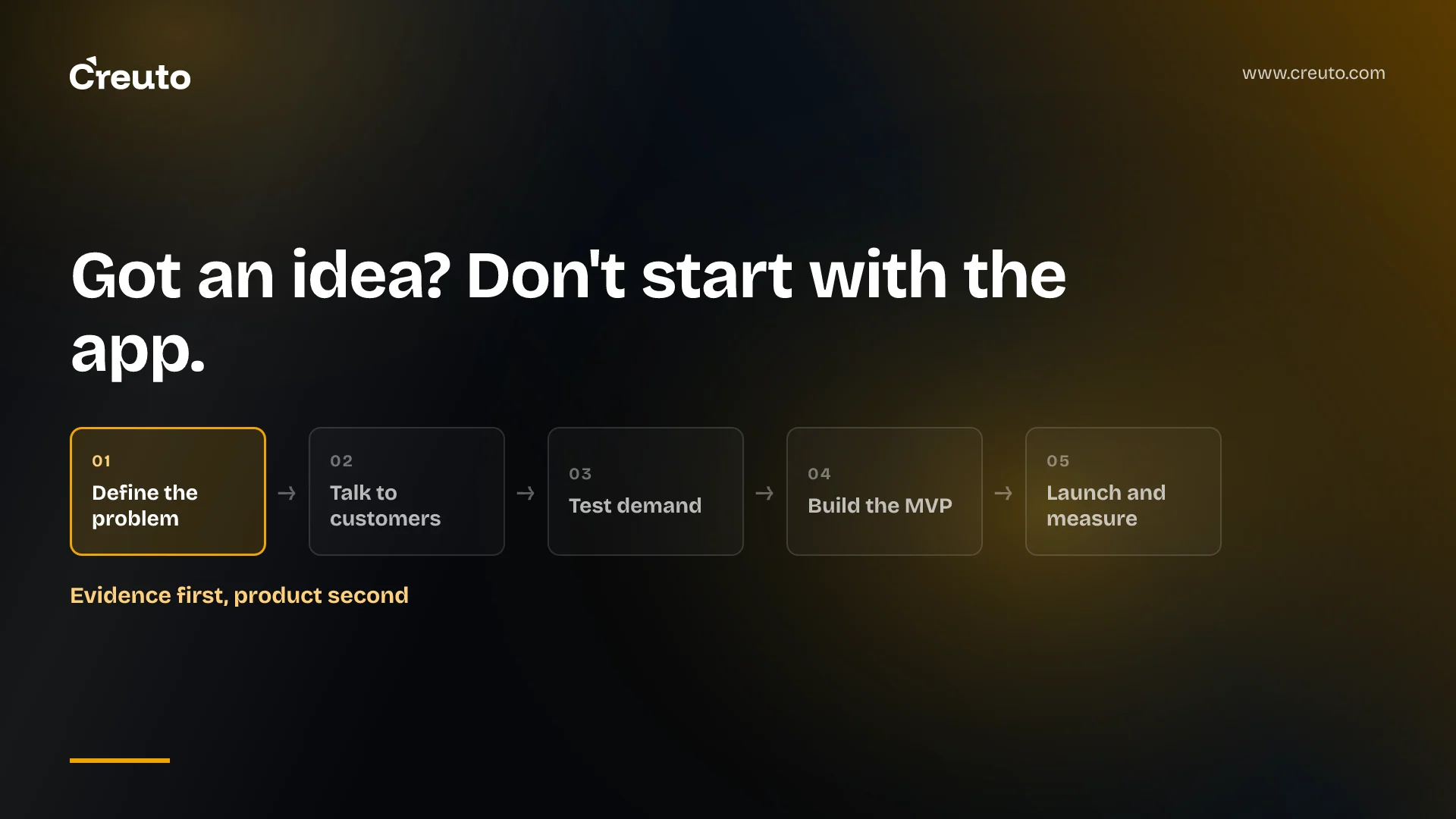
You have an idea you cannot stop thinking about. Now what? Most new ventures do not fail for lack of ideas; they fail because the founder builds before checking whether anyone will pay, or never turns the idea into a plan. This guide is a practical sequence for anyone asking "I have a business idea — where do I start?", with a worked example running through it.
Our example: a mobile app that helps busy families track household spending and savings goals, inspired by the founder's own frustration with spreadsheets.
1. Define the problem, not the product
Write one sentence: who has the problem, what it costs them, and why current options fail. "Families who want to save struggle to track shared spending because bank apps show transactions, not household goals" is a problem. "A budgeting app" is a product. Start with the problem; the product may change.
2. Talk to potential customers
Interview at least ten to twenty people who have the problem. Ask how they handle it today, what they have tried, and what they would pay to fix it. Listen for behaviour ("I stopped using three apps") rather than opinions ("that sounds useful"). For our example, you might learn that couples care most about shared goals, not detailed categories.
3. Study the market and competitors
Look at who else solves this problem, what they charge and what users complain about in reviews. Competition is usually a good sign — it proves demand. Your job is to find the gap they leave.
4. Work out the business model
How will you make money — subscriptions, one-off purchases, commission, advertising? What does it cost to acquire a customer, and how long do they stay? Rough numbers are fine; the point is to find out early whether the model can work.
5. Write a lean business plan
A short plan covering the problem, customer, solution, business model, costs, milestones and funding needs. It keeps you honest and is what investors and partners will ask for.
6. Validate before you build
Test demand cheaply: a landing page with a sign-up, a clickable prototype, a manual service delivered by hand, or pre-orders. Set a target before you start — for example, a number of sign-ups from people who match your customer profile.
7. Build a minimum viable product
When the evidence is encouraging, build the smallest working version that delivers the core value — for our example, shared goals and simple spending tracking, not investment advice. Our guide to building an MVP first covers how to scope it, and mobile app development cost explains what drives the budget.
8. Set up the business properly
Choose a legal structure, register the business, open a business bank account and understand the rules that apply — for a finance app, data protection and payment regulations in particular. Get professional advice for your country.
9. Fund it sensibly
Options include your own savings, revenue from early customers, friends and family, grants, angel investors and venture capital. Validation evidence and an MVP with real usage make every one of those conversations easier.
10. Launch, measure and improve
Launch to a focused group, track activation, retention and revenue, and improve based on what users do. Growth tactics come after you have something people keep using; see how to build and scale a SaaS product.
Common mistakes
- Building for months before speaking to a single customer.
- Asking friends if they like the idea and treating politeness as validation.
- Hiring a development team before the problem and scope are clear.
- Choosing a technology partner on price alone; see what to look for in a development partner.
If your idea involves software, our MVP development team can help you scope the first version, estimate it honestly and build it on foundations that can grow.
Frequently asked questions
The first step is to define the problem clearly: who has it, what it costs them and why current options fail. Then interview potential customers to check the problem is real and important to them before building anything.
Validate a business idea by interviewing potential customers, studying competitors and reviews, then testing demand cheaply with a landing page, clickable prototype, manual service or pre-orders against a target you set in advance.
A short, lean business plan is worth writing before you start. It should cover the problem, customer, solution, business model, costs, milestones and funding needs, and keeps decisions grounded while helping conversations with investors and partners.
Build an MVP after customer conversations and cheap demand tests suggest the problem is real and people will pay. The MVP should deliver only the core value, so you can learn from real usage before investing in a full product.