HubSpot vs custom CRM: the seat maths that decides it
HubSpot vs custom CRM, priced: 50 Professional seats cost $163,500 over three years. Where custom objects, API limits and seat count tip the decision.
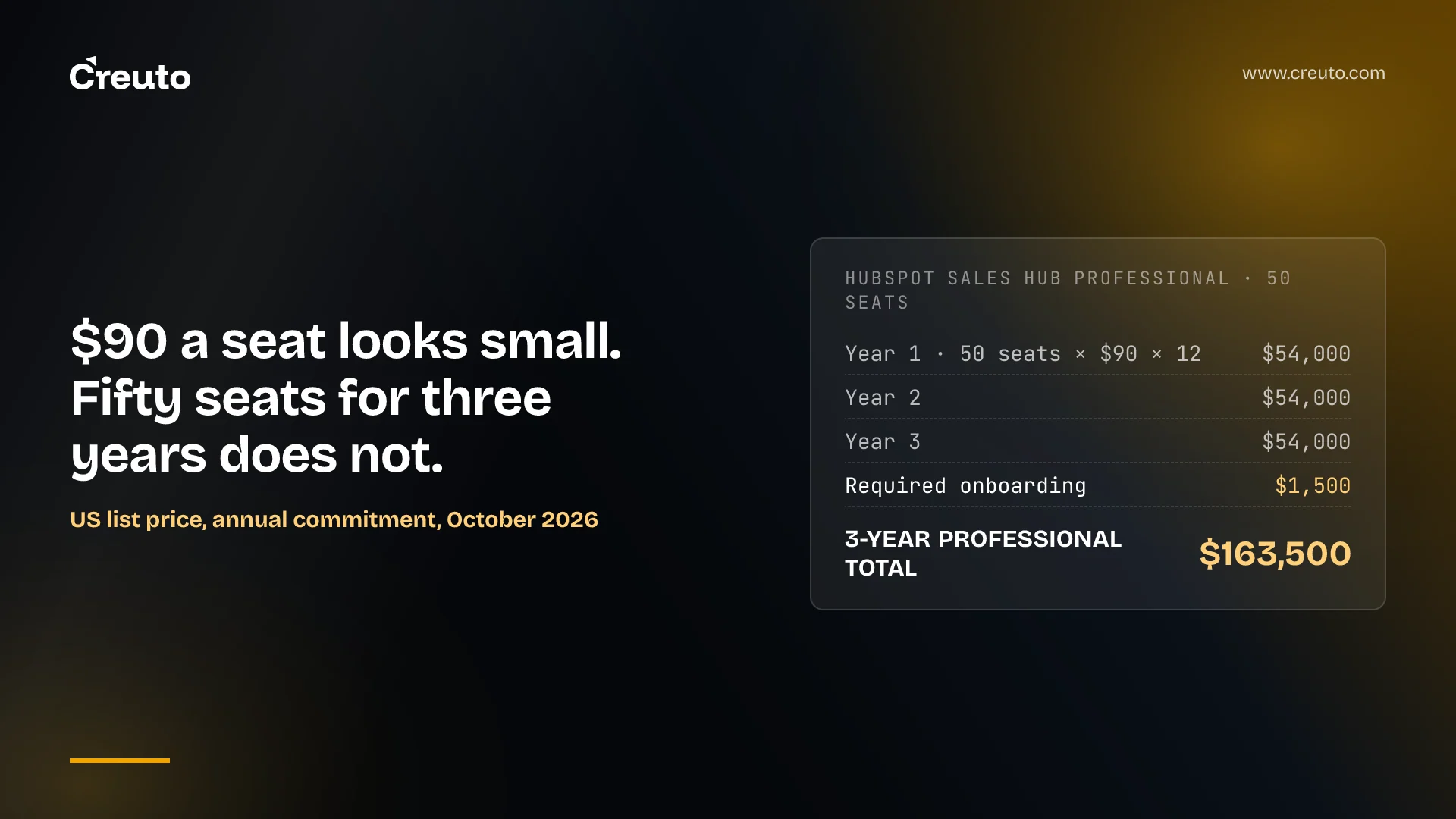
Fifty Sales Hub Professional seats on an annual commitment cost $163,500 over three years before you buy a single add-on, and most of that bill arrives after the onboarding fee is long forgotten. The hubspot vs custom crm decision is rarely about features at the start. It is about seat count, the jump to Enterprise, and how far your sales process has drifted from HubSpot's objects. By the end of this post you will have the three-year number your own build has to beat, and the signals that say not to build at all.
All prices below are HubSpot's US list prices as published on its Sales Hub pricing page, read in October 2026. HubSpot changes these often, and regional editions differ, so check the page before you put any of this in a budget.
How much does HubSpot Sales Hub Professional cost per seat?
HubSpot Sales Hub Professional costs $90 per seat per month with an annual commitment, or $100 per seat per month without one, according to HubSpot's pricing page and its own pricing guide, updated 9 September 2026. Enterprise is $150 per seat per month, and the same guide describes it as billed annually.
| Edition | Per seat, per month | One-time onboarding | Workflows | Pipelines per account |
|---|---|---|---|---|
| Starter | $20 list (promotional $7 annual) | None | 50 | 15 |
| Professional | $90 annual / $100 monthly | $1,500, required | 300 | 100 |
| Enterprise | $150 | $3,500, required | 1,000 | 350 |
The limits in the table come from the same HubSpot pricing page, which states that the Professional price "does not include the required, one-time Professional Onboarding for a fee of $1,500". The Starter list and promotional prices are as recorded by Hublead's pricing calculator, read on hubspot.com on 22 October 2026.
The hubspot professional onboarding fee is small at scale and large at five seats
Hublead's worked example puts it plainly: on a five-seat Professional team, the onboarding fee adds 28% to the first-year cost. That checks out against list price, since five seats at $90 for twelve months is $5,400. At fifty seats the same $1,500 is under 3% of year one. If you are modelling a crossover, the onboarding fee is a rounding error. The recurring seat line is the number that matters.
Where third-party guides disagree with HubSpot
Pricing aggregators do not agree with each other or with HubSpot. Docket's guide, last verified April 2026, lists Professional at $100 per seat on annual billing and roughly $115 monthly. HubSpot's own page now shows $90 and $100. Either the price moved during 2026 or the aggregator is wrong, and a 10% difference per seat compounds across a 100-seat, three-year model. Use the vendor's page as the source of record, and treat any blog figure, including ours, as a date-stamped snapshot.
The seat maths: hubspot pricing at 100 seats and below
Seat-based pricing means the bill grows linearly with headcount. HubSpot moved every hub to seats from 5 March 2024 and, in its pricing announcement, removed seat minimums for Sales Hub. That made the first seats cheaper and every later seat a straight multiplication. Here is that multiplication at list price, annual commitment, with the one-time onboarding fee included once.
| Sales seats | Professional, per year | Professional, 3 years | Enterprise, per year | Enterprise, 3 years |
|---|---|---|---|---|
| 10 | $10,800 | $33,900 | $18,000 | $57,500 |
| 25 | $27,000 | $82,500 | $45,000 | $138,500 |
| 50 | $54,000 | $163,500 | $90,000 | $273,500 |
| 100 | $108,000 | $325,500 | $180,000 | $543,500 |
| 200 | $216,000 | $649,500 | $360,000 | $1,083,500 |
These are our calculations from HubSpot's published per-seat prices: $90 or $150 a seat, times twelve, times seats, plus $1,500 or $3,500 once. They exclude core seats for non-sales users, extra HubSpot credits, extra calling minutes, Marketing Hub contacts and any negotiated discount. Your real invoice will differ in both directions. The shape will not: the line has no plateau.
Is hubspot worth it for a 50 person sales team?
For a 50-person sales team whose process fits deals, contacts, companies and tickets, HubSpot Professional is usually worth it. $54,000 a year buys a maintained product with sequences, forecasting and 300 workflows that you do not have to build, host or staff. The case weakens when the same team needs data HubSpot Professional cannot model, which is the trigger most build-vs-buy discussions miss.
The real trigger is custom objects, not headcount
Custom objects require an Enterprise subscription. HubSpot's knowledge base article on creating custom objects lists only Enterprise editions of its hubs as eligible. If your sales process revolves around something that is not a deal or a company, such as a vehicle, a site, a policy, a pond or a franchise location, Professional has nowhere native to put it.
Price that need honestly. Moving 50 sales seats from Professional to Enterprise adds $60 a seat a month, which is $36,000 a year at list price. Over three years the 50-seat bill goes from $163,500 to $273,500. Read the knowledge base article before you accept that number, though: it lists Enterprise editions of several hubs as qualifying, not only Sales Hub, so a cheaper qualifying route may exist for your account. Ask HubSpot to quote it.
Other Professional limits that push teams sideways
Custom objects are the loudest limit, not the only one. Professional allows 300 workflows and 100 pipelines per account, per the pricing page. API traffic for privately distributed apps on Professional is capped at 190 requests per 10 seconds per app and 625,000 requests per day per account, according to HubSpot's API usage guidelines. Teams that sync HubSpot with an ERP, a telephony stack and a data warehouse feel those ceilings before sales leadership does. The platform itself also moves under you: HubSpot is retiring older API versions, which we covered in our post on HubSpot API deprecation.
Is a custom CRM cheaper than HubSpot?
A custom CRM is cheaper than HubSpot only when its build cost plus three to five years of hosting, support and enhancement comes in under the subscription line in the table above. Below roughly 25 seats on Professional, that rarely happens. The three-year bill is $82,500, and a production CRM with migration, permissions, reporting and integrations takes real engineering time; on our CRM development page we state that multi-module CRM platforms generally take three to five months, depending on complexity.
The strongest argument against building deserves its full weight. HubSpot spreads its engineering, security and compliance work across its whole customer base. Your custom build carries all of that alone, forever: someone has to patch dependencies, answer the on-call page, and build the next feature sales asks for. A custom CRM that is not funded for maintenance after launch quietly decays into the spreadsheet it replaced.
The argument for building is just as concrete. The build cost is mostly incurred once, while seat costs recur every year and rise with every hire. A custom system models your actual entities instead of forcing them into deal properties. And the data model, the API limits and the roadmap are yours. The total cost of ownership comparison is not "HubSpot price vs build price"; it is "three-year seat line vs build plus three years of run cost".
Build vs buy CRM: a decision table
| Your situation | Lean towards | Why |
|---|---|---|
| Under 25 sales seats, standard deal pipeline | HubSpot Professional | Three-year spend of $82,500 or less is hard for any build plus run cost to beat |
| 25-100 seats, process fits deals and companies | HubSpot, renegotiate | Seat line is large, but you would be building what you already rent |
| Core entity HubSpot cannot model without Enterprise | Price both seriously | The Enterprise uplift is $720 a seat a year at list |
| 100+ seats, heavy integration traffic | Custom CRM development | A $325,500+ three-year line, plus API ceilings you will hit |
| Marketing team lives in Marketing Hub | HubSpot | Rebuilding attribution and email tooling is a second project |
When should you build your own CRM?
You should build your own CRM when three things are true at once: the seat line is large enough to fund a build, the process cannot be expressed in HubSpot's standard objects without Enterprise, and you have an owner for the system after launch. Two out of three is a reason to renegotiate, not to rebuild.
When to replace HubSpot with a custom CRM also depends on what surrounds it. If sales hands off to an ERP for orders, invoicing or warranty, a CRM that shares a database with that ERP removes an integration you would otherwise pay for in API limits and sync bugs. That is the same logic we applied when comparing Salesforce Core pricing against a custom CRM: the licence line is visible, the integration cost is not.
This is the wrong choice if your sales process changes every quarter and nobody can describe it on one page. A custom CRM encodes your process; if the process is not settled, you will pay to rebuild it twice.
What we learned building a sales CRM
Our Sales CRM case study started from spreadsheets, not from HubSpot, so it is not a migration story and we will not pretend it is. What it shows is what a purpose-built CRM looks like when the process is specific: a before-sales pipeline with Kanban and list views, an after-sales module for complaints, ticketing and warranty, role-based dashboards, and an AI layer for location-based demand insights, built on React, Node.js, PostgreSQL and AWS. The after-sales and warranty workflow is the kind of entity that would need custom objects in HubSpot.
The part that took the most care was not the pipeline screen. It was data migration and lead ownership rules, because a CRM with unreliable data does not get used. Budget for that work whichever way you go: moving off HubSpot means exporting every object, association and activity history, and checking it against what sales believes is true.
Running the hubspot vs custom crm numbers for your team
Before your next renewal, do three things. Count the sales seats you will have in three years, not today, and multiply by $1,080 a year for Professional or $1,800 for Enterprise at list. List every entity your team tracks outside deals, contacts and companies, and decide whether it needs a custom object. Then pull a month of API usage from your integrations and compare it with the 625,000-a-day Professional ceiling.
If the first number is above $300,000 and the second list is not empty, a custom build is worth a serious estimate. Our CRM development team will scope it against your three-year HubSpot line, including migration and run cost, so you are comparing two real numbers at renewal rather than a quote and a guess.
Frequently asked questions
HubSpot Sales Hub Professional costs $90 per seat per month with an annual commitment, or $100 per seat per month without one, at US list price in October 2026. HubSpot also charges a required one-time Professional onboarding fee of $1,500, which is not included in the seat price.
A custom CRM is cheaper than HubSpot only when its build cost plus several years of hosting, support and enhancement falls below the HubSpot seat bill over the same period. For teams under about 25 Professional seats, whose three-year list cost is $82,500 or less, that rarely happens.
Creating custom objects in HubSpot requires an Enterprise subscription, according to HubSpot's knowledge base. The article lists Enterprise editions of several hubs as eligible, not only Sales Hub, so a team that needs custom objects should ask HubSpot to quote the cheapest qualifying Enterprise route before upgrading every sales seat.
Building your own CRM makes sense when the HubSpot seat bill is large enough to fund a build, your core entities cannot be modelled in HubSpot without Enterprise, and someone owns the system after launch. If only two of those are true, renegotiating the HubSpot renewal is usually the better move.
HubSpot's API usage guidelines cap privately distributed apps on Professional at 190 requests per 10 seconds per app and 625,000 requests per day per account. Enterprise raises the daily limit to 1,000,000, and an API limit increase add-on adds 1,000,000 daily calls per purchase, up to two.