HRMS build vs buy: the plan gates that decide it
HRMS build vs buy for 200-500 staff: greytHR and Keka gate API, multi-entity payroll and shift rules to top plans. Keka caps its API at 50 requests a minute.
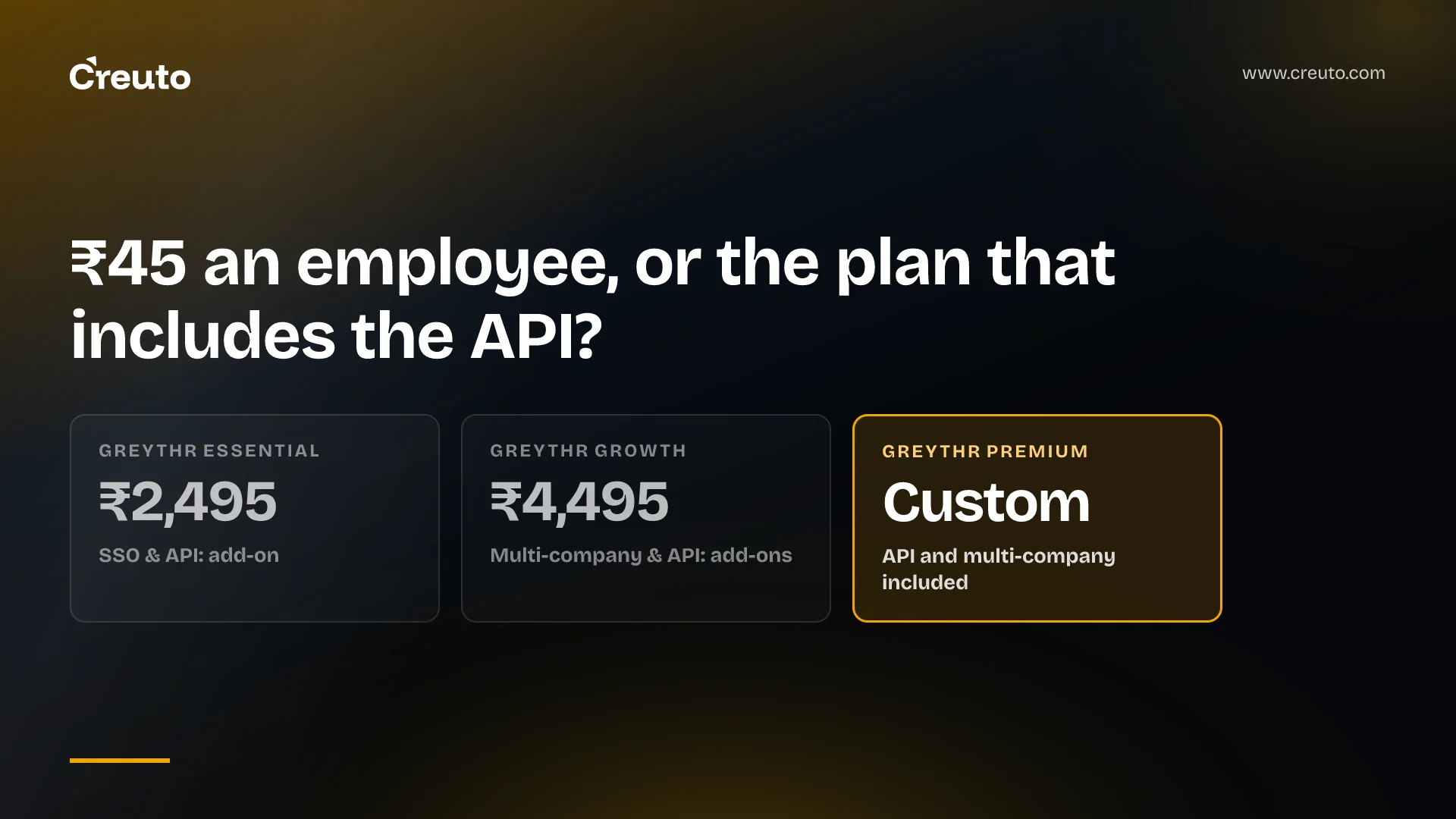
The cheapest greytHR plan that includes an API and multi-company support has no published price. That one fact settles most of the hrms build vs buy question for a 200-500 person company with shift workers and several legal entities. The per-employee rate is published and easy to compare. The plan gates are not, and they decide whether you can buy at all. By the end of this post you will know which gates matter, what each vendor publishes as of 4 November 2026, and when building your own HRMS is the cheaper path.
We are writing for the COO or CTO whose HR SaaS renewal is coming up and whose attendance or ERP integrations keep breaking. The real question is a choice between three paths: move to Keka's top plan, stay on greytHR and pay for add-ons, or build an HRMS around your own attendance and payroll rules.
What the vendors publish, and what they keep behind "talk to us"
Of the five HRMS vendors we compared, only two publish a price you can put in a spreadsheet. Everyone else wants a sales call first, and that is worth saying plainly before any seat maths, because it means you cannot finish the comparison from your desk.
| Vendor | Published price (checked 4 November 2026) | Where API and multi-entity sit |
|---|---|---|
| greytHR | Essential ₹2,495/month for the first 50 employees, then ₹45 each; Growth ₹4,495/month for 50, then ₹85 each; Premium is "Custom" | Add-ons on Essential and Growth; included only on Premium |
| Keka | No prices; plans end in "Talk to us", plus a "nominal setup fee" | Listed only under the Growth plan's "Add Ons" |
| BambooHR | Core $10, Pro $17, Elite $25 per employee per month on the plan cards; $10.25 and $17.50 in the FAQ on the same page | Payroll is a US-only add-on |
| Darwinbox | No prices; a request-a-quote form | Not published |
| Zoho People | Not verified for this post | API calls capped per licence and per day by edition |
The greytHR figures come from its pricing page. Keka's pricing page lists three HRMS and payroll plans (Foundation, Strength and Growth) with no figures at all. Darwinbox's quote page offers "a customized quote" once you pick modules. BambooHR's pricing page contradicts itself: the cards say Core is $10 and Pro is $17, while its own FAQ says $10.25 and $17.50. We cannot tell you which figure is current, and neither can the page.
The seat maths: hrms cost per employee at 300 and 500 people
For a 300-person company, greytHR Growth comes to ₹25,745 a month before tax and add-ons: ₹4,495 for the first 50 employees plus 250 × ₹85, using the rates on the greytHR pricing page. Essential comes to ₹13,745. At 500 employees the figures are ₹42,745 and ₹22,745. Our arithmetic assumes the per-employee rate is monthly, as the page presents it, and the page we read did not mention GST or annual billing terms.
| Headcount | greytHR Essential / month | greytHR Growth / month |
|---|---|---|
| 300 | ₹13,745 | ₹25,745 |
| 500 | ₹22,745 | ₹42,745 |
These numbers are small next to the cost of building anything. A company that only needs leave, attendance and a payslip should stop reading here and buy. Per-employee pricing does not stop making sense on headcount alone. It stops making sense when the plan you can afford does not do what your operation needs, and the plan that does has no price on it.
That is the same pattern we found when we worked through the seat maths for HubSpot against a custom CRM: the per-seat figure gets the attention, and the edition boundary decides the bill.
Three plan gates that decide it before the seat maths does
A shift-based, multi-entity company hits three gates: API access, payroll across several legal entities, and rule-based shift rostering. Each one moves you up a tier or onto an add-on, and none of the published per-employee rates covers all three.
Gate 1: API access is an add-on or a top-tier feature
On greytHR, API access is an add-on on both Essential ("SSO & API") and Growth ("SSO, Multi-company & API"), and included only on the quoted Premium plan, according to the greytHR pricing page. The same page prices other add-ons, such as Time Sheets at ₹35 per user per month and GPS Live Tracking at ₹140, but gives no price for the API add-on. On Keka, "API & Webhooks" appears nowhere under Foundation or Strength; it is listed only under Growth's "Add Ons" on Keka's pricing page, and the page does not say whether Growth includes it or sells it separately.
Gate 2: hrms with multi entity payroll
Keka can handle multiple legal entities, but only at the top of its range. "Multiple Legal Entities (Pay Groups)", which Keka describes as running payroll for multiple companies and defining multiple pay groups, sits in the same Growth "Add Ons" block on the Keka pricing page. greytHR bundles multi-company with API and SSO as a Growth add-on, and includes it on Premium. If you run three companies under one group, you are on the top plan or paying for an unpriced extra on both products.
Gate 3: hrms for shift based workforce
Shift rules are where manufacturers and logistics firms feel the gap first. Keka's Foundation plan has basic shift management with shift boards; automatic assignment "based on preset rules" with rotation is "Advanced shift management", again under Growth's add-ons on the Keka pricing page. greytHR puts "Advanced attendance & shift management" in Growth and does not list it for Essential, per its pricing page. So the ₹45 Essential rate is not the rate a shift-based company actually pays.
Does Keka have an API, and will your integrations survive it?
Keka does have an API, and it is capped at 50 requests per minute. Go past that and you get HTTP 429 with the reason "rateLimitExceeded"; the documented fix is to wait a minute and retry, according to Keka's rate-limit reference. The default page size is 100 records, per Keka's pagination reference.
The strongest case for the cap being fine deserves stating. Fifty requests a minute is 72,000 a day, and bulk reads at 100 records a page move a lot of data. A nightly export to your ERP will rarely hit the limit.
The trouble is the integrations that are not bulk reads. An integration that makes one call per employee needs ten minutes of quota to touch 500 people once. A biometric or gate system that pushes punches in near real time during a shift change, and an ERP sync running at the same time, are competing for the same 50 requests. If your integration does not queue and back off on 429, it drops data, and the cause looks like a flaky vendor rather than a ceiling you can read in the docs. We cover the wider cost of this kind of work in what API integration price ranges leave out.
hrms api rate limits integration: Zoho People's daily cap
Zoho People caps API calls per user licence per day, with an edition ceiling on top, per its API limits page. Essential HR allows 250 calls per licence up to 5,000 a day; Professional 250 up to 10,000; Premium 250 up to 15,000; Enterprise 500 up to 25,000. If each employee counts as a licence, the per-licence allowance stops growing at 20 users on Essential HR and 40 on Professional. For a 300-person company the edition ceiling is the only number that matters, and adding people does not buy you more calls. The page does not say what happens when you exceed the limit.
When to build a custom hrms instead
Build when the gates, not the seats, are what you would be paying for. In practice that means at least two of these are true:
- You run payroll for more than one legal entity and need consolidated reporting across them.
- Your shift and overtime rules are specific enough that "advanced shift management" still needs workarounds.
- Attendance comes from devices or systems that need near-real-time sync, and a per-minute or per-day API cap would throttle it.
- The only plan that clears these gates is quote-only, so you cannot compare it with a build until a vendor's sales team decides your price.
This is the wrong choice if your rules are standard and your integrations are a nightly file. Then greytHR Growth at roughly ₹25,745 a month for 300 people buys a product that someone else keeps current, and a build cannot compete on that. We make the general version of this argument in which SaaS layers to own when you build vs buy enterprise software: own the layer where your rules differ, rent the rest.
What a custom HRMS build looked like for us
We built Nomina, an enterprise HR and payroll platform, in 20 weeks from kick-off to full rollout, according to our enterprise payroll management case study. Before it, the client ran HR and payroll on spreadsheets, email chains and manual approvals, and HR spent 4 to 5 days closing each monthly cycle. After rollout it takes under one day, which the case study reports as 5× faster payroll processing.
The scope was 13 core modules, including attendance and time tracking, payroll processing, payslips, expenses, loans and advances, and an HR analytics dashboard. It had five roles: employee, manager, HR admin, finance admin and super admin. We delivered a web platform for HR, iOS and Android apps for employees, and a super admin panel for finance and leadership, built on React, Next.js, Node.js, PostgreSQL, React Native and AWS.
Two limits apply. That project replaced spreadsheets, not a SaaS HRMS, so it is evidence of what a build involves rather than a measured comparison against Keka or greytHR. And we have not published a cost for it, so we will not quote one here. How much a custom HRMS costs depends on the modules, the number of entities and the integrations, which is why we scope it rather than quote a range.
How to decide hrms build vs buy before your renewal
Run the decision in this order. It puts the gates first because they are the part a price page will not show you.
- List the three gates for your company: entities, shift rules and integrations, with the call volume each integration needs per minute and per day.
- Ask Keka and greytHR for written quotes on the plan that clears all three, including the API and multi-entity add-ons and Keka's setup fee.
- Check each integration against the published caps: 50 requests per minute on Keka, the edition ceiling on Zoho People.
- Compare the quoted annual figure, not the published per-employee rate, with the cost of building and running your own system.
- Before you switch either way, plan a parallel payroll run and confirm you can export your full employee and payroll history from the current vendor.
If step 4 shows you paying top-tier prices for gates your own rules would clear, that is when building starts to pay. Our custom software development team can scope an HRMS around your entities, shift rules and attendance integrations, using the same stack we used for Nomina, so you have a build figure to put next to the vendor quotes before you sign the renewal.
Frequently asked questions
A 200-500 person company should buy an HRMS if its leave, attendance and payroll rules are standard and its integrations are nightly files. Building makes sense when multi-entity payroll, rule-based shift rostering and real-time attendance sync all push you onto a vendor's quote-only top plan or unpriced add-ons.
Keka can run payroll for multiple legal entities through its Multiple Legal Entities (Pay Groups) feature. On Keka's pricing page that feature is listed only under the Growth plan's Add Ons section, not under Foundation or Strength, and Keka publishes no price for it or for any plan.
Keka has an API, listed as API and Webhooks under the Growth plan's add-ons. Keka's developer documentation caps it at 50 requests per minute and returns HTTP 429 with the reason rateLimitExceeded when you exceed that, so integrations need to queue requests and retry after the minute resets.
greytHR Growth for 300 employees comes to ₹25,745 a month at its published rates of ₹4,495 for the first 50 employees and ₹85 for each one after. Essential comes to ₹13,745. Both figures exclude add-ons, and API and multi-company support are add-ons on both plans.
A custom HRMS has no fixed price, because cost depends on the number of modules, legal entities and integrations. Creuto's Nomina HR and payroll platform covered 13 core modules and five user roles and took 20 weeks from kick-off to full rollout, but its cost is not published.
