How to Modernize Legacy Systems Without Breaking Your Business
How to modernize legacy systems without breaking your business: assess impact, avoid big-bang rewrites, pin down behaviour, decouple, and migrate data safely.
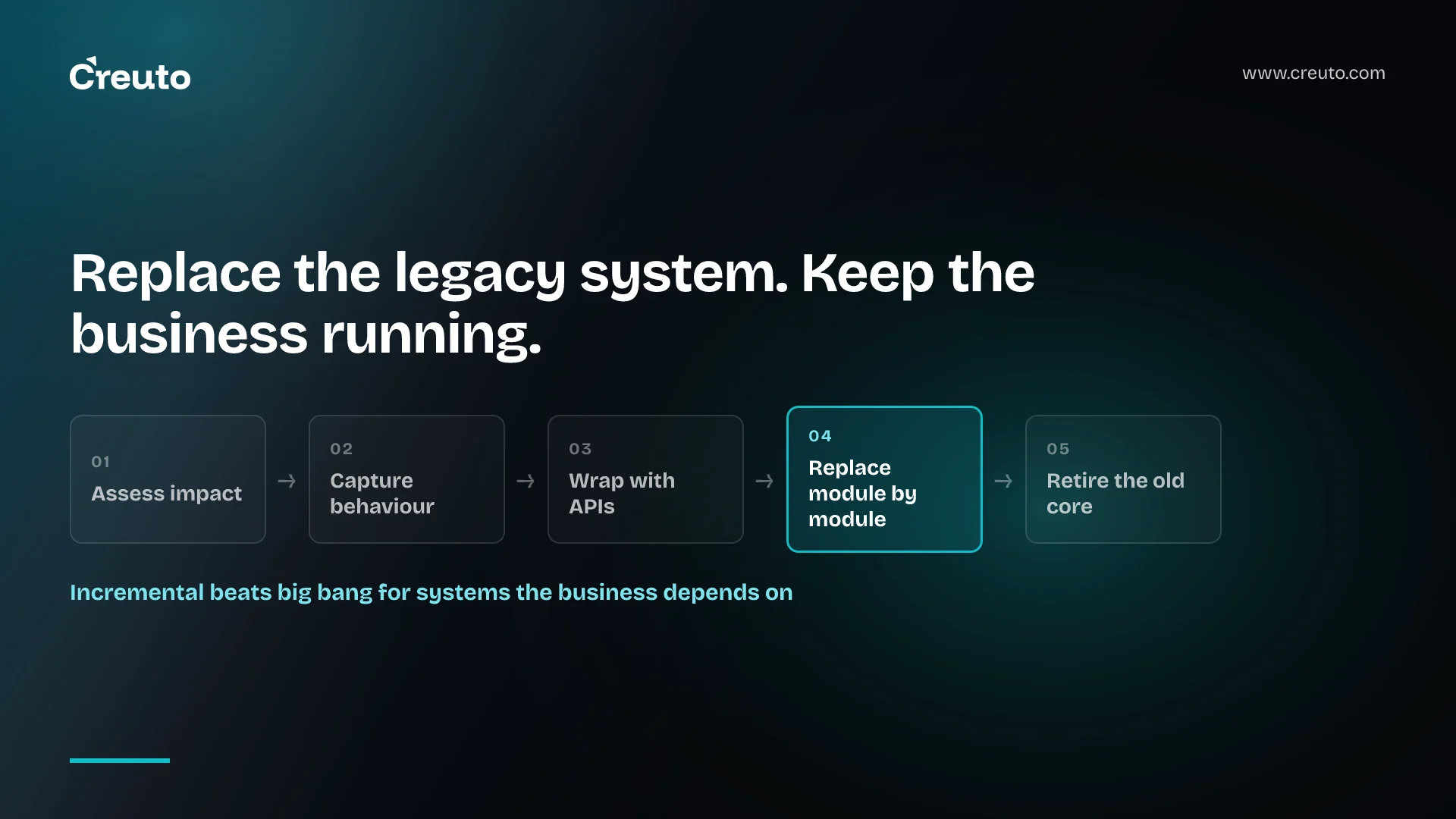
Legacy systems are both an asset and a liability. They run core operations and hold years of business logic and data, but they become rigid, expensive to maintain and hard to connect to modern tools. The question is rarely whether to modernise — it is how to modernise legacy systems without disrupting operations, revenue or customers. The answer, almost always, is incrementally.
The real risks of legacy systems
- Limited scalability as data and users grow.
- Integration barriers with CRMs, e-commerce, mobile apps and partner systems.
- Rising maintenance cost, often tied to a shrinking pool of people who understand the system.
- Security exposure from unsupported platforms and dependencies — a live issue for anyone still on end-of-support software.
- Slower innovation, because every change is risky.
But replacing everything at once carries its own risks: downtime, data loss, confused users and a project that runs years over plan.
Step 1: Assess business impact first
Map which systems are mission-critical, where the bottlenecks are, what maintenance really costs and which processes depend on outdated components. Prioritise by business risk and return, not by which code engineers dislike most.
Step 2: Avoid the big-bang replacement
Choose the lightest approach that solves each problem:
- Rehost — move to modern infrastructure with minimal code change.
- Refactor — improve the parts that change most or cause most incidents.
- Wrap — put APIs in front of the legacy system so new applications can use it.
- Replace gradually — rebuild module by module, routing traffic to new components as they are ready (the "strangler fig" pattern).
GitHub's recent agent-assisted rewrite of its Copilot runtime shows the incremental approach at large scale — shipping continuously while replacing the system underneath — as we describe in AI code migration: incremental vs big bang.
Step 3: Pin down behaviour before you change it
Legacy systems often do things nobody documented. Before refactoring, capture current behaviour with characterization tests, so any change in behaviour is detected rather than discovered by customers.
Step 4: Decouple before you replace
Introduce APIs or middleware between the legacy core and everything around it. This lets new applications integrate now and makes each later replacement a contained change.
Step 5: Plan data migration carefully
- Clean and validate legacy data.
- Map old structures to new ones explicitly.
- Migrate in stages and reconcile results.
- Run old and new side by side before switching over.
Rushed data migration is one of the most common causes of modernisation failure. Database moves need the same care — for example, migrating Oracle PL/SQL to MariaDB.
Step 6: Strengthen security along the way
Update access control, encryption and monitoring as you go. Transitional periods, with two systems running, need particular attention.
Step 7: Prepare people and processes
Communicate early, train users, update documentation and test with real staff. Many modernisation problems are change-management problems, not technical ones.
The payoff
Done well, modernisation delivers better scalability, easier integration, lower maintenance cost, stronger security and — most importantly — the ability to change quickly again. Legacy systems are not bad; they are years of business knowledge. The goal is to evolve them, not erase them.
Our legacy application modernisation team starts with an assessment and a behaviour baseline, then modernises in phases so the business keeps running throughout. We applied the same approach on a custom ERP for large-scale industries.
Frequently asked questions
Modernise a legacy system incrementally: assess business impact, capture current behaviour with tests, put APIs in front of the legacy core, replace modules one at a time, migrate data in stages with reconciliation, and run old and new systems side by side before switching.
The strangler fig pattern replaces a legacy system gradually by building new components around it and routing functionality to them one piece at a time, until the old system can be retired. It avoids the risk of a single big-bang cutover.
Refactoring or incremental replacement is usually safer than a full rewrite, because the business keeps running and each change is small and testable. A full rewrite is only viable when a strong test suite can prove the new system behaves like the old one.
Data migration is one of the biggest risks in legacy modernisation. Clean the data first, map structures explicitly, migrate in stages, reconcile results and run systems in parallel before cutover to avoid data loss and operational disruption.